
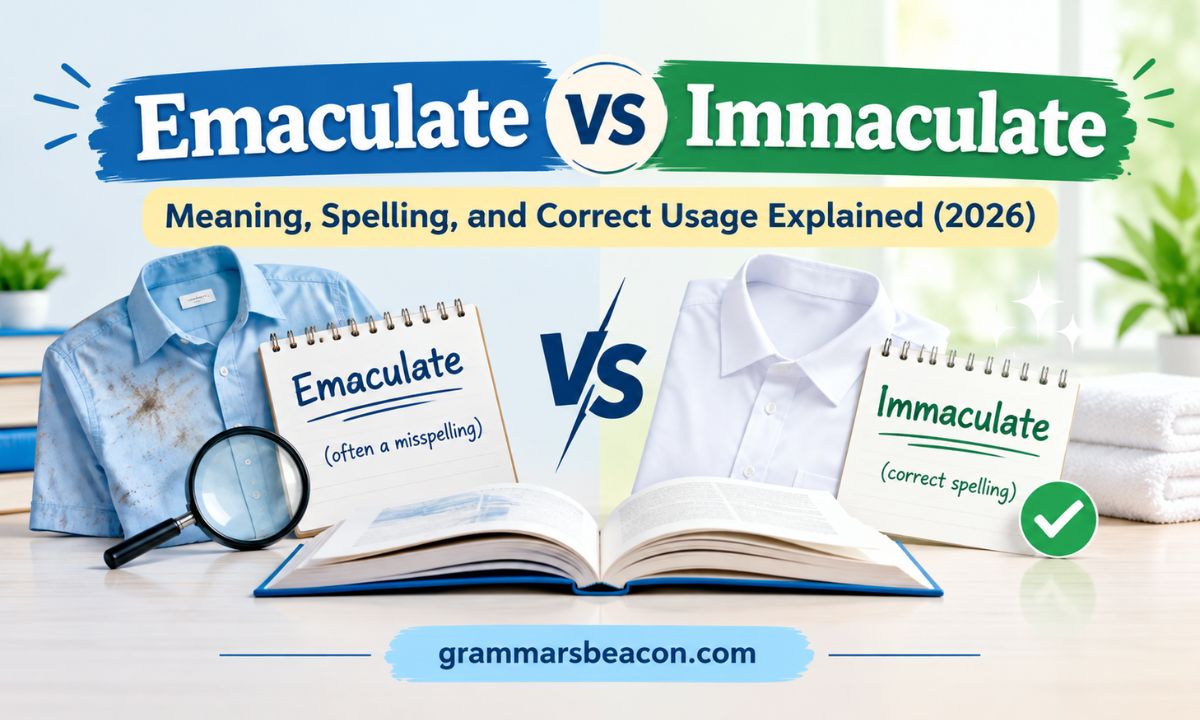
If you have ever typed “emaculate” and wondered whether your spelling was off, you are in good company. This is one of the most common spelling errors in English, and it shows up in school essays, work emails, and product descriptions alike. The good news is that the correct word is easy to learn once you know where it comes from. This guide explains what each spelling means, why the mistake happens, and how to get it right every time.
Emaculate
“Emaculate” is not a real English word. It does not appear in standard dictionaries, and no recognized meaning is attached to it. It is a misspelling of “immaculate,” which has two m’s and begins with “im,” not “e.”
The Short Answer?
Use immaculate. It means spotlessly clean, free from any flaw, or in excellent condition. “Emaculate” is simply an error.
Immaculate Meaning: What Does It Actually Mean?
Immaculate is an adjective. It describes something that has no stains, marks, or defects. It can also describe work that is done with great care and precision, or a person whose appearance is perfectly neat.
Simple Breakdown
- Clean: A kitchen with no crumbs, grease, or dust is immaculate.
- Flawless: A performance or piece of work with no mistakes can be called immaculate.
- Neat: A person dressed with careful attention to detail looks immaculate.
What Does Emaculate Mean?
Nothing, in standard English. Because “emaculate” has no accepted definition, a reader who sees it will assume you meant “immaculate” and may judge the writing as careless. In formal writing, that impression can hurt your credibility, even when the rest of your argument is strong.
Immaculate Definition in Grammar and Usage
Immaculate Definition (Grammar)
Immaculate is an adjective, so it usually comes before a noun (“an immaculate room”) or after a linking verb such as “is,” “looks,” or “remained” (“the room is immaculate”). It does not change form to show number or tense.
Example:
- The hotel lobby was immaculate, with polished floors and fresh flowers on every table.
Immaculate Adjective Meaning in Context
The meaning shifts slightly depending on the subject:
- A clean surface is immaculate when it has no marks.
- A performance is immaculate when it has no errors.
- A person’s appearance is immaculate when every detail is in order.
Is “Emaculate” a Real Word?
No. Spell-checkers flag it, and dictionaries do not list it as a variant.
Is emaculate a word?
It is not. Treat it as a misspelling, and replace it with “immaculate” in any writing you publish or submit.
Emaculate Meaning
There is no accepted meaning for “emaculate.” If you encounter it in a text, the author almost certainly meant “immaculate.”
Why This Matters
Search engines also treat the two spellings differently. People searching for the correct word want accurate information, and a page that uses the right spelling consistently signals quality to both readers and search tools. Correct spelling also protects your reputation in professional writing.
Emaculate vs Immaculate Difference (Side-by-Side)
| Feature | Emaculate | Immaculate |
| Dictionary status | Not recognized | Standard English adjective |
| Meaning | None | Spotless, flawless, or perfectly neat |
| Correct use | Never | Yes, in all formal and informal writing |
| Letters | E-M-A-C-U-L-A-T-E (9) | I-M-M-A-C-U-L-A-T-E (10) |
| Common mistake? | Yes | Frequently misspelled |
Why Do People Misspell “Immaculate”?
Most spelling errors follow predictable patterns, and this word has several traps.
Common Reasons
- The double m: Many people write one m instead of two, then wonder why the word looks wrong.
- The starting sound: The “im” at the start is often pronounced softly, so people guess at the letters.
- Silent letters and vowel guesses: The “a” and “u” in the middle are easy to swap.
- Confusion with similar words: Writers sometimes mix it up with “emaciate,” which means to become very thin.
Related Examples
- Emaciated (extremely thin) is a real word that looks similar but means something entirely different.
- Immanent (existing within something) and imminent (about to happen) are often confused with each other.
The Origin of “Immaculate” (This Makes It Stick)
Understanding a word’s history makes it easier to remember. Once you see the building blocks, the spelling stops being arbitrary.
Immaculate Word Origin
The word comes from the Latin immaculatus, which combines in- (meaning “not”) with macula (meaning “spot” or “stain”). Put together, the original sense is “unspotted” or “without stain.” English adopted the word in the Middle Ages, and its meaning has stayed close to that root ever since.
Why This Helps
If you remember that the core idea is “not spotted,” you will naturally think of the double m and the “im” prefix. The “m” in “macula” is the key link. It also explains why the word works so well for clean surfaces and flawless work.
Immaculate Conception
Immaculate Conception is a religious term in Catholic doctrine. It refers to the belief that the Virgin Mary was conceived without original sin. Pope Pius IX formally declared this teaching in 1854. This meaning is different from the Virgin Birth, which concerns the conception of Jesus. Writers should be careful with this term, because it is a specific theological phrase and not a general synonym for “pure” or “perfect.”
How to Spell Immaculate Correctly (Without Second Guessing)
Memory Hacks That Work
- Think “im-” as “not”: Just like “impossible” or “impure,” the prefix means “not,” and the root “macula” means spot.
- Count the m’s: Two m’s at the start, then one c and one l. Say “im-mac-u-late” slowly.
- Picture a spotless surface: A clean mirror has no macula. If you picture the mirror while typing, the spelling tends to follow.
- Use the root word: Remember that “maculate” means stained, so “immaculate” is its opposite.
Quick Checklist
- Does the word start with “im” and not “e”?
- Are there two m’s together?
- Is there a “c” followed by “u” and “l”?
- Does it end in “-ate”?
If you can answer yes to all four, your spelling is correct.
How to Use Immaculate in a Sentence (Real Examples)
Seeing the word in action makes it easier to use confidently.
Immaculate in a Sentence (Everyday Use)
- She keeps her apartment immaculate, even with two dogs and a toddler.
- He arrived at the interview in an immaculate gray suit.
Immaculate Example Sentences by Context
Cleanliness
- The surgical suite was immaculate before the team began the procedure.
Performance
- The pianist gave an immaculate performance with not a single missed note.
Appearance
- Her immaculate handwriting made the recipe card easy to follow.
When to Use Immaculate in English
Best Situations
- Describing spotless spaces, such as kitchens, hospitals, or hotel rooms
- Praising work that is precise and error-free
- Describing a neat, polished appearance
- Writing about sports or games when a player or team performs without mistakes
Avoid Overuse
Immaculate is a strong word. If you use it for every clean or good thing, it loses impact. Save it for moments when you want to emphasize a high standard. In casual speech, “clean” or “spotless” may sound more natural.
Immaculate vs Perfect vs Impeccable
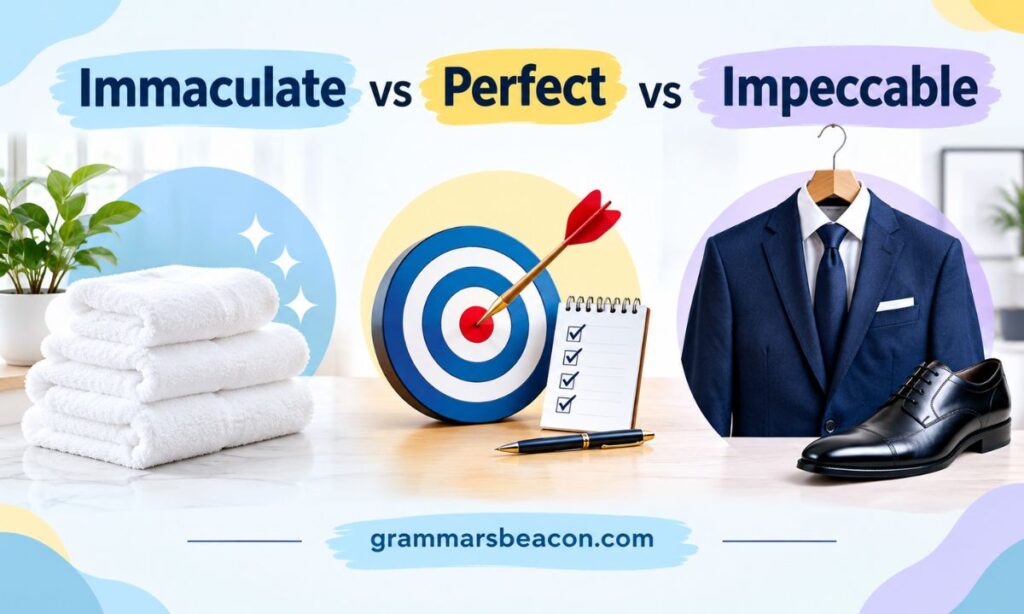
These three words are often swapped, but they carry different shades of meaning.
Immaculate vs Perfect
Perfect means lacking any flaw at all, and it can apply to almost anything, including ideas and plans. Immaculate is narrower. It focuses on cleanliness, neatness, or freedom from visible marks. A plan can be perfect, but a room is more naturally described as immaculate.
Immaculate vs Impeccable
Impeccable means without fault in conduct, behavior, or standards. You might say someone has impeccable manners or impeccable taste. Immaculate leans toward physical condition and visual neatness. Both can describe a flawless outfit, but impeccable is the better choice when the subject is behavior or judgment.
Comparison Table
| Word | Core idea | Best used for | Example |
| Immaculate | Spotless or neat | Surfaces, appearance, precise work | An immaculate kitchen |
| Perfect | No flaws at all | Ideas, results, outcomes | A perfect score |
| Impeccable | Faultless conduct or standards | Manners, taste, service | Impeccable manners |
Words Similar to Immaculate (Synonyms and Antonyms)
Immaculate Synonym List
- Spotless
- Pristine
- Flawless
- Unblemished
- Spick-and-span
- Faultless
- Neat
Immaculate Antonyms
- Dirty
- Soiled
- Stained
- Grimy
- Messy
- Tarnished
Choosing between these depends on your goal. “Pristine” suggests untouched purity, while “spick-and-span” sounds cheerful and informal.
Common Spelling Mistakes Like “Emaculate”
Immaculate is not the only word that trips people up. Similar errors appear often:
- Accomodate should be accommodate (two c’s, two m’s)
- Occurence should be occurrence (two c’s and two r’s)
- Definately should be definitely
- Seperate should be separate
Other Grammar Spelling Errors
Many errors come from pronunciation. When a word sounds shorter than it looks, people tend to drop a letter. Slowing down and sounding out each syllable catches most of these mistakes.
Read More: Taught vs Tought: Correct Spelling and Usage (2026)
Why It Matters
Spelling errors distract readers and make them question your other claims. In professional settings, even small mistakes can reduce trust. Proofreading with a spell-checker and reading your work aloud are simple habits that prevent most of these problems.
One Word, Big Impact
Word choice can change how a sentence feels. Compare these two versions of the same description.
Candidate A
The lobby was clean and nice.
Candidate B
The lobby was immaculate, with polished marble floors and not a single fingerprint on the glass.
Candidate B paints a clearer picture and sounds more confident. The word “immaculate” adds precision, and the supporting details make the claim believable. When you want your writing to stand out, one carefully chosen word can do a lot of work.
How to Remember the Spelling of Immaculate (For Good)
Proven Techniques
- Write it out by hand: Writing a word several times builds muscle memory.
- Create a sentence: Make up a memorable line, such as “Immaculate has two m’s and no e,” and repeat it.
- Use a flashcard: Put “emaculate” on one side and “immaculate” on the other, then test yourself.
- Connect it to the root: Remember “macula” as the spot that the word is free from.
Spelling Confusion Immaculate
Confusion around this word is common because it sits near several similar-looking words, including “emaciate,” “immanent,” and “imminent.” When you are unsure, look up the word in a dictionary or use a trusted spell-checker. Over time, the correct form will become automatic.
Key Takeaways (Quick Breakdown)
- “Emaculate” is a misspelling. The correct word is immaculate.
- Immaculate means spotlessly clean, flawless, or neatly presented.
- The word comes from Latin roots meaning “not spotted.”
- Use immaculate for cleanliness, precision, and neat appearance. Use impeccable for conduct and standards.
- Memory tricks such as counting the m’s and linking the word to “macula” make the spelling stick.
Frequently Asked Questions
Is “emaculate” ever correct?
No. It is not recognized in any standard English dictionary, so it should always be replaced with “immaculate.”
What is the simplest definition of immaculate?
It means completely clean, with no stains, marks, or mistakes.
Is immaculate a formal or informal word?
It works in both settings, though it sounds more polished in formal writing.
What is the difference between immaculate and spotless?
Both describe cleanliness, but immaculate can also describe flawless work or neat appearance, while spotless is mostly limited to physical cleanliness.
Why does the Immaculate Conception matter?
It is a specific Catholic doctrine about Mary’s conception, so the term has a religious meaning separate from everyday usage.
Conclusion
The difference between “emaculate” and “immaculate” comes down to one missing m and one extra e. Immaculate is a precise, useful word that describes spotless spaces, flawless work, and polished appearances. Once you know its Latin root, macula, meaning “spot,” the spelling becomes much easier to hold onto. Keep the checklist and memory tricks handy, and your writing will look sharper and more trustworthy every time you use the word.









1 thought on “Emaculate vs Immaculate: Meaning, Spelling, and Correct Usage Explained (2026)”