
If you have ever wondered whether “lunchtime” or “lunch time” is correct, you are not alone. The two forms look almost identical, and both can be understood in English. However, modern English generally prefers “lunchtime” as the standard compound noun for the period when people usually eat lunch.
“Lunch time” can still appear when the writer wants to emphasize a particular time, duration, or scheduled period connected with lunch. Understanding this small difference can make your writing sound more natural and polished.
A review of current search results shows that leading grammar and vocabulary resources consistently focus on compound nouns, spelling, context, historical development, and practical examples when explaining this distinction.
Understanding Lunchtime vs. Lunch Time
The easiest way to understand the difference is to look at how the words function together.
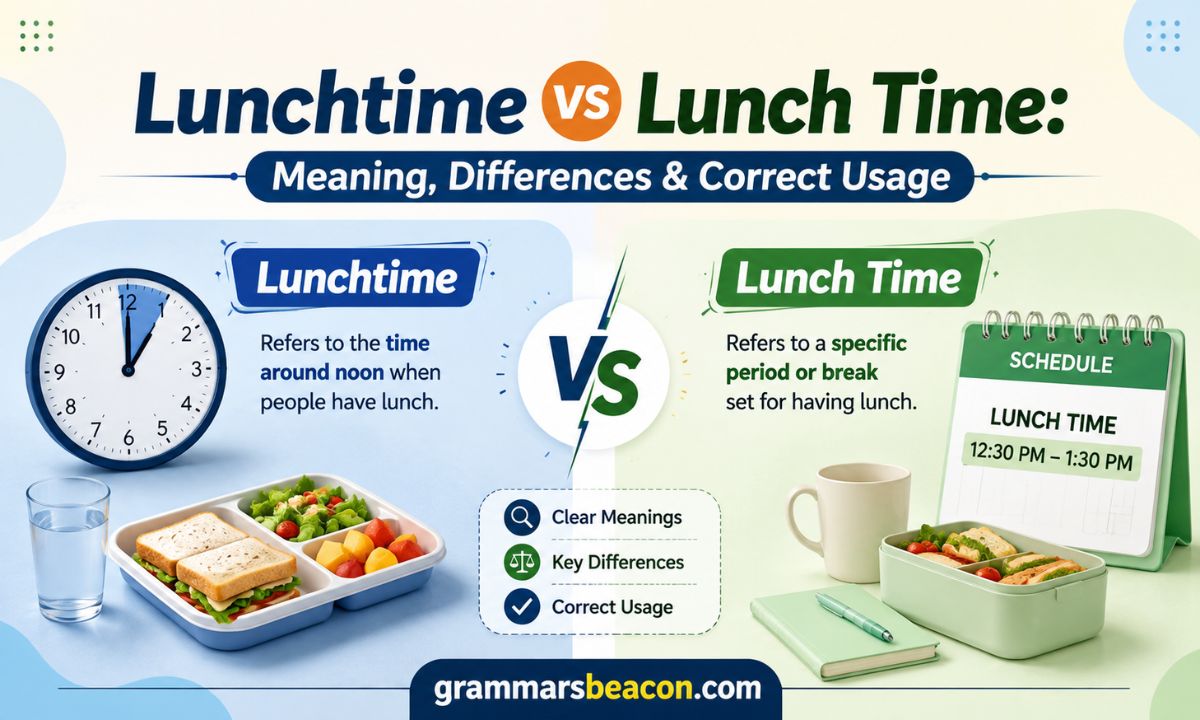
Lunchtime is a compound noun. It refers to the usual period during which people eat lunch. Dictionaries define it as the period set aside for lunch, commonly around the middle of the day.
Lunch time is an open noun phrase made from “lunch” and “time.” It can emphasize the particular time or amount of time associated with eating lunch.
| Form | Structure | Main meaning | Typical use |
| Lunchtime | Compound noun | General lunch period | Everyday and professional writing |
| Lunch time | Noun phrase | Particular time connected with lunch | Scheduling or emphasis |
| Lunch-time | Hyphenated form | Older compound spelling | Rare or historical writing |
When you are unsure, lunchtime is usually the safest and most natural choice.
What Each Term Really Means
The two forms overlap in meaning, but their grammatical structure gives them slightly different uses.
Lunch Time Meaning
“Lunch time” literally combines the words lunch and time. It can mean the time when lunch occurs or a specific period allocated for eating lunch.
For example:
The lunch time for the conference has been changed to 1:00 p.m.
Here, the writer is focusing on the scheduled time.
Definition of “Lunchtime”
Lunchtime means the usual period of the day when people eat lunch. It does not necessarily indicate one exact minute.
For example:
The restaurant becomes busy at lunchtime.
Here, “lunchtime” refers to a familiar part of the day rather than a precise appointment.
Quick Example
- Lunchtime: I usually take a break at lunchtime.
- Lunch time: The school has changed the students’ lunch time.
The first example describes a general period. The second emphasizes a specific scheduled period.
Definition of “Lunch Time”
“Lunch time” is not necessarily grammatically wrong. It simply has a different structure from the established compound lunchtime.
You might encounter the two-word form when someone is talking about:
- A scheduled lunch period
- The exact time lunch begins
- The amount of time available for lunch
- A timetable or organized event
For example:
Employees have only thirty minutes of lunch time.
The focus here is on the amount of time available for lunch.
Grammar Rules Behind Both Forms
English frequently turns commonly used word combinations into compound words. A compound noun can begin as two separate words and eventually become one established word.
Examples include:
- bedroom
- classroom
- weekend
- breakfast
- lunchtime
- dinnertime
The same general process helps explain why lunchtime is now the dominant spelling.
Compound Nouns Becoming One Word
When two words are repeatedly used together to express one familiar idea, English often closes the compound.
The development can be understood like this:
lunch + time → lunch time → lunchtime
This does not mean every two-word combination eventually becomes one word. Dictionaries and established usage determine whether a compound has become standard.
Modern dictionary evidence strongly supports lunchtime as the established form. Dictionary.com, for example, lists “lunchtime” as a noun and dates its first recorded use to the mid-19th century.
Hyphenation Notes
You may occasionally see “lunch-time” in older books or historical writing. This hyphenated spelling was once possible during the development of the compound.
Modern English generally favors:
lunchtime
rather than:
lunch-time
If you are writing a blog post, school assignment, professional email, article, or website page today, there is normally no reason to use the hyphenated form.
Formality Levels
Lunchtime works comfortably in both informal and formal English.
You can use it in:
- Casual conversations
- Business emails
- Academic writing
- Workplace policies
- News writing
- Websites
- School materials
“Lunch time” may sound more deliberate when a writer is focusing on a specific scheduled period.
Practical Usage: When to Choose One Over the Other
A simple rule can help:
Use “lunchtime” for the general meal period.
Use “lunch time” when the wording specifically emphasizes a particular time or duration.
For example:
Let’s meet at lunchtime.
This sounds natural because the speaker means the general period when lunch takes place.
Compare it with:
The lunch time has been moved from 12:00 to 12:30.
The second sentence focuses on a scheduled change.
In many cases, however, alternatives such as “lunch break,” “time for lunch,” or “the scheduled lunch period” may sound even clearer.
Everyday Usage
In ordinary conversation, lunchtime is usually the natural choice.
Common expressions include:
- It’s almost lunchtime.
- I’ll call you at lunchtime.
- We usually eat together at lunchtime.
- The café is crowded at lunchtime.
- What are you doing at lunchtime?
This is why lunchtime is generally the best choice when you are simply describing the middle-of-the-day meal period.
When “Lunch Time” Makes Sense
“Lunch time” can make sense when the word time needs special attention.
For example:
We have only twenty minutes of lunch time.
Or:
The manager recorded each employee’s lunch time.
In these examples, the emphasis is on the duration or specific timing rather than simply naming the general part of the day.
Historical Development of the Term
The word lunch itself has a long history. It developed as a shortened form related to “luncheon,” a term associated with a midday meal.
As lunch became an established part of daily life, English speakers increasingly needed a convenient word for the period in which it was eaten.
That helped create the compound lunchtime.
Dictionary.com records the word as first appearing around 1855 to 1860, formed from “lunch” and “time.”
Early Appearances
Earlier English could represent compounds with spaces or hyphens. Over time, frequently used compounds often became closed forms.
This pattern is not unique to lunchtime. English contains many familiar compounds whose spelling developed gradually through repeated usage.
Language Trend
The development of lunchtime reflects a broader feature of English: high-frequency combinations can become established compound words.
The modern spelling is now much more familiar than “lunch-time,” while “lunch time” remains possible in specific contexts.
Regional and Cultural Usage Differences
The spelling difference should not be confused with differences in the actual time people eat lunch.
Meal schedules vary considerably between countries, workplaces, schools, and families.
United States
In the United States, lunch is commonly associated with the period around late morning or midday. Lunchtime is the standard spelling for the general meal period.
United Kingdom
British English also commonly uses lunchtime. The word is natural in everyday conversation, school settings, workplace communication, and formal writing.
Canada
Canadian English generally follows the same modern compound spelling, with lunchtime being the normal choice when referring to the general lunch period.
Australia
Australian English also commonly uses lunchtime as the established compound noun. The actual timing of lunch can vary according to work schedules, school routines, and individual habits.
Dinnertime or Dinner Time
The same question can arise with dinnertime and dinner time.
Dinnertime is an established compound noun referring to the usual period when dinner is eaten.
For example:
The children should be home by dinnertime.
The same compound pattern helps explain lunchtime.
Other common meal-related compounds include:
- breakfast time
- dinnertime
- teatime
- mealtime
However, not every meal expression follows exactly the same spelling rules, so dictionary usage remains the best guide.
Cross-Cultural Interpretations of Lunchtime
The word lunchtime describes a meal period, but the actual period differs around the world.
Mediterranean Countries
In countries such as Spain and parts of the Mediterranean region, the main midday meal may occur later than what people in Northern Europe or North America consider typical lunchtime.
Northern Europe
Lunch is often scheduled earlier, particularly in workplace and school environments. The exact timing depends on local routines and institutional schedules.
Asian Countries
Asian countries have diverse meal traditions, so there is no single universal lunchtime. In some places, lunch is relatively close to noon, while work and school schedules may determine the exact time.
The important point is that lunchtime does not mean one universal clock time. It describes the period associated with eating lunch.
Lunchtime in Daily Life
Lunchtime affects daily schedules in homes, schools, offices, restaurants, and public institutions.
People often use the word to describe:
- Meal breaks
- Restaurant rush periods
- School breaks
- Workplace schedules
- Social meetings
- Travel plans
For example:
The museum café gets crowded at lunchtime.
The sentence does not require a specific clock time. The meaning depends on the normal lunch schedule of that setting.
Workplace Lunchtimes
Workplace lunchtime can be highly structured. Some employees have fixed lunch breaks, while others can choose when to eat.
Common workplace expressions include:
- lunchtime meeting
- lunch break
- lunchtime rush
- lunchtime appointment
- lunchtime special
Interesting Workplace Patterns
Different workplaces may organize lunch differently.
An office might schedule lunch from 12:00 to 1:00. A restaurant may experience its busiest period between noon and early afternoon. A remote worker may choose a flexible lunch period based on meetings.
This is why lunchtime describes a general period, while a phrase such as “the scheduled lunch time” can identify a particular appointment or timetable.
School Lunchtimes
Schools often have clearly defined lunch periods.
Elementary School
Young children typically have a fixed lunch period supervised by teachers or staff.
The children go to the cafeteria at lunchtime.
Middle & High School
Older students may have assigned lunch periods based on class schedules, school capacity, or grade level.
University
University students usually have more flexibility. They may eat lunch between lectures, during a study break, or whenever their schedule allows.
Is Lunchtime One Word
Yes. Lunchtime is one word, and it is the standard modern spelling when you mean the general period when people eat lunch.
If you are writing a sentence such as:
I’ll see you at lunchtime.
the one-word form is the natural choice.
“Lunch time” can still occur when the context treats “time” as a separately emphasized noun, especially in schedules or descriptions of a specific duration. Current grammar resources commonly identify lunchtime as the preferred modern compound.
Lunchtime Etiquette and Social Expectations
Lunchtime is not only a grammatical concept. In many settings, it is also a social period.
General Etiquette
Good lunchtime etiquette usually includes:
- Respecting other people’s break time
- Arriving on time for a lunch appointment
- Keeping workplace conversations appropriate
- Following shared dining rules
- Avoiding unnecessary interruptions during someone’s meal break
Cultural Etiquette Examples
Dining customs vary from culture to culture. Expectations about when to eat, how long lunch should last, and whether lunch is primarily social or practical can differ significantly.
The word lunchtime remains the same, but the social meaning surrounding it can change from one community to another.
Common Misconceptions
❌ “Lunchtime” always means noon.
Not necessarily. Lunchtime means the usual period for eating lunch, and that period can vary by person, country, school, or workplace.
❌ “Lunch time” is incorrect.
Not always. “Lunch time” can be grammatically appropriate when the context emphasizes a particular time, schedule, or duration.
❌ Both terms mean the exact same thing.
They overlap heavily, but “lunchtime” is the established compound noun, while “lunch time” can emphasize the separate idea of a particular time connected with lunch.
❌ “Lunchtime” is British and “lunch time” is American.
This is incorrect. Lunchtime is widely used across major varieties of English, including American, British, Canadian, and Australian English.
Related Mealtime Expressions
English has many expressions connected with meals and daily routines.
| Expression | Meaning |
| Breakfast time | Time associated with breakfast |
| Lunchtime | Usual period for lunch |
| Lunch break | Break from work or study for lunch |
| Dinnertime | Usual period for dinner |
| Mealtime | General time for eating |
| Teatime | Time traditionally associated with tea |
These expressions show how English develops familiar compounds and phrases around recurring daily activities.
READ MORE: Sweetie vs Sweety vs Sweatie: Meaning, Differences & Correct Usage
Examples in Real Sentences
Using “Lunchtime”
- The office cafeteria is busiest at lunchtime.
- I’ll call you after lunchtime.
- We usually meet during lunchtime.
- The students are excited because lunchtime is approaching.
- The restaurant offers a special menu at lunchtime.
Using “Lunch Time”
- The school changed the students’ lunch time.
- Our lunch time is only thirty minutes.
- The conference lunch time has been moved to 1:00 p.m.
- Please record the employee’s lunch time accurately.
- We need to adjust the lunch time because the meeting runs late.
Side-by-Side Comparison
| Sentence | Why it works |
| Let’s meet at lunchtime. | General lunch period |
| The restaurant is busy at lunchtime. | Refers to a recurring period |
| The lunch time has changed. | Focuses on a specific scheduled time |
| Employees receive thirty minutes of lunch time. | Focuses on duration |
| I’ll call you during lunchtime. | General period |
Conclusion
When deciding between lunchtime vs. lunch time, the safest general rule is simple: use lunchtime when you mean the usual period when people eat lunch. It is the standard, established compound noun and works naturally in casual, professional, academic, and formal writing.
Use lunch time when the sentence specifically emphasizes a particular scheduled time, duration, or timing connected with lunch. Although the two forms overlap in meaning, context determines whether separating the words adds useful emphasis.
For most everyday writing, remember this easy rule: general meal period = lunchtime; specific timing or duration = lunch time. When in doubt, lunchtime is usually the more natural modern choice. Current dictionary and grammar references support its status as the established form.