Few words cause as much spelling confusion as icicle. Many people write “icycle” because it looks like a natural blend of “ice” and “cycle,” but only one spelling is correct. This guide explains the right spelling, what an icicle is, how icicles form, and how to use the word confidently in everyday and professional writing.
Icicle or Icycle
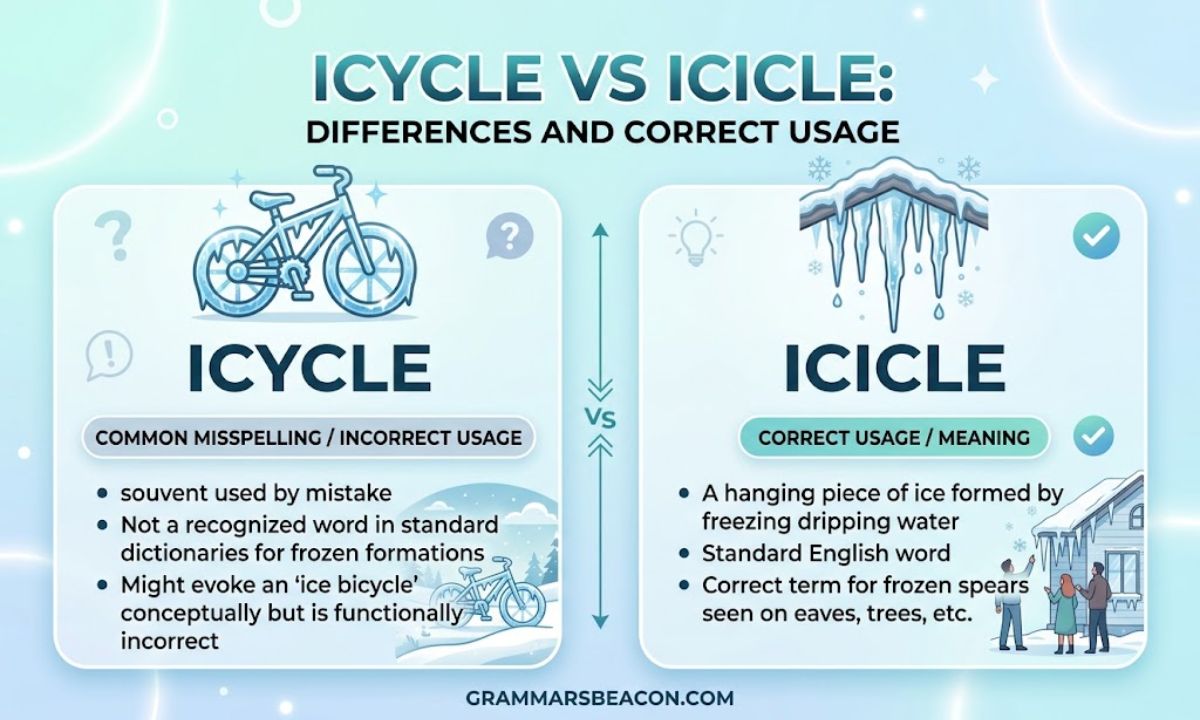
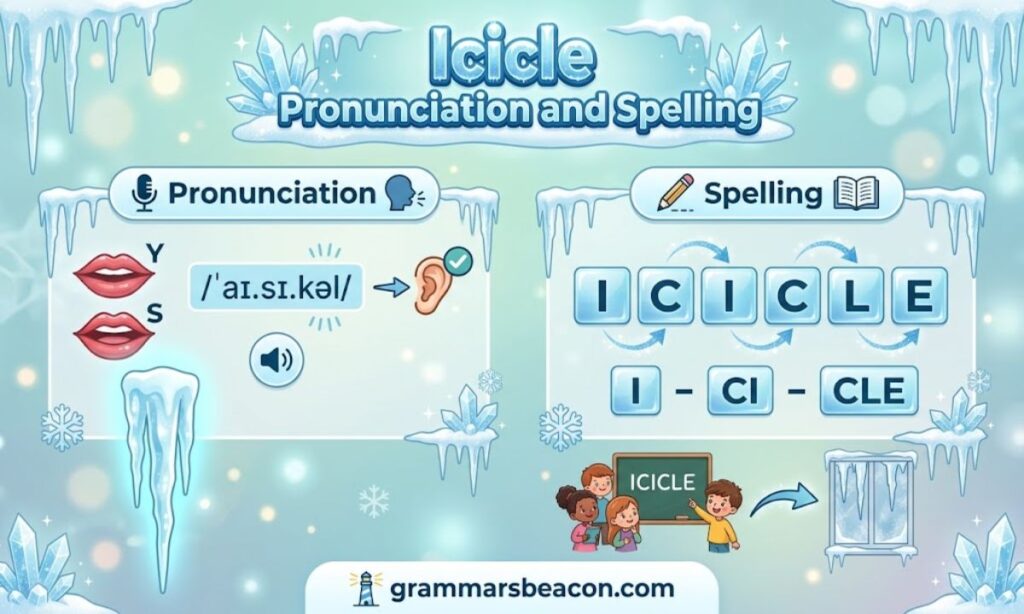
The correct spelling is icicle, spelled i-c-i-c-l-e. The word has three syllables and is pronounced “EYE-sih-kul.” Writers often mix it up with “bicycle,” which shares the same ending, and that similarity pulls many people toward the wrong spelling.
Is “Icycle” a Real Word?
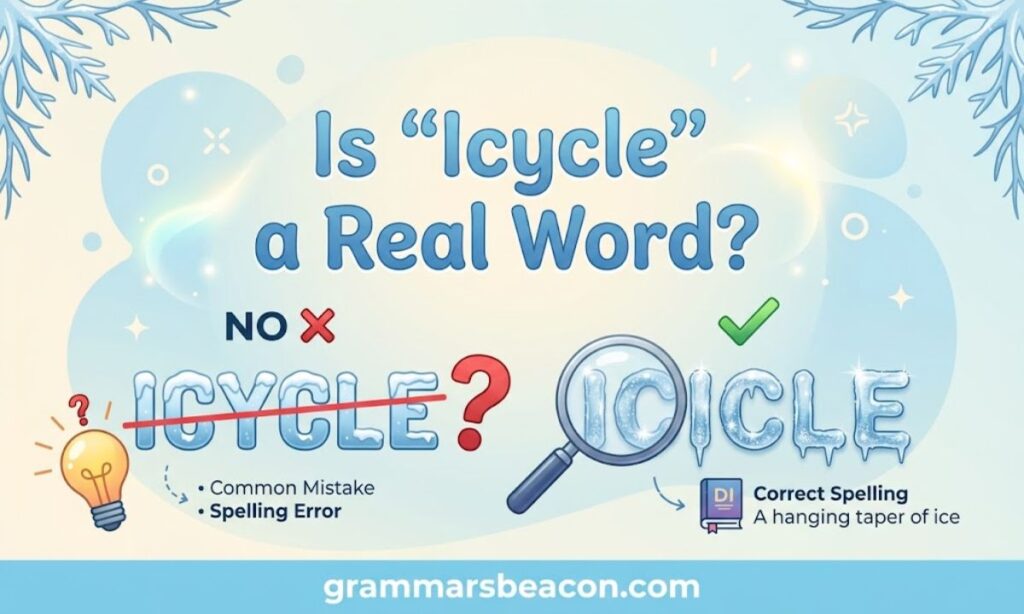
No, “icycle” is not a recognized English word. It is a misspelling that appears frequently in casual writing, search queries, and even printed material. Standard dictionaries list only “icicle.”
Definitive Answer
“Icycle” is incorrect. “Icicle” is the only accepted spelling in English dictionaries, style guides, and academic writing.
Is Icycle Correct or Incorrect?
“Icycle” is incorrect in every context. Whether you are writing a school essay, a weather report, a product description, or a blog post, use “icicle.”
Icycle Meaning (Clarified)
Because “icycle” is not a real word, it has no standalone meaning. When someone uses it, they almost always mean an icicle, the hanging spike of ice described below.
What Is an Icicle? (Icicle Definition)
An icicle is a tapering, pointed column of ice that hangs downward, usually from the edge of a roof, a tree branch, a rock ledge, or any surface where dripping water freezes as it falls or runs.
Icicle Meaning in English
In everyday English, an icicle refers to the long, thin spike of ice you often see hanging from gutters and eaves during winter. The word describes both the object and its shape: narrow at the tip and wider where it attaches to the surface above.
Formal Icicle Definition
In formal and technical contexts, an icicle is an elongated ice formation created when meltwater flows along a surface, drips from an edge, and freezes progressively. Its characteristic tapered shape results from freezing that occurs layer by layer as water moves toward the tip.
Key Features of Icicles
Icicles share several recognizable traits:
- Shape: They are typically long, narrow, and pointed at the bottom.
- Texture: Their surface can look smooth and glassy or ridged, depending on how water flowed over it.
- Transparency: Clear ice often appears translucent, while icicles that trap air bubbles look cloudy or white.
- Location: They commonly form on roof edges, gutters, tree limbs, cliffs, and cave ceilings.
- Size: Icicles range from a few centimeters to over a meter in length, depending on conditions.
Examples of Icicle in a Sentence
- The morning sun melted the icicles hanging from the cabin roof.
- Thick icicles dangled from the bridge railing after three days of freezing fog.
- Children tried to break off the longest icicle on the porch.
How Icicles Form (Scientific Explanation)
Icicles may look like a simple winter decoration, but their formation involves basic physics. Understanding the process also explains why icicles grow in some places and not others.
Step-by-Step Process
- Snow or ice melts on a warm surface. Sunlight, indoor heat escaping from a building, or a warm day causes snow on a roof to melt.
- Meltwater runs toward the edge. The water flows downhill until it reaches the eave, gutter, or branch tip.
- The water drips into freezing air. Outdoor temperatures below the freezing point cause each drop to begin freezing at its surface.
- Ice builds up at the tip. Water that continues to drip or flow along the surface freezes onto the existing ice, extending it downward.
- The shape tapers. Water spreads along the sides and freezes there, but the tip receives the most water and keeps growing. The narrow point forms as the ice builds up in layers.
Scientific Insight
Water releases heat as it freezes, which is called latent heat of fusion. This release slows the freezing of the tip slightly and gives the water more time to flow to the bottom before solidifying. That is one reason icicles grow long and thin rather than forming a flat sheet of ice. Air bubbles trapped during rapid freezing can make an icicle look white, while slow freezing produces clear ice.
Essential Conditions
Icicles need a specific combination of conditions to form:
- Air temperature at or below freezing, often combined with a warmer surface above
- A steady source of meltwater, such as snowmelt or dripping ice
- A surface edge where water can drip or run off
- Calm enough conditions for the water to stay in place as it freezes
Icycle vs Icicle: Key Differences
Although the two words look and sound similar, only one is correct. The table below highlights the main differences.
Difference Between Icicle and Icycle
| Feature | Icicle | Icycle |
| Correct spelling | Yes | No |
| Found in dictionaries | Yes | No |
| Accepted in formal writing | Yes | No |
| Meaning | A hanging spike of ice | No recognized meaning |
| Syllables | Three (EYE-sih-kul) | Not applicable |
| Common origin of error | Correct form | Blending “ice” and “cycle” |
Why Do People Spell Icicle as Icycle?
Misspellings usually have clear causes, and identifying them makes the correct form easier to remember.
Main Reasons
- Sound confusion: Many people pronounce the word quickly, and the unstressed middle syllable can blur together.
- Word blending: Writers combine “ice” with “cycle” because the two words seem related to cold, motion, or repetition.
- Autocorrect and typing errors: Keyboards can introduce small errors, especially when the word is typed quickly.
- Familiar patterns: English has many words ending in “-cycle,” such as “bicycle” and “recycle,” which encourages the same ending.
Icicle vs Bicycle Confusion
“Icicle” and “bicycle” share the ending “-icle” or “-cle,” which is one of the strongest sources of confusion. Bicycle comes from the Latin roots “bi” (two) and “cycle” (wheel or circle), while icicle comes from ice. The two words have no relationship, so keeping their origins separate in your mind helps prevent mix-ups.
Correct Spelling Icicle: How To Spell It
Correct Form
The correct spelling is icicle. Break it into two familiar parts if that helps: “ic” and “icle.” The word follows the pattern of “icicle,” with the same letters repeating in the middle.
Memory Tip
Think of an icicle as “ice” plus “sickle” in shape. The hanging tip resembles a curved blade. This image makes the spelling easier to recall while also reminding you of the object’s appearance.
Common Misspellings
- Icycle
- Icicel
- Iccicle
- Icickle
- Icical
Each of these is incorrect. Only “icicle” is accepted.
Icicle Pronunciation and Spelling
Standard Pronunciation
The standard pronunciation in American English is “EYE-sih-kul.” The stress falls on the first syllable, and the final syllable is soft, almost like “kul.”
Pronunciation Guide
- First syllable: “EYE” (like the word “eye”)
- Second syllable: “sih” (a short, unstressed sound)
- Third syllable: “kul” (a soft, reduced ending)
In British English, the pronunciation is similar, with the first syllable still stressed.
Common Errors
- Dropping the middle syllable and saying “EYE-kul”
- Stressing the second syllable
- Pronouncing the final syllable as “kle” with a hard sound
Practicing the three-syllable rhythm, “EYE-sih-kul,” helps the spelling feel natural as well.
How To Use Icicle in a Sentence
Grammar Usage
“Icicle” is a countable noun, so it takes singular and plural forms: one icicle, several icicles. It can serve as the subject or object of a sentence and is often modified by adjectives such as long, thin, clear, or frozen.
Examples of Icicle in a Sentence
- A single icicle hung from the edge of the tin roof.
- We counted twelve icicles along the gutter before the thaw began.
- The hikers ducked under icicles that sparkled in the afternoon light.
Professional Examples
- The maintenance report noted that heavy icicles had loosened part of the gutter system.
- Our winter safety guide recommends removing large icicles from walkways before they fall.
- The climate study measured icicle growth rates across three mountain sites.
Common Mistakes to Avoid
Even careful writers slip into these errors. Watch for them during editing.
❌ Using “Icycle” Instead of “Icicle”
This is the most common error. Always check the middle letters: i-c-i-c-l-e.
❌ Treating It as a Compound Word
Some writers think “icicle” is made of “ice” and “cycle,” so they write it as a compound. It is a single word with its own history, not a combination of “ice” and “cycle.”
❌ Incorrect Spelling in Formal Writing
Misspellings in résumés, academic papers, and published articles reduce credibility. Editors and readers notice these errors quickly, even when the meaning is clear.
Quick Tip to Avoid These Mistakes
Run a spell check, then search your document for the word “icy” and “icicle” to confirm consistent spelling. A quick proofread for this one word takes seconds and prevents embarrassing errors.
Context Matters: Proper Usage of Icicle

The word appears in different settings, and the tone changes slightly depending on where you use it.
Weather Context
In weather reports and seasonal advice, icicles often signal freezing conditions. For example: “Overnight temperatures will drop sharply, so expect icicles on exposed rooflines.”
Scientific Context
Scientists describe icicles when discussing ice formation, heat transfer, or cave geology. In these settings, precision matters, so writers often explain the conditions that produced the ice.
Everyday Context
In casual conversation, icicles usually appear in descriptions of winter scenes, home maintenance, or childhood memories. A simple sentence works well here: “The icicles on our porch looked like glass.”
Do Icicles Damage Property?
Icicles are beautiful, but they can cause real problems.
Yes, They Can
Large or heavy icicles can damage gutters, pull away from roof edges, and break off unexpectedly. Falling icicles can injure people or harm vehicles parked below. Ice buildup on roofs can also indicate ice dams, which allow melting snow to back up under shingles and leak into the building.
Case Insight
Consider a homeowner whose gutter sagged under the weight of a long icicle cluster. The gutter pulled away from the fascia board, and meltwater leaked behind the siding. Clearing the gutter and improving attic insulation addressed both the icicles and the underlying heat loss. Removing icicles safely, using a roof rake from the ground, reduces this risk without climbing on a slippery roof.
What Causes Icicles to Form?
Icicles form when water melts and refreezes repeatedly in cold conditions.
Primary Causes
- Heat loss from buildings: Warm air escaping through poorly insulated attics melts snow on the roof.
- Sunlight: Direct sun warms dark surfaces and melts snow even when the air is cold.
- Freezing air temperatures: Outdoor cold causes meltwater to freeze as it drips.
- Dripping water sources: Trees, rock faces, and cave ceilings can also produce icicles from seeping water.
Process Summary
Melting, flowing, dripping, and freezing repeat over and over. Each cycle adds a thin layer of ice, and the layers build into the familiar tapered shape.
Word Origin: Icicle Etymology
Understanding where a word comes from can make it easier to remember.
Old English Origin
“Icicle” comes from Old English. The early form, “gicel,” joined a word for ice with a suffix that indicated a small piece or sliver. Over centuries, the spelling changed into the modern “icicle.”
Meaning
The root meaning points to a small piece of ice. That idea fits the object well, since an icicle is a narrow, separated piece of frozen water hanging from a surface.
Read More: Taught vs Tought Correct Spelling and Usage (2026)
Is Icicle Related to Bicycle?
No, the two words are not related. “Icicle” comes from Old English and refers to ice. “Bicycle” comes from Latin and French roots meaning two and wheel. The shared ending creates a visual similarity, but the meanings and histories are completely separate.
Correct vs Incorrect Usage
Correct
- The icicles glittered on the windowsill after the storm.
- Please remove the icicles from the walkway before anyone walks there.
- The science textbook explains how an icicle forms.
Incorrect
- The icycles glittered on the windowsill after the storm.
- Please remove the icycles from the walkway before anyone walks there.
- The science textbook explains how an icycle forms.
Practice Section (More Exercises)
Test your understanding with these exercises. Answers appear after each set.
Fill in the Blanks
- Long __________ hung from the gutter after the freezing rain. (Answer: icicles)
- Water dripping from the roof turned into an __________. (Answer: icicle)
Choose the Correct Word
Pick the correct spelling in each pair.
- Icicle / Icycle (Answer: Icicle)
- Icicles / Icycles (Answer: Icicles)
Correct the Sentence
Rewrite this sentence with the correct spelling:
“The icycles on the cabin roof were taller than my brother.”
Answer: “The icicles on the cabin roof were taller than my brother.”
Write Your Own Sentence
Try writing one sentence using “icicle” to describe a winter scene. Then check the spelling carefully.
Quick Tip
Read your sentence aloud and listen for the three syllables: “EYE-sih-kul.” If the spelling does not match the sound, check it again.
Multiple Choice
Which sentence uses the word correctly?
a) The icycle melted in the sunshine.
b) The icicle melted in the sunshine.
c) The ice-cycle melted in the sunshine.
Answer: b
Quick Recap: Icycle vs Icicle
“Icicle” is the correct spelling. “Icycle” is a common misspelling with no dictionary standing. An icicle is a tapered column of ice formed by repeated cycles of melting, flowing, dripping, and freezing. The word comes from Old English, and it has no connection to “bicycle.” Keep the spelling consistent in all your writing.
Key Takeaways
- Always spell the word icicle, with the letters i-c-i-c-l-e.
- An icicle is a hanging, tapered spike of ice formed by dripping, freezing water.
- Icicles form when meltwater flows to an edge and freezes in cold air.
- The word has no relationship to “bicycle” despite the similar ending.
- Icicles can damage gutters and roofs, so remove large ones safely.
- Proofread for the word “icycle” before publishing any document.
FAQs
How do you spell the word icycle?
“Icycle” is a misspelling. The correct spelling is icicle, pronounced “EYE-sih-kul.”
Is icycle correct or incorrect?
Icycle is incorrect. Only icicle appears in standard English dictionaries and style guides.
What is a hanging piece of ice called?
A hanging piece of ice is called an icicle. It is usually long, thin, and pointed at the tip.
Why is icicle often misspelled?
People often misspell icicle because they associate it with “bicycle” and “cycle,” and the middle syllable is easy to blur in speech.
Do icicles damage property?
Yes, heavy icicles can pull gutters loose, damage roof edges, and fall on people or vehicles below.
What causes icicles to form?
Icicles form when meltwater flows to a surface edge and freezes in below-freezing air. Heat loss from buildings and direct sunlight often start the melting.
What is the correct spelling of icicle?
The correct spelling is i-c-i-c-l-e. Keep the “ic” pattern repeated in the middle of the word.
Conclusion
Spelling “icicle” correctly is simple once you know the rule: the word has no “y,” no “cycle,” and no connection to bicycles. An icicle is a beautiful winter formation created by water that melts, flows, drips, and freezes into a tapered spike. Understanding how icicles form also helps you recognize the conditions that create them and the steps to take when they become hazardous. Use the correct spelling in every piece of writing, check your work for the common misspelling, and you will communicate clearly and professionally every time.