If you have ever paused mid sentence wondering whether to type “verbiage” or “verbage,” you are not alone. This mix up shows up in emails, legal contracts, business reports, and everyday conversation. The good news is that the answer is simple once you know the rule, and this guide will walk you through everything you need to use the word correctly, understand where the confusion comes from, and sound polished in both casual and professional writing.
By the end of this article, you will know the correct spelling, the real meaning of verbiage, how to pronounce it, and how to use it naturally in sentences without second guessing yourself.
Verbiage vs Wording
At first glance, verbiage and wording seem interchangeable, and in many contexts they are. Both refer to the specific words chosen to express an idea. However, there is a subtle difference in tone.
“Wording” is neutral. It simply describes how something is phrased, without judgment about length or quality. “Verbiage,” on the other hand, often carries a slight implication of excess or formality, especially in traditional usage. That said, in modern business English, verbiage is frequently used as a synonym for wording without any negative connotation at all.
Verbiage vs Verbage: The Quick Answer
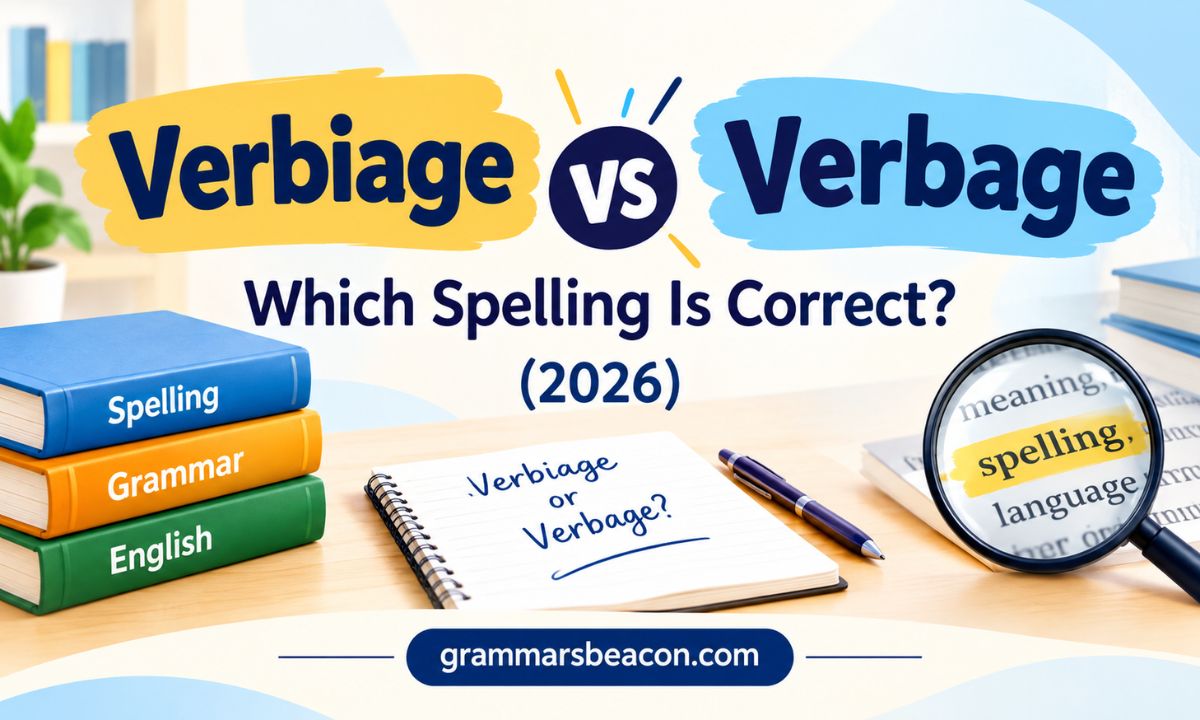
Here is the short version for anyone in a hurry: verbiage is correct, and verbage is not a recognized word in standard English.
Verbiage is a legitimate noun found in every major dictionary, including Merriam Webster and the Oxford English Dictionary. Verbage does not appear in these dictionaries as a standard entry. It is considered a common misspelling, usually caused by how the word sounds when spoken quickly.
So if you are ever unsure, default to verbiage. It is the safe, correct, and professional choice in every context, from casual writing to formal legal documents.
Is Verbage a Real Word?
No, verbage is not an officially recognized word. It does not appear in standard dictionaries as a valid entry, and style guides consistently flag it as an error.
That said, the word shows up often enough in speech and informal writing that some people assume it is simply an alternate or shortened form of verbiage. This is a misconception. Language experts and grammar resources agree that verbage is a misspelling, not a variant spelling, similar to how “alot” is a common but incorrect version of “a lot.”
If you search for verbage in a professional dictionary, you will either find no results or a note redirecting you to verbiage.
What Does Verbiage Mean?
Verbiage is a noun with two closely related meanings, both tied to language and expression.
Verbiage as Excessive Wording
The traditional and original sense of verbiage refers to wordiness, meaning language that uses more words than necessary to communicate an idea. This usage often has a mildly negative or critical tone.
For example, a contract stuffed with redundant clauses or a speech padded with filler phrases could both be described as having too much verbiage.
Verbiage as Language or Wording
The second, more modern meaning treats verbiage as a neutral term for the specific text or wording used in a document, advertisement, or piece of communication. In this sense, it simply means “the words used,” without any judgment about length.
This is the meaning you will most often encounter in business, marketing, and legal settings today, such as “please review the verbiage on page two before we finalize the agreement.”
Verbiage vs Verbage: Grammar
From a grammatical standpoint, verbiage functions as a singular, uncountable noun, much like “language” or “wording.” It does not typically take a plural form, since it refers to a mass or quality rather than individual countable items.
Verbage, since it is not a standard word, has no established grammatical rules. Any attempt to use it in formal writing will likely be flagged by spell checkers, editors, and grammar tools.
| Feature | Verbiage | Verbage |
| Dictionary status | Standard, recognized word | Not a recognized word |
| Part of speech | Noun (uncountable) | None, considered a misspelling |
| Acceptable in formal writing | Yes | No |
| Common in speech | Yes | Yes, but incorrect |
Verbiage Definition in Modern English
In contemporary usage, verbiage has softened from its older, more critical meaning. Today it is commonly used as a fairly neutral synonym for “text,” “wording,” or “language,” especially in business and technical contexts.
For instance, a marketing team might ask a colleague to “update the verbiage on the homepage,” meaning simply the text content, with no implication that the current wording is excessive or poorly written.
Verbiage vs Verbage: What’s the Difference?
The core difference is straightforward: one word exists in the English language, and the other does not. Verbiage is a legitimate, dictionary-approved noun describing wording or wordiness. Verbage is a misspelling that likely arose from how people pronounce verbiage in casual speech, dropping the middle syllable.
There is no scenario in professional or academic writing where verbage should be used instead of verbiage.
The Origin and History of Verbiage
Verbiage traces its roots to the Latin word “verbum,” meaning “word.” It passed through French before entering the English language in the 18th century. Originally, the term carried a distinctly negative connotation, referring to speech or writing that was overly wordy, pompous, or difficult to follow.
Over the past century, the meaning has gradually broadened. While the “excessive wordiness” sense still exists and remains common internationally, especially in British and Commonwealth English, American English has increasingly adopted verbiage as a neutral stand in for “wording” or “text,” particularly in business and legal settings.
Read More: Across vs Accross
Why Do People Spell Verbiage as Verbage?
The confusion between these two spellings is extremely common, and there are a few clear reasons behind it.
Pronunciation Creates Confusion
Verbiage can be pronounced with either three syllables (ver-bee-ij) or two syllables (ver-bij), and both are accepted by major dictionaries. When people hear the two syllable pronunciation, they often assume the spelling matches what they hear, dropping the “i” entirely and writing “verbage.”
Similar English Word Endings
English has many words ending in “-age,” such as “storage,” “package,” and “damage.” Because these words are so familiar, it is natural for writers to unconsciously apply that same pattern to verbiage, resulting in the incorrect “verbage.”
Typing and Memory Errors
Simple typos and memory slips also play a role. Since verbiage is not an everyday word for most people, it is easy to misremember the exact letter order, especially when typing quickly in emails or documents.
Verbiage Pronunciation
Knowing how to pronounce verbiage correctly can also help you spell it correctly, since the two are closely linked.
American English Pronunciation
In American English, verbiage is commonly pronounced as either “VUR-bee-ij” (three syllables) or “VUR-bij” (two syllables). Both versions appear in major American dictionaries as standard and acceptable.
British English Pronunciation
British English speakers typically favor the three syllable pronunciation, “VUR-bee-ij,” with a clearer emphasis on the middle vowel sound. This may explain why the verbage misspelling is somewhat less common in British writing compared to American writing.
Does Verbiage Always Have a Negative Meaning?
No, verbiage does not always carry a negative meaning. While its older, traditional use implied wordiness or unnecessary complexity, modern usage, particularly in American business and marketing contexts, treats it as a neutral term for wording or text.
Context matters here. If someone says a report is “full of unnecessary verbiage,” the negative connotation is clear. But if a colleague asks you to “check the verbiage on the invoice,” they simply mean the text itself, with no judgment implied.
Verbiage vs Language
“Language” is a broader term that refers to an entire system of communication, including grammar, vocabulary, and structure, such as English, French, or Spanish. “Verbiage” is narrower and more specific, referring to the particular words or phrasing used in a given piece of writing or speech.
In short, language is the system, while verbiage is the specific output within that system.
Wording vs Verbiage
Wording
Wording is a neutral, everyday term for how something is phrased. It carries no built in judgment about length, tone, or quality. It is used casually and formally alike.
Verbiage
Verbiage can be neutral in modern business usage, but it still carries a subtle formal or slightly critical undertone in traditional contexts, especially when referring to excessive or overly complex language.
Diction vs Verbiage
Diction
Diction refers to a writer’s or speaker’s choice of words and their style, often evaluated for clarity, tone, and appropriateness. It is commonly discussed in the context of literature, public speaking, and formal writing analysis.
Verbiage
Verbiage focuses more on the amount and specific content of the wording used, rather than the stylistic quality of the word choices themselves.
Verbiage Synonym
Depending on the intended meaning, several words can substitute for verbiage:
- For excessive wordiness: wordiness, verbosity, padding, redundancy
- For neutral wording: phrasing, text, language, wording, terminology
Choosing the right synonym depends on whether you want to convey a critical tone or a purely descriptive one.
Legal Verbiage: What Does It Mean?
In legal contexts, “verbiage” typically refers to the specific wording, clauses, or language used within a contract, agreement, or legal document. Legal professionals often use the term neutrally, as in “let’s revise the verbiage in section four,” simply meaning the text of that section.
Legal documents are frequently criticized for excessive verbiage in the traditional sense too, since contracts often include dense, repetitive language that can be difficult for non lawyers to interpret.
Read More: Drove vs Driven
Technical Verbiage in Professional Communication
In technical writing, such as user manuals, software documentation, or product specifications, verbiage refers to the precise wording used to explain a process, feature, or instruction. Clear, well chosen verbiage in technical documents is essential, since ambiguous wording can lead to user errors or misunderstandings.
Verbiage in Business Writing
Business writing relies heavily on the neutral use of verbiage to describe text found in proposals, reports, emails, and presentations. Teams often discuss “updating the verbiage” on a webpage, slide deck, or brochure, meaning simply the written content that needs revision.
Verbiage Meaning in Business Writing
Within business contexts specifically, verbiage almost always refers to the actual text or copy used in a document, advertisement, or internal communication. It is rarely used critically in this setting and instead functions as a practical, everyday term among colleagues.
Verbiage Meaning in Legal Documents
In legal writing, verbiage carries a dual meaning. It can refer neutrally to the specific clauses and phrasing within a contract, or it can be used critically to describe unnecessarily complicated or dense legal language that makes documents harder to understand for the average reader.
Verbiage Usage in Modern Writing
Modern writers use verbiage across a wide range of fields, from marketing and law to software development and academic writing. Its flexibility, functioning as both a neutral and critical term depending on context, makes it a useful word once you understand how to apply it correctly.
Verbiage in a Sentence
Seeing verbiage used in different contexts can help clarify its meaning and tone.
Negative Examples
- The report was weighed down by unnecessary verbiage that obscured the main findings.
- Readers often skip past the dense verbiage in terms and conditions pages.
Neutral Examples
- Please double check the verbiage on the invitation before we send it out.
- The marketing team updated the verbiage on the landing page to improve clarity.
Professional Examples
- Our legal team reviewed the verbiage in the contract to ensure compliance.
- The technical writer refined the verbiage in the user guide for better readability.
Excessive Verbiage and Writing Quality
Excessive verbiage can seriously harm the quality and readability of any piece of writing. When sentences are padded with unnecessary words, filler phrases, or repetitive explanations, readers lose interest and key information becomes harder to find.
Common signs of excessive verbiage include:
- Repeating the same idea in different words
- Using long, complex phrases where a single word would work
- Adding qualifiers and filler that do not add meaning
- Overusing passive voice, which often requires more words than active voice
Concise Writing vs Verbiage
Concise writing aims to communicate ideas using the fewest words necessary without sacrificing clarity. It stands in direct contrast to excessive verbiage, which buries meaning under unnecessary language.
Strong writers actively edit their work to cut verbiage, favoring shorter sentences, active voice, and precise word choices. This is especially important in professional and digital writing, where readers often skim rather than read every word closely.
Common Mistakes with Verbiage
Writing Verbage
The most frequent mistake is simply misspelling verbiage as verbage. Always remember that verbiage contains an “i,” which helps distinguish it from the incorrect version.
Confusing Verbiage with Vocabulary
Vocabulary refers to the total set of words a person knows or uses, while verbiage refers to the specific wording within a particular piece of writing or speech. They are related but not interchangeable.
Assuming Verbiage Is Always Positive
While modern usage often treats verbiage neutrally, it is not inherently a compliment. Calling someone’s writing “full of verbiage” can still imply wordiness or a lack of clarity, depending on context.
Confusing Verbiage with Jargon
Jargon refers to specialized terminology used within a particular field or profession, while verbiage refers more broadly to the wording or text itself, regardless of how technical or specialized it is.
Conclusion
Verbiage is the correct spelling, and verbage is a common but incorrect misspelling that should be avoided in all formal and professional writing. Remembering the “i” in verbiage, and connecting it to its correct pronunciation, is the easiest way to avoid this mistake going forward.
Whether you are drafting a legal contract, polishing a business report, or simply writing an email, using verbiage correctly signals attention to detail and strengthens your credibility as a clear communicator. Keep this guide handy, and you will never second guess this spelling again.