
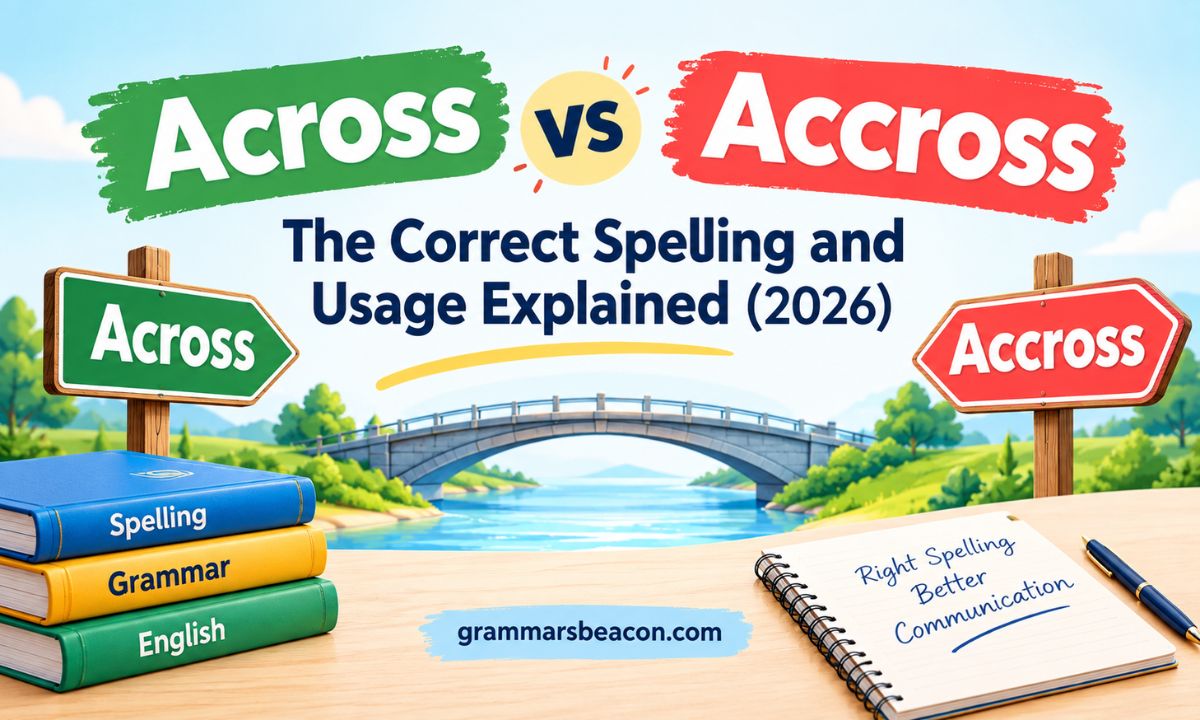
If you have ever typed “accross” and then paused, wondering if it looked right, you are not alone. This is one of the most common spelling mix-ups in English, and it trips up native speakers and English learners alike. The good news is that the rule is simple once you understand where the confusion comes from.
In this guide, you will learn the correct spelling, why “accross” is always wrong, how to use “across” correctly in a sentence, and how it differs from similar words like “through” and “over.” By the end, you will never second-guess this word again.
Accross
Let’s address this directly: “accross” is not a word. It does not appear in any standard English dictionary, whether British or American. It is simply a misspelling of “across,” created by doubling the letter “c.”
No matter how often you see it typed in emails, social media posts, or casual messages, “accross” has never been and will never be accepted as correct English. If you have used it in the past, this article will help make sure you never do again.
The Correct Spelling Explained
The correct spelling is across, spelled with a single “c” in the middle: a-c-r-o-s-s.
Here is a quick breakdown of the word:
| Letter Sequence | Correct | Incorrect |
| A-C-R-O-S-S | ✅ Across | |
| A-C-C-R-O-S-S | ❌ Accross |
Notice that “across” has only one “c” but two “s” letters at the end. This is exactly where most people get confused, because they mistakenly double the wrong letter.
What Does Across Mean in English?
“Across” is a preposition and sometimes an adverb that describes movement or position from one side of something to the other. It is used to talk about:
- Physical movement over a space, such as “she walked across the room”
- Position on the opposite side, such as “the bakery is across the street”
- Extension throughout an area, such as “the news spread across the country”
In simple terms, “across” connects two points that lie on either side of a space, whether that space is a street, a river, a table, or something more abstract like time or a topic.
Accross vs Across Meaning Explained
Since “accross” is not a real word, it does not carry any meaning of its own. It simply functions as an error in place of “across.” There is no separate definition, context, or grammatical rule that makes “accross” acceptable in any form of writing, whether formal or informal.
Think of it this way: every time you write or say “accross,” your intended meaning is really “across.” The meaning does not change based on the spelling, but the correctness of your writing absolutely does.
Accross vs Across Examples
Seeing both spellings side by side makes the difference easier to remember.
| Incorrect (Accross) | Correct (Across) |
| We walked accross the bridge. | We walked across the bridge. |
| The store is accross the road. | The store is across the road. |
| She swam accross the lake. | She swam across the lake. |
| The message spread accross social media. | The message spread across social media. |
| His office is accross from mine. | His office is across from mine. |
If you find yourself unsure while writing, simply picture the word with one “c” and two “s” letters, and you will always get it right.
Why Is Across Spelled With One “C”?
The reason lies in the word’s origin. “Across” comes from Middle English, formed by combining the prefix “a-” (meaning “on” or “in”) with the word “cross.” Since “cross” already contains one “c,” adding the “a-” prefix does not double that letter. The result is “a” plus “cross,” which becomes “across,” not “accross.”
Understanding this small piece of etymology makes the spelling far easier to remember. You are not adding an extra “c” for emphasis; you are simply attaching a short prefix to the existing word “cross.”
Why Do People Spell Across Wrong?
Spelling mistakes rarely happen by accident alone. There are usually clear patterns behind them, and “accross” is no exception. Common reasons include:
- Double-letter confusion: English has many words with double consonants, like “accommodate” or “occasion,” which can make writers assume “across” follows the same pattern.
- Auditory spelling: Some people spell words based on how they sound rather than how they are written, and the “ə-krɔs” sound does not clearly indicate a single “c.”
- Autocorrect gaps: Not every device or app flags “accross” as an error, especially in casual typing apps or older software.
- Habit and repetition: Once someone learns the wrong spelling, it can become a habit that is hard to unlearn without conscious correction.
- Influence of similar words: Words like “accept” or “according” also start with “ac-,” which can subconsciously push writers toward doubling the “c” in “across” as well.
Recognizing these patterns is the first step to breaking the habit for good.
Accross vs Across Grammar Rules Explained
Since “accross” is not a recognized word, there are no grammar rules attached to it. All grammatical guidance applies to “across” alone. Here is what you need to know:
- As a preposition, “across” is followed by a noun or noun phrase: “across the street,” “across the world.”
- As an adverb, “across” can stand alone without an object: “the river is too wide to swim across.”
- In fixed phrases, “across” appears in expressions like “across the board” (meaning applying to everything) and “come across” (meaning to encounter or seem a certain way).
Always double-check that you are using “across” with the correct preposition pattern, especially in phrases like “across from,” which is used to describe something directly on the opposite side.
Read More: How To vs How Tos
How to Use Across in a Sentence Correctly
Using “across” correctly becomes second nature once you practice it in different contexts. Here are some practical examples:
- Describing movement: “The dog ran across the yard to greet us.”
- Describing position: “The pharmacy is located across from the hospital.”
- Describing spread or reach: “The company has offices across Europe and Asia.”
- Describing measurement: “The lake is about two miles across.”
- In idiomatic use: “The new policy applies across the board.”
A helpful tip is to ask yourself whether you are describing something spanning from one side to another. If the answer is yes, “across” is almost certainly the word you need.
Across vs Through vs Over: Key Differences
These three words are often confused because they all describe movement or position relative to a space, but each has a distinct meaning.
| Word | Meaning | Example |
| Across | Movement or position from one side of a surface to the other | She walked across the field. |
| Through | Movement within or inside something, often surrounded on multiple sides | She walked through the forest. |
| Over | Movement above or covering something, often implying height or elevation | The plane flew over the mountains. |
A simple way to remember the difference: use “across” for flat surfaces, “through” for enclosed or three-dimensional spaces, and “over” when something passes above or spans on top of another object.
Read More: Drove vs Driven
Synonyms and Similar Words to Across
Depending on context, several words can serve as alternatives to “across,” though none are perfect substitutes in every situation.
- Over
- Throughout
- Opposite
- Spanning
- From side to side
- Crosswise
Choosing the right synonym depends heavily on the sentence. For example, “throughout” works well for describing something happening everywhere within an area, while “opposite” is better suited for describing a direct facing position rather than distance spanned.
Across Pronunciation
“Across” is pronounced as uh-KRAWS in American English, with the stress placed clearly on the second syllable. In IPA notation, this is written as /əˈkrɔːs/ in British English and /əˈkrɔs/ in American English.
A few pronunciation tips:
- Keep the “kr” sound tightly blended, without inserting an extra vowel between the “k” and “r.”
- Stress the second syllable, not the first.
- Avoid pronouncing it as “a-cross-t,” which is a common but nonstandard variation heard in some regional dialects.
Across Spelling UK vs US: Any Difference?
There is no spelling difference between British and American English for this word. Both varieties spell it identically as “across.” The only minor variation is in pronunciation, where British English tends to use a slightly more open vowel sound compared to American English, but the written form remains the same worldwide.
This makes “across” one of the more consistent words in English, unlike words such as “colour/color” or “organise/organize,” which do vary by region.
Read More: What Kind of vs What Kinds of
Is Accross Ever Correct to Use?
No. There is no context, formal or informal, academic or casual, where “accross” is considered correct. It does not appear in Merriam-Webster, the Oxford English Dictionary, Cambridge Dictionary, or any other reputable language resource. Autocorrect tools and spell checkers typically flag it as an error, and using it in professional writing can undermine your credibility.
If you ever see “accross” used somewhere, including in published content, it is simply a typo or spelling mistake that was missed during editing.
The Impact of Spelling Errors on Writing
Small spelling mistakes like “accross” instead of “across” can have a bigger impact than most people realize. Here is why accuracy matters:
- Credibility: Readers often judge expertise and professionalism based on writing quality, especially in business or academic contexts.
- Clarity: While most readers will still understand the intended meaning, spelling errors can momentarily disrupt reading flow.
- SEO and digital content: Search engines and content platforms increasingly reward well-edited, accurate writing, which affects visibility and trust signals.
- First impressions: In resumes, emails, or client communication, spelling mistakes can create doubt about attention to detail.
Taking a few extra seconds to double-check commonly confused words like “across” can meaningfully improve the overall quality of your writing.
Conclusion
The rule is simple: across is always correct, and accross is always wrong. Remembering that the word comes from “a-” plus “cross” makes the single “c” spelling easy to recall permanently.
Whether you are writing an email, an essay, or content for your website, getting this small detail right reflects positively on your overall writing quality. Keep this guide handy, practice with the examples above, and you will never confuse “across” and “accross” again.











2 thoughts on “Across vs Accross: The Correct Spelling and Usage Explained (2026)”