
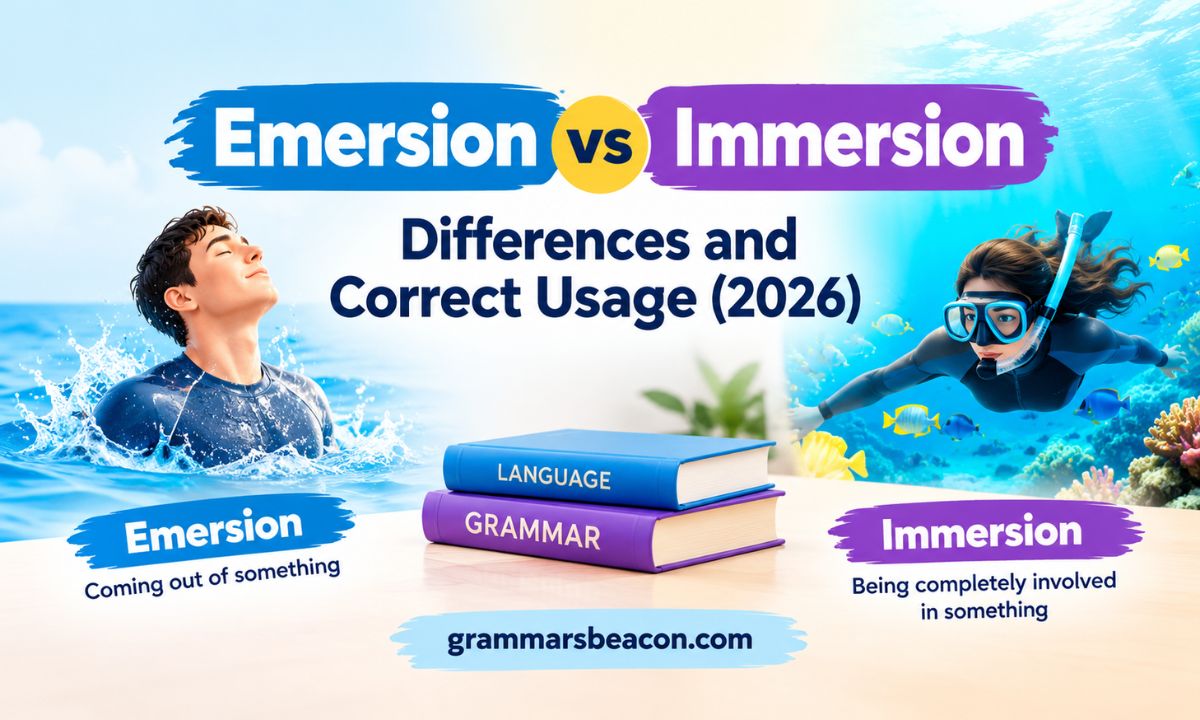
Few word pairs confuse English speakers as reliably as emersion and immersion. They look almost identical on paper, they sound alike when spoken, and both trace back to Latin roots tied to water. Yet they describe opposite actions. One is about rising up and out. The other is about sinking in and staying under, whether literally in liquid or figuratively in an experience.
This guide breaks down what each word actually means, where each one is used correctly, and how to stop mixing them up for good. You will find real examples from science, technology, education, psychology, and everyday writing, plus a simple memory trick that makes the choice automatic.
Immersion vs Submersion
Before comparing emersion and immersion, it helps to clear up a third word that often gets tangled into the same conversation: submersion.
Immersion means being deeply engaged or surrounded by something, whether that is water, a language, or a virtual world. It does not always mean total coverage. You can be “immersed” in a book without being physically covered by it at all.
Submersion, on the other hand, specifically means being placed completely under the surface of a liquid. A submarine is submerged. A sunken shipwreck is submerged. Submersion is almost always literal and physical, while immersion stretches comfortably into abstract and sensory use.
| Term | Core Meaning | Typical Use |
| Immersion | Deep involvement or surrounding | Physical or figurative |
| Submersion | Complete coverage under liquid | Almost always physical |
| Emersion | Coming out or rising up | Physical or figurative |
Understanding this distinction matters because writers sometimes swap submersion and immersion carelessly, which only adds to the confusion around emersion.
Emersion vs Immersion: A Quick Comparison
Here is the short version before we dig into the details.
| Feature | Emersion | Immersion |
| Meaning | Coming out or emerging | Going in or being fully absorbed |
| Direction | Outward | Inward |
| Common Field | Astronomy, marine biology | Technology, education, psychology |
| Root Word | Latin emergere (to rise up) | Latin immergere (to dip into) |
| Frequency of Use | Rare, technical | Common, everyday |
| Example | Emersion of a whale from water | Immersion in a foreign language |
The two words are true opposites, similar to how emigrate means to leave a country and immigrate means to enter one. If you remember that relationship, the rest becomes much easier to apply.
Emersion Meaning, Definition and Scientific Context
Emersion is not a word most people use in daily conversation, and that rarity is exactly why it trips writers up. It sits mostly in scientific and technical vocabulary, describing something that becomes visible again after being hidden or covered.
Emersion Definition
Emersion is the act of emerging or coming out from a state of being covered, submerged, or hidden. It is most often applied to something rising out of water or reappearing after being blocked from view. Dictionaries commonly define it as the opposite of immersion, and in astronomy specifically, it refers to the reappearance of a celestial object after an eclipse or occultation.
In short, emersion always signals an outward, upward movement toward visibility.
Scientific Fields Where Emersion Is Used
Emersion shows up in a handful of specialized fields where precision matters. Here is where you will actually encounter it.
Marine biology
In marine biology, emersion describes the period when an organism that normally lives underwater is exposed to air, typically during low tide. Coastal creatures like barnacles, mussels, and intertidal snails experience regular cycles of emersion and submersion as tides rise and fall. Researchers studying these zones often measure how long a species can tolerate emersion before it needs to be back underwater.
Astronomy
This is arguably the most formal and widely documented scientific use of the word. In astronomy, emersion refers to the moment a celestial body, such as a moon, star, or planet, reappears after being eclipsed, occulted, or transited by another body. The opposite moment, when the object disappears from view, is called immersion. Astronomers use both terms with exact timing, often down to the second, when tracking eclipses.
Environmental science
Environmental scientists use emersion when discussing wetlands, shorelines, and flood cycles. A riverbank or marsh area may undergo seasonal emersion as water levels drop, exposing sediment, plant roots, or aquatic habitats that were previously submerged. This terminology helps researchers track ecological changes tied to water level fluctuations.
Origin and Etymology of Emersion
Emersion comes from the Latin word emergere, formed from e- (meaning “out of”) and mergere (meaning “to dip or plunge”). Put together, the word literally means “to rise out of.” It entered English usage in the early 1600s, largely through scientific and astronomical writing, which explains why it remains tied to formal and technical contexts rather than casual speech.
Notice that mergere is the same Latin root behind immersion, submersion, and even the modern word “merge.” All of these words share a family connection to the idea of dipping, plunging, or blending into something, with different prefixes changing the direction or completeness of that action.
Emersion in Literature and Metaphorical Use
While emersion is rare in fiction and everyday writing, it does appear occasionally as a literary or metaphorical device. Writers sometimes use it to describe a character’s emotional or psychological “resurfacing,” such as emerging from grief, confusion, or a period of isolation.
For example, a novelist might describe a character’s emersion from depression as a slow return to clarity and connection with the world. This kind of figurative use is intentional and stylistic rather than standard, so it works best in creative or reflective writing rather than technical or business content.
Immersion Definition and Meaning
Immersion is the far more common of the two words, and it carries both a literal, physical meaning and a widely used figurative one.
Immersion Definition
Immersion is the state of being deeply surrounded by, involved in, or absorbed by something, whether that is a physical substance like water or an experience like learning, gaming, or culture. It comes from the Latin immergere, meaning “to dip into” or “to plunge into.”
Physical Immersion
Physical immersion refers to something being surrounded or covered by a substance, most commonly a liquid. Dipping a thermometer into water, baptizing someone by full-body immersion, or lowering an object into a chemical bath are all examples of physical immersion. It is a literal, measurable action.
Psychological Immersion
Psychological immersion happens when a person becomes so absorbed in an activity that they lose track of time, surroundings, or distractions. Reading a gripping novel, watching an emotionally intense film, or losing yourself in a creative project all reflect this mental state. It is closely tied to what psychologists call “flow,” a state of complete focus and engagement.
Immersion in Technology and Digital Environments
Modern technology has made immersion one of the most frequently used words in product design, entertainment, and marketing. It describes how deeply a piece of technology can pull a user into an experience.
Virtual reality
Virtual reality (VR) exists almost entirely around the concept of immersion. Headsets, spatial audio, and motion tracking are all designed to make users feel physically present inside a digital environment. The more convincingly a VR system blocks out the real world and replaces it with a believable simulated one, the higher its “immersion level” is considered to be.
Gaming and entertainment
Video games rely heavily on immersion to keep players engaged for long stretches of time. Detailed environments, responsive storytelling, realistic sound design, and interactive mechanics all contribute to how immersive a game feels. Streaming platforms and interactive films use similar techniques, building narrative depth so viewers feel emotionally pulled into the story rather than just watching it from a distance.
Emersion vs Immersion Blender
This comparison often confuses shoppers searching for kitchen tools online. The correct term for the handheld kitchen tool used to blend soups, sauces, and smoothies directly in a pot or container is an immersion blender, not an emersion blender.
The name makes sense once you understand the word choice: the blending head is immersed, or dipped, into the liquid you are blending. “Emersion blender” is a common misspelling that shows up frequently in search queries, but it is not a recognized or correct product name. If you are shopping for one, search for “immersion blender” to get accurate results from retailers.
Emersion vs Immersion: Key Differences
Now that both words have been defined individually, here is a direct side-by-side breakdown of how they differ.
Direction of Experience
Immersion moves inward. Something or someone enters, sinks into, or becomes surrounded by another state, substance, or experience. Emersion moves outward. Something rises up, reappears, or exits a state it was previously inside of.
Read More: Across vs Accross
Stage of Experience
Immersion typically represents the beginning or ongoing middle of an experience, such as entering a new culture or starting a language program. Emersion represents the end or exit point, such as completing that experience and returning to a previous state or awareness.
Frequency of Use
Immersion is used constantly across technology, education, psychology, and everyday conversation. Emersion is rare, appearing mostly in scientific, astronomical, or literary contexts. If you are unsure which word fits your sentence, immersion is statistically the far more likely correct choice.
Emersion vs Immersion in Education
Education is one of the clearest real-world settings where both direction and stage matter.
Immersion Learning Programs
Immersion learning programs place students directly inside an environment where they must use new skills or knowledge constantly, without relying on their native context. Language immersion schools, for example, teach subjects like math and science entirely in the target language, forcing students to think and communicate within that framework from day one.
Benefits of immersive learning
Immersive learning programs are associated with several well documented advantages:
- Faster real-world fluency compared to traditional classroom-only instruction
- Stronger long-term retention because skills are tied to lived experience
- Increased confidence in applying knowledge under real conditions
- Greater cultural or contextual understanding alongside technical skill
Emersion vs Immersion in Language Learning
Language acquisition offers one of the most practical examples of how these two words can genuinely work as a pair, describing two ends of the same journey.
Immersion phase
The immersion phase is when a learner is fully surrounded by a new language, whether through study abroad, immersion schooling, or daily practice with native speakers. This phase focuses on absorption: listening, mimicking, and gradually internalizing grammar and vocabulary through constant exposure.
Emersion phase
The emersion phase, while far less commonly labeled this way, can describe the point at which a learner “comes out” of that intensive immersion period and returns to their native environment, now equipped with new language skills. Some educators use this framing to describe the transition back and how learners retain or apply what they absorbed once the immersive environment is removed.
Emersion vs Immersion Psychology
Psychology borrows both words, though with very different levels of popularity.
Psychological Immersion
In psychology, immersion describes a mental state of total engagement, similar to the “flow state” described by psychologist Mihaly Csikszentmihalyi. During deep immersion, a person’s sense of time and self-awareness fades because their attention is fully absorbed by the task or experience in front of them.
Emersion Reflection in Psychology
Emersion, by contrast, is occasionally used in a reflective or metaphorical sense to describe a person’s return to full awareness after a period of intense focus, dissociation, or emotional withdrawal. This use is far less formal and appears mainly in therapeutic or reflective writing rather than clinical terminology.
Read More: Verbiage vs Verbage
Emersion vs Immersion Examples
Seeing both words in complete sentences makes the distinction much easier to remember.
Examples of Emersion
- The emersion of the moon from Earth’s shadow marked the end of the lunar eclipse.
- Scientists timed the emersion of the tide pool creatures as the water receded.
- Her emersion from months of isolation felt like stepping into sunlight for the first time.
Examples of Immersion
- Full immersion in the local language helped him become fluent within a year.
- The museum’s new exhibit uses immersion technology to recreate ancient Rome.
- She was in such deep immersion while painting that she never heard the phone ring.
Immersion Therapy
Immersion therapy, more formally known as exposure therapy, is a clinical treatment approach used to help people confront and manage fears, phobias, or anxiety triggers. It works by gradually or fully exposing a patient to the source of their anxiety in a controlled setting, allowing them to build tolerance and reduce their fear response over time.
Some forms of immersion therapy use virtual reality to simulate feared situations, such as flying, public speaking, or heights, safely and repeatedly. This blend of psychology and technology has made immersion therapy one of the more innovative applications of the word in modern healthcare.
Cultural Immersion Through Travel
Cultural immersion refers to the practice of engaging deeply with a foreign country’s customs, language, food, and daily life rather than observing it from a distance as a typical tourist. Travelers seeking cultural immersion often choose to live with local families, work or volunteer within a community, or avoid tourist-focused areas entirely in favor of authentic daily interactions.
This type of travel is widely considered more enriching and educational than conventional sightseeing, because it forces genuine engagement rather than passive observation.
Common Mistakes Writers Make
Even experienced writers slip up with this word pair. Here are the two most frequent errors.
Mistake: Using immersion when emersion is correct
This happens rarely, mostly because emersion is so uncommon that many writers do not know it exists at all. It typically shows up in scientific or astronomical writing where precision matters, so double-checking terminology in those specific contexts is worthwhile.
Mistake: Assuming the words mean the same thing
This is by far the more common error. Because the words look and sound so similar, some writers assume they are interchangeable synonyms rather than opposites. Using them incorrectly in professional, academic, or scientific writing can undermine credibility, especially in fields like astronomy or marine biology where the distinction carries real technical meaning.
Memory Trick for Emersion vs Immersion
Here is a simple way to lock in the difference for good:
- Immersion starts with “IM,” think “IN.” You go IN to something. Immersion means going inward or being surrounded.
- Emersion starts with “E,” think “EXIT.” You come out. Emersion means emerging or rising out.
Another helpful comparison is emigrate versus immigrate. Emigrate means leaving a country (exiting), and immigrate means entering one. Emersion and immersion follow that exact same outward versus inward logic.
Conclusion
Emersion and immersion may share a root and a rhyme, but they point in opposite directions. Immersion pulls you in, whether into water, a language, a game, or a state of deep focus. Emersion brings you back out, whether that is a whale surfacing for air, a moon reappearing after an eclipse, or a person returning to clarity after a difficult season.
Because immersion dominates everyday and professional writing, it is the safer default choice in almost every situation. Save emersion for the specific scientific, astronomical, or literary moments where “coming out” or “reappearing” is genuinely the meaning you intend. Once you anchor the direction, IN for immersion and OUT for emersion, mixing them up becomes far less likely.











1 thought on “Emersion vs Immersion: Differences and Correct Usage (2026)”