
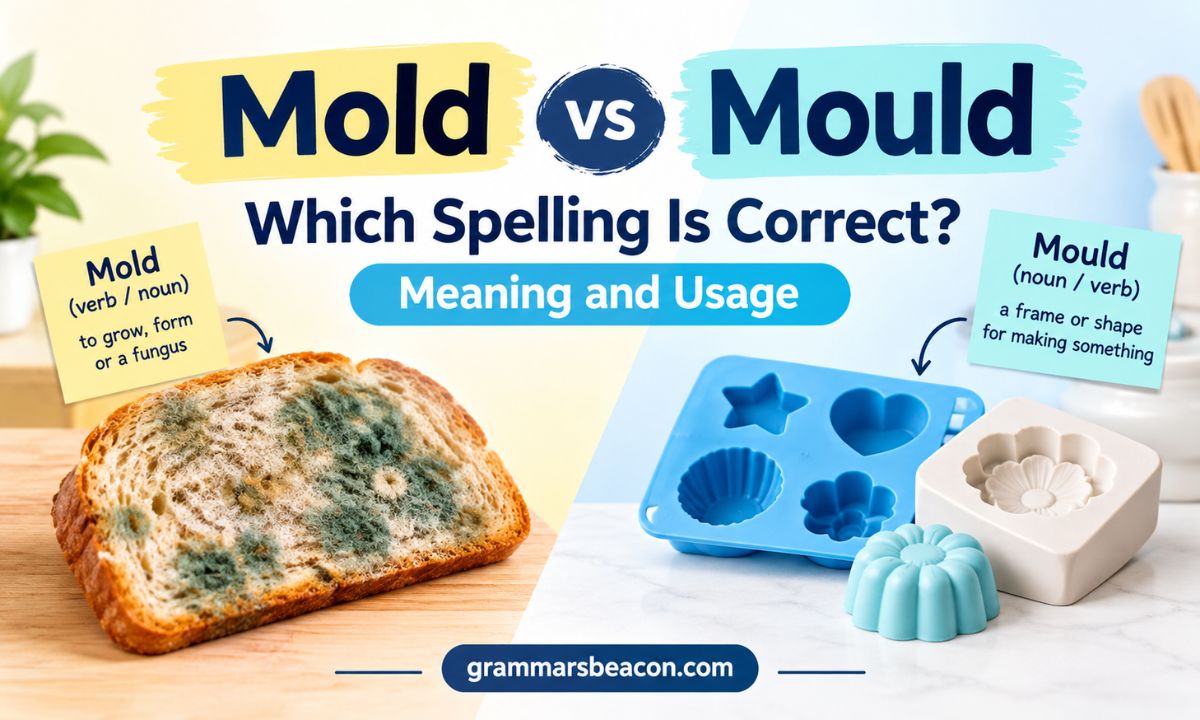
Both spellings are correct. Mold is the standard spelling in American English, and mould is the standard in British English. The meaning is identical, so the only real question is which spelling suits your audience.
This guide explains the meaning of mold and mould, how usage differs across regions, and how to pick the right spelling every time.
Mould Definition
Mould is the British, Australian, and most Commonwealth spelling of the word mold. It has three main meanings:
- A fuzzy fungal growth on damp or decaying surfaces
- A hollow container used to shape a material
- To shape or influence something
In short, mould and mold are the same word written two ways. Neither one is a typo.
Molding or Moulding
The same split carries over to related words. Americans write molding, and British writers use moulding. It works the same way for molded and moulded, and for moldy and mouldy.
| American English | British English |
| mold | mould |
| molding | moulding |
| molded | moulded |
| moldy | mouldy |
| moldable | mouldable |
Is It Mold vs Mould?
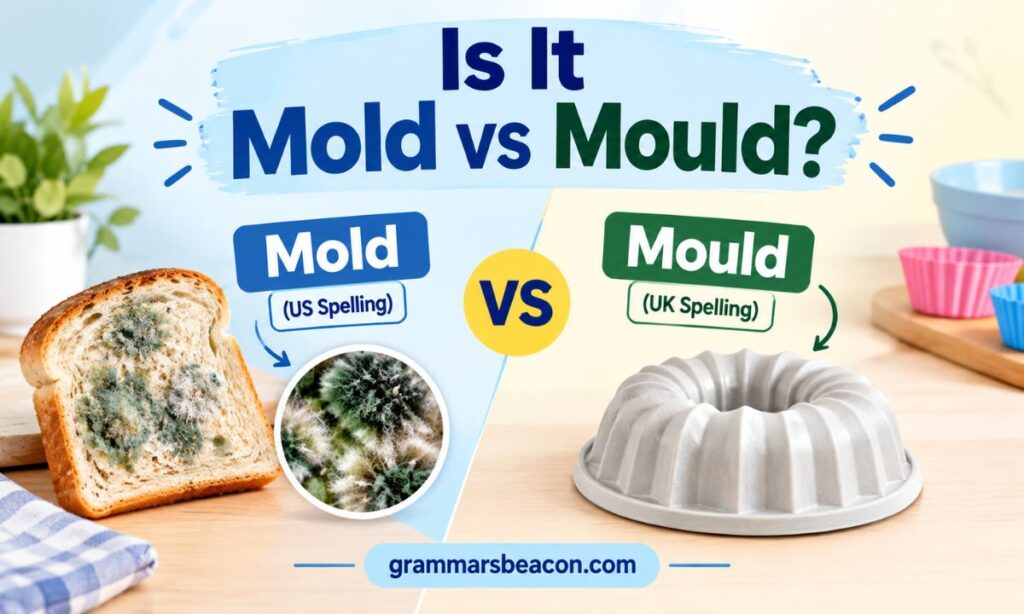
Yes, it is a spelling difference and nothing more. The choice depends on where your readers live. Use mold for a US audience and mould for readers in the UK, Australia, New Zealand, India, and much of Europe.
The key rule is consistency. Pick one spelling and keep it throughout your document.
What Does Mold Mean?
Mold covers several meanings, and context tells you which one is meant.
Mold as a Fungus
Mold is a type of fungus that grows as tiny filaments called hyphae. It thrives in warm, damp, poorly ventilated places. Common examples include the green fuzz on old bread and the dark patches on a shower curtain.
Mold as a Shape or Form
A mold is also a hollow container that gives shape to liquid or soft material. Think of a gelatin mold, a chocolate mold, or a metal casting mold. Once the material sets, it keeps the shape of the container.
Mold as a Verb
To mold something means to shape it or influence its development. You can mold clay with your hands. You can also mold a young employee’s skills through good coaching.
What Does Mould Mean?
The meanings of mould mirror those of mold exactly.
Mould as Fungus
In British English, mould describes the same fungal growth you would see on cheese, fruit, or bathroom walls. A sentence like “There is black mould behind the wardrobe” is a typical UK example.
Mould as a Container
A mould is a tool that shapes material. A jelly mould, a candle mould, and a plaster mould all fit this meaning. British bakers often reach for a cake mould or a pudding mould.
Mould as a Verb
To mould means to form or shape. A potter moulds clay, and a mentor moulds a team’s attitude. The idea is the same as in American usage.
Mold vs Mould What’s the Difference?
There is no difference in meaning, pronunciation, or grammar. The only difference is regional spelling.
| Feature | Mold | Mould |
| Meaning | Fungus, container, to shape | Fungus, container, to shape |
| Pronunciation | /moʊld/ | /moʊld/ |
| Main region | United States | UK, Australia, most Commonwealth countries |
| Correct? | Yes | Yes |
Mold vs Mould in American vs British English
Spelling habits depend on the audience, so it helps to know each region’s preference.
American English
Americans use mold for every meaning. Style guides such as the Associated Press and Chicago Manual of Style follow this rule. Dictionaries like Merriam-Webster list mold as the main entry.
British English
British writers use mould. Oxford and Cambridge dictionaries treat mold as an American variant. UK news sites, government pages, and home improvement guides use mould consistently.
Canadian English
Canadian spelling is a mix of American and British habits. Canadians generally write mould, though mold appears often because of US influence. Canadian government and health websites tend to favor mould, so follow your publisher’s style guide.
Australian English
Australia follows the British pattern. Mould is standard in books, news, and building advice. You will rarely see mold in Australian publications.
International Writing Tips
If you write for a global audience, these habits help:
- Decide on one regional standard before you start.
- Set your word processor’s language to match.
- Check your brand or publisher style guide.
- Keep related words consistent (mould, moulding, mouldy).
- Do not switch spelling halfway through a page.
Mold vs Mould Meaning in Different Contexts
The word shows up in many everyday situations. The meaning stays the same, and only the spelling changes.
Mold vs Mould Fungus
Mold and mould both refer to a multicellular fungus that breaks down organic matter. It plays a useful role in nature by recycling dead plants and animals. Indoors, it becomes a nuisance and sometimes a health concern.
Mold vs Mould Spores
Spores are the microscopic particles that mold releases to reproduce. They float through the air and settle on damp surfaces. Both spellings describe the same spores, and they are found almost everywhere, indoors and out.
Mold vs Mould in Bathroom
Bathrooms are prime spots for growth because of steam and poor airflow. Look for dark spots on grout, silicone seals, and ceilings. An extractor fan and regular cleaning reduce the risk.
Mold vs Mould on Food
Mold on food appears as fuzzy patches in green, white, blue, or black. Soft foods such as bread, yogurt, and berries should be thrown out once spoiled. Hard cheese can sometimes be saved by cutting away a generous margin around the spot, but food safety agencies advise caution.
Mold vs Mould in Manufacturing
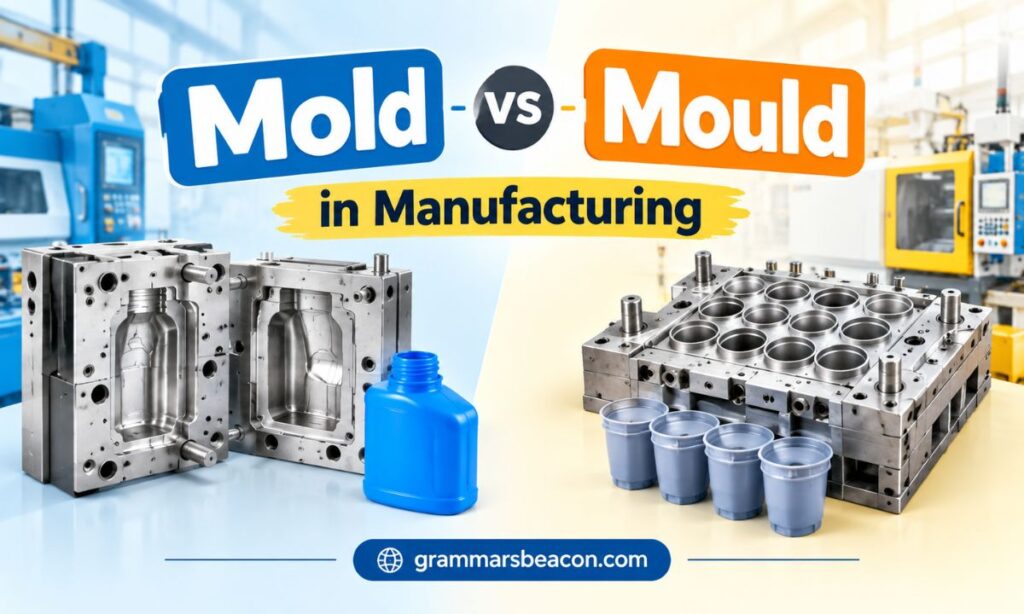
In factories, a mold is a shaped cavity or form used to produce identical parts. Plastic, metal, glass, rubber, and concrete products all start this way. Manufacturers in the US say mold, while UK firms say mould.
Common Manufacturing Molds
- Injection mold: Melted plastic is forced into a cavity and cooled.
- Blow mold: Air inflates heated plastic to make bottles and containers.
- Compression mold: Heat and pressure shape rubber or thermoset materials.
- Die casting mold: Molten metal fills a steel die under pressure.
- Rotational mold: A rotating shell coats the inside with plastic for large hollow items.
- Thermoforming mold: Heated plastic sheets are pulled over a form.
Mold vs Mould in Baking
Bakers use molds to give cakes, breads, and desserts their shape. American bakers say “bundt mold” or “silicone mold.” British bakers say “cake mould” or “jelly mould.”
Read More: Parents’ vs Parent’s
Baking also brings a warning. Bread stored in a humid kitchen grows mould quickly, so keep loaves in a cool, dry place.
Mold vs Mould in Cooking
Cooks use molds for aspic, panna cotta, rice, and ice cream. A ring mold, for example, gives a neat presentation to plated dishes.
Some mold is even desirable. Blue cheese, Brie, and Camembert owe their character to safe, cultivated molds. Salami and certain soy products also rely on beneficial cultures.
Mold vs Mould in Construction
In building, the word has two uses. First, molding (or moulding) is decorative trim such as crown molding, baseboard, and door casing. Second, mold in a building means fungal growth caused by moisture.
Builders also use molds, often called formwork, to shape poured concrete into walls, beams, and slabs.
Mold or Mould on Walls
Wall mold usually signals a moisture problem. Common causes include leaks, condensation, poor insulation, and rising damp.
Follow these steps if you spot it:
- Find and fix the water source first.
- Wear gloves, goggles, and a mask.
- Clean small patches with detergent and water.
- Dry the area completely.
- Call a professional for patches larger than about 10 square feet or for repeated growth.
Keeping indoor humidity between 30 and 50 percent is a widely recommended way to prevent regrowth.
Mold or Mould in Medicine
Mold matters in health for two reasons. Some people develop allergies, asthma flare-ups, or irritated airways after exposure to spores. People with weakened immune systems face higher risks of infection.
Mold has also helped medicine. Penicillin, one of the first antibiotics, came from the Penicillium mold, discovered by Alexander Fleming in 1928. Anyone with ongoing symptoms should speak to a doctor rather than self-diagnose.
Origin and History of Mold and Mould
The word has a long history in English. Both senses trace back to Middle English. The container sense is linked to Old French and the Latin word modulus, meaning a small measure. The fungus sense likely came from Scandinavian roots.
The mould spelling was standard in Britain for centuries. In the early 1800s, American lexicographer Noah Webster championed simpler spellings, and mold became the American norm. This is the same reform that gave us color and honor.
Why Spell Checkers Suggest Different Spellings

Spell checkers follow the language setting of your device or document. If your software is set to English (US), it flags mould as an error. If it is set to English (UK), it flags mold.
To fix this, change the proofing language in your editor. It is a quick step that avoids inconsistent spelling.
Common Mistakes People Make
Mixing US and UK Spellings
Writing “mould” in one paragraph and “mold” in the next looks careless. Stay with a single standard from start to finish.
Assuming One Spelling Is Wrong
Neither spelling is a mistake. Correcting a British writer’s mould to mold is an error of its own.
Ignoring Your Audience
A UK homeowner searching for “black mould removal” will likely not search for mold. Match your spelling to your readers and their search habits.
Confusing Mold With Molding
Mold is the noun or verb for the fungus or shaping tool. Molding is the process of shaping, or the decorative trim in a room. Do not swap them.
Similar American and British Spelling Differences
Mold and mould belong to a larger pattern.
| American | British |
| color | colour |
| flavor | flavour |
| neighbor | neighbour |
| favorite | favourite |
| smolder | smoulder |
| plow | plough |
| center | centre |
| defense | defence |
| gray | grey |
| organize | organise |
Mold or Mould Examples
Home Inspection
- “The inspector found mold under the kitchen sink.” (US)
- “The surveyor noted mould around the window frames.” (UK)
Read More: Sponser vs Sponsor
Construction
- “The crew installed crown molding in the living room.” (US)
- “The joiner fitted decorative moulding along the ceiling.” (UK)
Baking
- “Grease the mold before pouring in the batter.” (US)
- “Tip the sponge out of the mould once it cools.” (UK)
Gardening
- “Leaf mold improves soil structure.” (US)
- “Leaf mould makes an excellent mulch.” (UK)
School Writing
- “Teachers help to mold young minds.” (US)
- “Good teachers mould young minds.” (UK)
Business Writing
- “Our team will mold the strategy around customer feedback.” (US)
- “We aim to mould the strategy around customer feedback.” (UK)
Mold or Mould in a Sentence
Here are quick examples in both spellings:
- Damp air lets mold spread across the ceiling.
- Damp air lets mould spread across the ceiling.
- She poured the chocolate into a heart shaped mold.
- She poured the chocolate into a heart shaped mould.
Tips for Choosing the Correct Spelling
- Use mold for US readers and mould for UK, Australian, and most Commonwealth readers.
- Check your publisher’s or client’s style guide.
- Match your spell checker language to your audience.
- Stay consistent across the entire document.
- When writing for a mixed audience, follow the region where most readers live.
Is Mold or Mould More Common?
Globally, mold is more common in written English because of the size of the US audience. In the UK, Australia, and New Zealand, mould is the overwhelming favorite. Canada leans toward mould, though mold remains widely seen.
Conclusion
Mold and mould are two spellings of one word. Mold belongs to American English, and mould belongs to British, Australian, and most Commonwealth writing. Canadian English uses both, with a lean toward mould.
Choose the spelling that fits your readers, set your spell checker to match, and stay consistent. Do that, and your writing will look polished and professional wherever it is read.











1 thought on “Mold vs Mould: Which Spelling Is Correct? Meaning and Usage”