
You are typing a sentence, you reach for a strong word to describe something spotless, and then you freeze. Is it “emaculate” or “immaculate”? That small pause happens to plenty of confident writers.
This guide settles the question fast. You will learn the correct spelling, the meaning, the origin, and simple tricks to get it right every time. You will also find real example sentences, comparison tables, and a short FAQ.
The Short Answer?
Immaculate is the correct spelling. Emaculate is a misspelling.
The word starts with “im,” not “e.” It is spelled i-m-m-a-c-u-l-a-t-e, with two m’s and one c.
Quick reference:
| Spelling | Status |
| Immaculate | Correct |
| Emaculate | Incorrect |
| Imaculate | Incorrect (missing an m) |
| Immaculete | Incorrect |
Immaculate Meaning: What Does It Actually Mean?
Immaculate describes something perfectly clean, neat, or free from flaws. It can be used for a room, an outfit, a record, or a performance.
The word carries a strong tone. It suggests there is not a single spot, stain, or mistake to be found.
Simple Breakdown
- Part of speech: adjective
- Core meaning: perfectly clean or spotless
- Extended meaning: completely free from error, fault, or blemish
- Pronunciation: ih-MAK-yuh-lit
- Tone: positive, often admiring
Immaculate or Emaculate
If you are choosing between the two, choose immaculate every time.
Search engines even show “emaculate” as a common typo. That does not make it acceptable. Readers, teachers, and editors will spot it, and spell checkers will flag it in red.
Here is a fast test. If you can replace the word with “spotless” or “flawless” and the sentence still works, the word you want is immaculate.
Immaculate Definition in Grammar and Usage
Immaculate Definition (Grammar)
In grammar, immaculate is an adjective. It modifies a noun or follows a linking verb. It is a gradable word in casual speech, but many style guides treat it as absolute, so “most immaculate” is best avoided in formal writing.
Example:
- She kept an immaculate kitchen.
- The hotel room was immaculate.
Immaculate Adjective Meaning in Context
The meaning shifts slightly depending on what it describes.
- Physical objects: clean and free from dirt
- Behavior or records: free from fault or misconduct
- Skills or work: performed without errors
- Religious usage: free from sin, as in the phrase Immaculate Conception
Context tells the reader which shade of meaning you intend.
Is “Emaculate” a Real Word?
Is emaculate a word?
No. Emaculate is not recognized as a standard English word in modern dictionaries. Major references list only “immaculate.”
Some very old or obscure sources may carry rare variants, but you will not find it in everyday usage, academic writing, or professional communication.
Emaculate Meaning
Because it is a misspelling, emaculate has no official meaning. When people type it, they almost always mean “immaculate,” which means spotless or flawless.
Why This Matters
Small spelling errors can weaken trust. A single typo in a résumé, product description, or blog post can make the whole piece feel careless.
Getting this one word right protects your credibility, especially in professional writing.
What Does Emaculate Mean
Emaculate does not mean anything on its own. It is simply an incorrect version of immaculate.
If you see it in a text message, a social media caption, or an email, read it as “immaculate.” If you see it in your own draft, fix it before you publish.
Emaculate vs Immaculate Difference (Side-by-Side)
| Feature | Emaculate | Immaculate |
| Correct spelling | No | Yes |
| Found in dictionaries | No | Yes |
| Part of speech | None | Adjective |
| Meaning | None | Spotless, flawless |
| Safe for formal writing | No | Yes |
| Origin | Phonetic mistake | Latin immaculatus |
The difference comes down to one thing. One is a real word with a long history. The other is a slip of the keyboard.
Why Do People Misspell “Immaculate”?
Common Reasons
Several patterns cause this mistake:
- Sound confusion: the opening “im” is short and soft when spoken quickly, so it can sound like “eh” or “ee”
- Double letter doubt: many people are unsure whether a word takes one m or two
- Autopilot typing: fast typing often leads to dropped letters
- Lack of visual exposure: people hear the word more than they read it
- Confusion with similar prefixes: “e” prefixes (like in “emerge”) feel natural
Related Examples
The same problem shows up in other words:
- Embarrass (often written “embarass”)
- Accommodate (often written “accomodate”)
- Occurrence (often written “occurence”)
- Necessary (often written “neccessary”)
Double letters are a classic trouble spot in English spelling.
The Origin of “Immaculate” (This Makes It Stick)
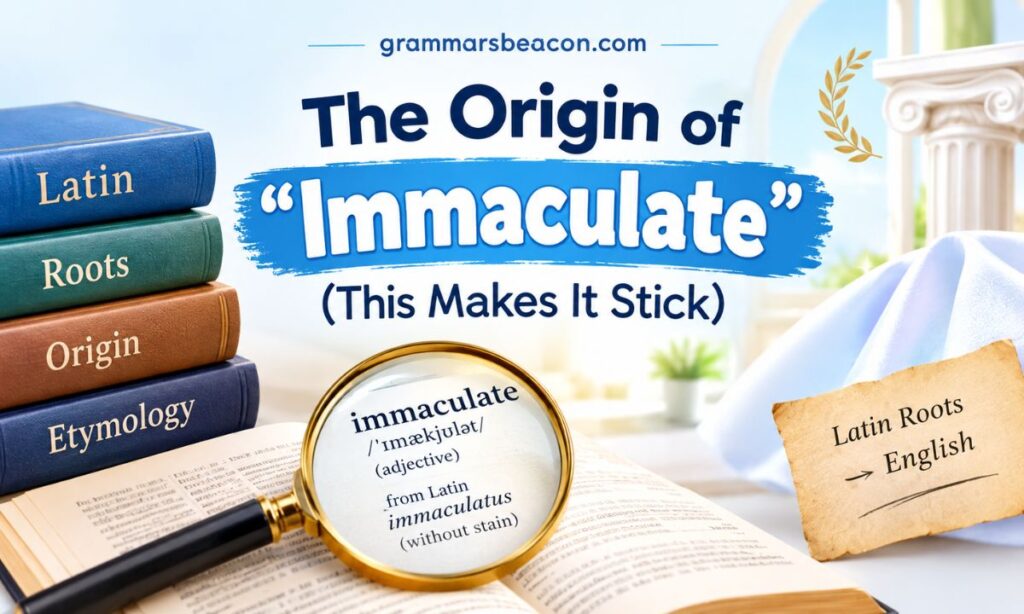
Immaculate Word Origin
Immaculate comes from the Latin word immaculatus. It is built from two parts:
- in- meaning “not”
- macula meaning “spot” or “stain”
So the word literally means “not spotted.” It entered English in the fifteenth century and kept its focus on purity and cleanliness.
The word also became widely known through the phrase “Immaculate Conception,” a doctrine in the Catholic Church that was formally defined in 1854.
Why This Helps
The Latin root gives you a built-in clue. The prefix is “in,” which changes to “im” before the letter m. That is why you get im + maculate.
Once you see that structure, the double m makes sense. The first m ends the prefix. The second m begins the root.
How to Spell Immaculate Correctly (Without Second Guessing)
Memory Hacks That Work
Try one of these:
- Split it: im + mac + u + late
- Think “I’m Macy”: picture someone named Macy who keeps everything clean
- Count the m’s: two m’s sit side by side, like two spotless towers
- Remember the root: macula means spot, and the word means “not spotted”
- Say it slowly: ih-mac-yoo-let, giving the first syllable its full sound
Quick Checklist
Before you hit publish, check that your spelling passes these tests:
- Does it start with “im”?
- Does it have two m’s in a row?
- Does it have only one c?
- Does it end with “ate”?
If you can say yes four times, you are safe.
How to Use Immaculate in a Sentence (Real Examples)
Immaculate in a Sentence (Everyday Use)
- Her apartment was always immaculate, even during a busy week.
- He arrived in an immaculate suit.
- The chef insisted on an immaculate work area.
Immaculate Example Sentences by Context
Cleanliness
- The hospital corridors were immaculate.
- After hours of scrubbing, the bathroom looked immaculate.
- Guests praised the immaculate pool area.
Performance
- The pianist gave an immaculate performance.
- The team played an immaculate first half.
- Her presentation was immaculate from start to finish.
Appearance
- The bride’s hair and makeup were immaculate.
- He kept an immaculate lawn all summer.
- The vintage car was in immaculate condition.
When to Use Immaculate in English
Best Situations
Use immaculate when you want to give strong praise. It works well in:
- Hotel and restaurant reviews
- Real estate listings
- Product descriptions
- Performance reviews
- Formal and professional writing
- Descriptive fiction
The word adds polish. It signals that you noticed the details.
Avoid Overuse
Because it is a powerful word, repeating it weakens its effect. Follow these habits:
- Use it once or twice per page, not in every paragraph
- Save it for things that truly deserve it
- Swap in a synonym when the tone allows
- Avoid using it for average results
If everything is immaculate, nothing is.
Read More: Mold vs Mould
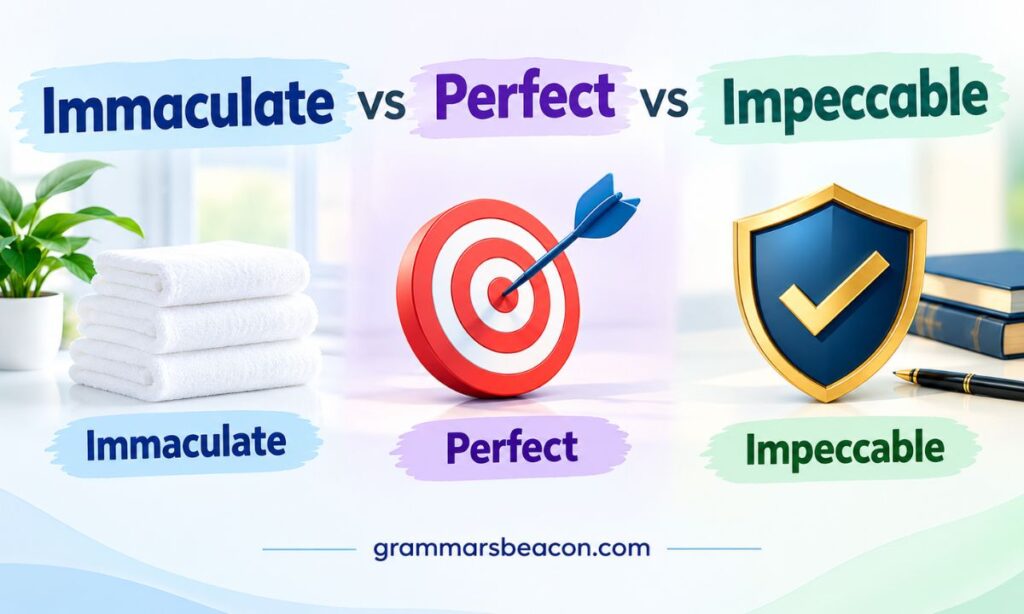
Immaculate vs Perfect vs Impeccable
Immaculate vs Perfect
Perfect means having no flaws at all and can apply to nearly anything, including ideas and plans. Immaculate leans toward cleanliness and visible neatness.
You can have a perfect plan. You would rarely call a plan immaculate.
Immaculate vs Impeccable
Impeccable usually describes behavior, taste, manners, or style. Immaculate more often describes cleanliness or spotless condition, though the two overlap.
Someone can have impeccable manners and an immaculate home.
Comparison Table
| Word | Best used for | Example |
| Immaculate | Cleanliness, condition, spotless results | An immaculate kitchen |
| Perfect | Overall flawlessness in general | A perfect score |
| Impeccable | Manners, taste, style, precision | Impeccable service |
Words Similar to Immaculate (Synonyms and Antonyms)
Immaculate Synonym List
- Spotless
- Pristine
- Flawless
- Unblemished
- Squeaky clean
- Spick and span
- Impeccable
- Pure
- Faultless
- Untarnished
Immaculate Antonyms
- Dirty
- Stained
- Flawed
- Messy
- Sullied
- Blemished
- Tarnished
- Unkempt
- Faulty
Knowing both sides helps you choose the right word for your tone.
Common Spelling Mistakes Like “Emaculate”
Other Grammar Spelling Errors
Many everyday words trip people up in similar ways. Here are the ones editors see most often:
| Incorrect | Correct |
| Definately | Definitely |
| Seperate | Separate |
| Recieve | Receive |
| Untill | Until |
| Wierd | Weird |
| Acheive | Achieve |
| Emaculate | Immaculate |
Why It Matters
Spelling shapes first impressions. A single error can lower trust with readers, clients, or hiring managers.
For website owners, spelling also affects search performance. Clean, accurate content signals quality and professionalism.
One Word, Big Impact
Let us compare the two spellings as if they were candidates applying for the same job.
Candidate A
Emaculate. Not found in dictionaries. Carries no meaning. Triggers spell checkers. Damages credibility. Not recommended.
Candidate B
Immaculate. Backed by Latin roots. Listed in every major dictionary. Clear meaning. Adds polish to writing. Hired.
One correct spelling can change how professional your work looks.
How to Remember the Spelling of Immaculate (For Good)
Proven Techniques
- Write it five times. Physical repetition builds muscle memory.
- Use it in a sentence today. Real use makes it stick.
- Create a mnemonic. Try “I’m Mac, and I’m always clean.”
- Use flashcards. Put the correct spelling on one side and the common mistake on the other.
- Read it often. Notice it in reviews and articles.
- Turn on spell check, but do not rely on it alone. Learn the reason behind the spelling.
Spelling Confusion Immaculate
Confusion around this word is common, and it is easy to fix. Remember three points:
- The prefix is “im,” not “e”
- The word has two m’s
- The root means “spot,” so the word means “without a spot”
Once those points click, the word becomes hard to misspell.
Key Takeaways (Quick Breakdown)
- Immaculate is the only correct spelling
- Emaculate is a common misspelling with no meaning
- It comes from Latin immaculatus, meaning “not spotted”
- It is an adjective describing something spotless or flawless
- Use it to praise cleanliness, performance, and appearance
- Do not overuse it, and pick synonyms when needed
- Remember “im + maculate” to lock in the double m
Final Thought
The choice between emaculate and immaculate is simple. Immaculate wins, and now you know why.
With its Latin roots, clear meaning, and wide range of uses, immaculate is a word worth spelling correctly. Keep the “im + maculate” trick in mind, use the checklist before publishing, and your writing will look as polished as the word itself.










1 thought on “Emaculate vs Immaculate: Correct Spelling, Meaning, and Usage (2026)”