
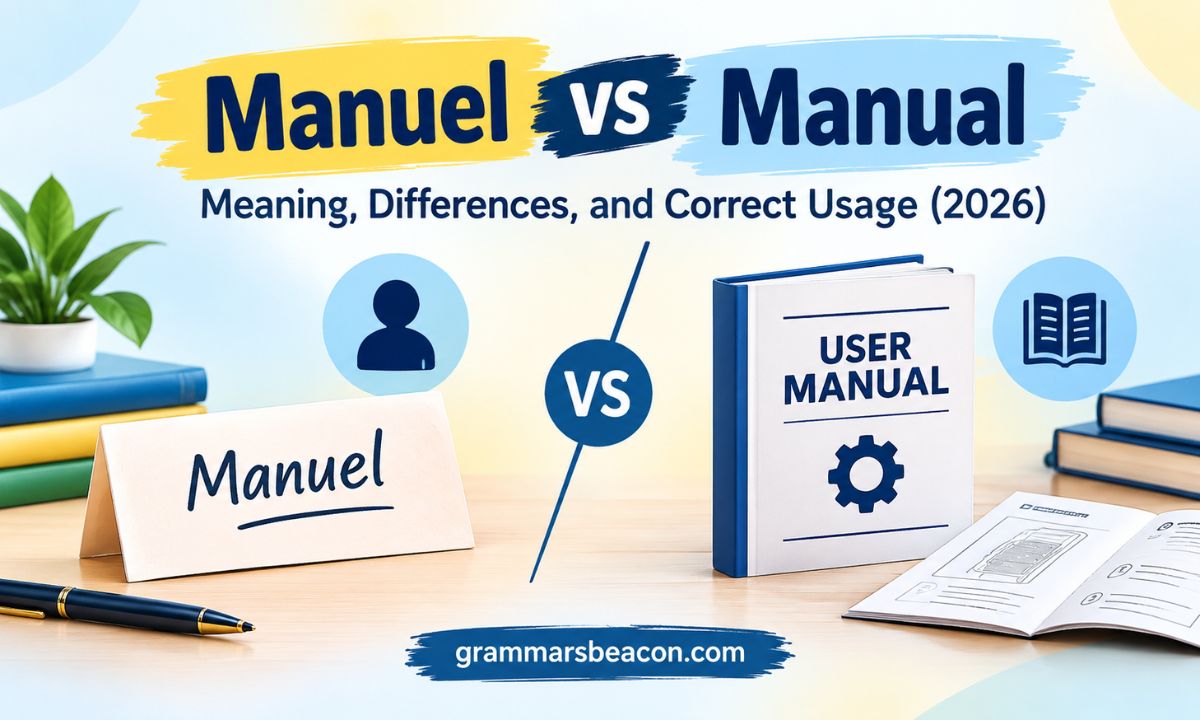
Have you ever typed “user manuel” and wondered if it looked wrong? You are not alone. Manuel vs manual is one of the most common spelling mix-ups in English, because the two words differ by just one letter. This guide explains what each word means, when to use it, and how to get it right every time.
Manuel
Manuel is a proper noun. It is a given name, mainly used in Spanish and Portuguese speaking countries. It is the local form of Emmanuel, a Hebrew name often translated as “God is with us.”
Because it is a name, Manuel always starts with a capital letter. It never describes a book, a task, or a gear system in English.
Manuel vs Manual
The difference is simple. Manuel names a person. Manual describes something done by hand, or it names an instruction book.
Quick Comparison
| Feature | Manuel | Manual |
| Part of speech | Proper noun | Noun and adjective |
| Meaning | A male first name | By hand, or an instruction guide |
| Capitalized? | Always | Only at the start of a sentence |
| Origin | Spanish and Portuguese form of Emmanuel | Latin manualis, from manus (hand) |
| Example | “Manuel called me.” | “Read the manual first.” |
| Correct in English writing? | Only as a name | Yes, in all general uses |
Simple Rule to Remember
If you mean a person, write Manuel. If you mean anything else, write manual.
A quick test: can you replace the word with “Mark” or “Maria”? If yes, use Manuel. If not, use manual.
What Does Manual Mean?
Manual is a flexible word. It works as both an adjective and a noun, and both meanings connect back to the idea of hands.
Manual Definition in English
As an adjective, manual describes work or operation done by hand, not by a machine or automatic system. It can also mean physical effort, or anything related to the hands.
As a noun, a manual is a book or guide that explains how to use, fix, or do something.
The word comes from the Latin manualis, which grew out of manus, meaning hand. Other words share that root, such as manufacture, manuscript, and manicure.
Manual Meaning as a Noun
When manual is a noun, it usually points to a written guide. It tells you how to operate a device, follow a process, or learn a skill.
Common Examples
Here are the most frequent types of manuals:
- User manual for phones, laptops, and appliances
- Owner’s manual for cars and motorcycles
- Instruction manual for furniture assembly
- Employee manual or staff handbook
- Training manual for new hires
- Repair or service manual for technicians
- Style manual for writers and editors
In music, a manual can also mean a keyboard on a pipe organ that is played by hand.
Examples of Manual in a Sentence
- The manual explains how to reset the router.
- I found the answer on page 12 of the owner’s manual.
- Every new nurse receives a training manual on day one.
- She wrote a short manual on customer support.
Manual Meaning as an Adjective
As an adjective, manual describes how something is done. It is the opposite of automatic, mechanical, or computer controlled.
Common Uses
- Manual labor: work that needs physical effort
- Manual transmission: a gearbox shifted by the driver
- Manual control: a setting adjusted by hand
- Manual entry: typing data instead of importing it
- Manual dexterity: skill with the hands
The adverb form is manually, as in “The report was updated manually.”
Example Sentences
- He prefers manual work over desk jobs.
- My camera has a manual focus ring.
- The clerk checked each invoice by manual review.
- Surgeons need excellent manual dexterity.
What Does Manuel Mean?
Manuel has no dictionary definition as a common English word. It functions only as a name.
Manuel Meaning
Manuel is a masculine name of Hebrew origin that came into Spanish and Portuguese through Emmanuel. Its traditional meaning is “God is with us.” You will find it in many countries, and it is also used as a surname in some regions.
In French, manuel is a real word, but it means manual in both senses: hand related and a textbook. That fact explains part of the confusion, since French and English spellings differ by only a letter.
Is Manuel a Word in English?
No. Manuel is not a general English word. English dictionaries list it, at most, as a personal name. If you are writing about instructions or hand operated tasks in English, the correct spelling is manual.
Example Sentences
- Correct: Manuel is joining our design team next week.
- Correct: Please ask Manuel for the project files.
- Incorrect: Please check the user manuel.
- Incorrect: This car has a manuel gearbox.
Why Writers Confuse Manuel vs Manual

The mix-up is natural. Both words sound almost the same when spoken quickly, and both appear often in daily life.
Main Reasons for the Mistake
- Similar spelling. One vowel change is easy to miss.
- Similar sound. In casual speech, the endings blur together.
- Familiarity with the name. Many people see Manuel more often than they think.
- Autocorrect. Phones may keep a name spelling because it looks valid.
- Foreign language influence. Speakers of French may carry over the spelling manuel.
- Fast typing. Small slips slip past when you do not proofread.
Why Manuel Is Incorrect Spelling in Most Writing
In nearly every situation involving instructions, tasks, or vehicles, manuel is a typo. Search engines, editors, and readers all treat it as an error unless a person is being named.
Incorrect Example
“Before installing the software, please read the manuel and disable manuel updates.”
Correct Version
“Before installing the software, please read the manual and disable manual updates.”
Notice that both uses in the sentence are common ones. One is a noun, and one is an adjective. Neither refers to a person, so manual is right both times.
Situations Where Manual Is Used
Manual shows up in many parts of everyday life. Here are the biggest areas where you will see it.
Technology and Software
In tech, manual can describe both documentation and process.
- A software manual explains features and settings.
- Manual testing means a human checks a product without automated scripts.
- Manual backup means you start the copy yourself.
- Manual configuration means you adjust settings by hand.
Writers in this field should spell it correctly, since a single typo can look careless in technical documentation.
Automotive Industry
Cars are the most common place people meet the word.
- A manual transmission uses a clutch and gear stick.
- The owner’s manual lists maintenance schedules and warning lights.
- A service manual guides mechanics through repairs.
Drivers sometimes say “stick shift” for a manual car, especially in the United States.
Workplace Training and Documentation
Companies rely on manuals to keep work consistent.
- Employee manual: rules, benefits, and conduct
- Safety manual: procedures for handling hazards
- Operations manual: step by step workflows
- Onboarding manual: a guide for new staff
Clear manuals reduce mistakes, speed up training, and protect both workers and businesses.
Manual vs Automatic Meaning
Manual and automatic are opposites. Manual needs a person to act. Automatic works on its own once it is set up.
| Term | Manual | Automatic |
| Who controls it? | A person | The system |
| Effort needed | Higher | Lower |
| Car example | Driver shifts gears | Car shifts gears |
| Software example | Click to run a task | Task runs on a schedule |
| Best for | Control and precision | Speed and convenience |
Neither is always better. Manual gives you control, while automatic saves time.
Read More: Emaculate vs Immaculate
Manual Book Meaning
A manual book is simply an instruction book. People often say “manual book” in casual speech, though “manual” alone is usually enough. It covers user guides, handbooks, and how-to booklets that come with products or training programs.
Manuel vs Manual Examples in Sentences
The examples below show the difference side by side. Read them out loud to hear how naturally the right word fits.
Sentences Using Manuel
- Manuel finished the report before noon.
- I sent the invitation to Manuel and his sister.
- Our coach, Manuel, will lead the workshop.
- Manuel’s favorite subject is engineering.
- Have you met Manuel from the sales team?
Sentences Using Manual
- The manual is stored in the top drawer.
- Manual data entry takes too long.
- She learned to drive a manual car last year.
- The company updated its safety manual in 2026.
- Some tasks still require manual approval.
A Small Spelling Error With Big Consequences
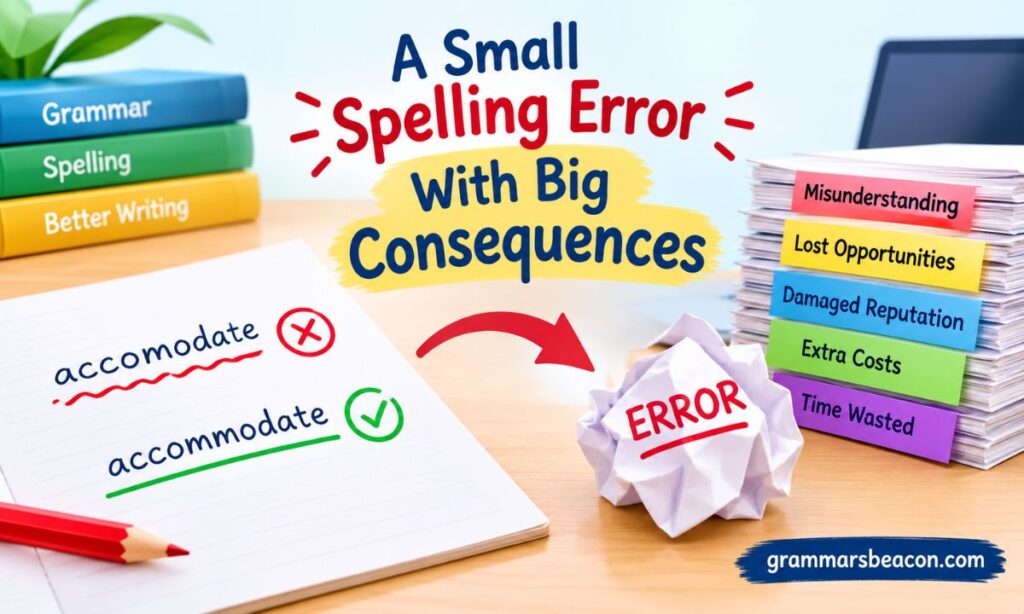
One wrong letter may seem harmless, but it can change how readers see your work. A resume that lists “manuel testing” instead of “manual testing” can cost you credibility. A product page that promises a “user manuel” can lower trust and hurt search visibility.
In professional writing, spelling is a signal of care. Readers may not forgive small errors when the writing is meant to teach or instruct.
Easy Tricks to Remember the Correct Spelling
Trick One
Think of the word “hand.” Manual relates to hands, and both end with a letter pattern you can remember: man-ual. The Latin root manus even starts with “man.”
Trick Two
Remember that the word ends in “al,” like “manual,” “practical,” and “digital.” Words describing a type of thing often end in “al.” Names like Manuel end in “el,” as in Samuel, Daniel, and Gabriel.
Trick Three
Use the name test. If the word can be a person, capitalize it and write Manuel. If it cannot, write manual. You can also picture a book cover: “User Manual” is what you see, never “User Manuel.”
Why Correct Spelling Matters in Writing
Good spelling builds trust. Readers judge accuracy quickly, and even small slips can make content feel rushed. For businesses, bloggers, and students, correct spelling supports authority and helps search engines understand your page.
Effects of Spelling Errors
- Lower credibility with readers
- Confusion about your meaning
- Weaker rankings for search terms
- Poor impressions in job applications
- Extra work fixing mistakes later
Quick Manuel vs Manual Comparison
- Manuel is a name. Capitalize it.
- Manual is an adjective and a noun. Use it for instructions or hand operated tasks.
- Manually is the adverb form.
- If you are unsure, check whether a person is being described.
Other Common English Spelling Confusions
Manuel and manual are not the only pair that trips people up. Watch for these as well:
| Confusing Pair | Quick Difference |
| Affect vs Effect | Affect is usually a verb, effect a noun |
| Their vs There | Their shows ownership, there shows place |
| Principal vs Principle | Principal is a head or main, principle is a rule |
| Stationary vs Stationery | Stationary means still, stationery means paper goods |
| Complement vs Compliment | Complement completes, compliment praises |
| Advice vs Advise | Advice is a noun, advise is a verb |
Reference Cambridge Dictionary Definitions
Cambridge Dictionary and other major references, including Merriam-Webster, Collins, and Dictionary.com, agree on the core meanings of manual. As an adjective, it refers to something done or operated by hand, or work needing physical effort. As a noun, it refers to a book of instructions, especially one that comes with a machine.
None of these references treat manuel as a standard English term. For the most current wording, check the Cambridge Dictionary entry directly.
Final Thoughts:
Manuel vs manual comes down to one clear rule. Manuel is a name, and manual is the word for hand operated work or an instruction guide. Whenever you are writing about products, cars, software, training, or tasks done by hand, choose manual.
Keep the name test in mind, proofread before publishing, and do not rely on autocorrect alone. A small habit like this protects your credibility and keeps your writing clean and professional.











1 thought on “Manuel vs Manual: Meaning, Differences, and Correct Usage (2026)”