
Few spelling questions trip up writers as often as this one. You type “catalog,” your spell checker is fine with it, and then a British colleague says it should be “catalogue.” Who is right?
Both are. This guide explains the difference between catalog and catalogue, when to use each, and how to stay consistent so your writing looks polished and your content ranks well.
Catalog vs Catalogue
Catalog and catalogue are two spellings of one English word. It refers to a systematic list of items, such as products, books, artworks, or data records. As a verb, it means to record or list items in an organized way.
The only real difference is regional spelling. Americans usually write catalog. Most of the English-speaking world outside the United States writes catalogue.
What Is the Difference Between Catalog and Catalogue?
Short answer: spelling, not meaning.
Catalogue is the older, fuller form. It came into English through Old French and Latin from a Greek root meaning “to list.” The shorter catalog spelling became popular in the United States in the 19th century, when American spelling reformers pushed for simpler forms. Noah Webster’s dictionaries helped spread many of these changes.
The Meaning Is Exactly the Same
Both spellings share the same definitions:
- Noun: a complete list of items, often with descriptions or prices
- Noun: a publication that lists products for sale
- Noun: an organized record of a library, museum, or archive collection
- Verb: to make a list or record of items in order
Swapping one spelling for the other never changes the sentence. “Please review the catalog” and “Please review the catalogue” say the same thing.
Catalog vs Catalogue in American and British English
Regional preference is the deciding factor, so it helps to know where each form belongs.
American English
In the United States, catalog is the standard spelling. Major American dictionaries list it first. You will see it in retail, education, publishing, and tech.
American verb forms follow the same pattern:
- cataloged
- cataloging
Most American style guides treat catalogue as a less common variant, though it still appears in some arts, library, and museum settings.
British English
In the United Kingdom, catalogue is the standard spelling. Oxford and Cambridge references list it as the main form. It is also the norm in Australia, New Zealand, India, and South Africa. Canadian English usually leans toward catalogue as well, though catalog appears often in business and tech writing there.
British verb forms keep the extra letters:
- catalogued
- cataloguing
This is part of a larger pattern. Words like dialogue and analogue keep the “ue” ending in British English, while American English often drops it in everyday use. Americans still write dialogue in most contexts, so catalog is a stronger shortening than most.
Catalog vs Catalogue Examples
Seeing both spellings in context makes the choice easier.
| Context | American English | British English |
| Product list | Our spring catalog is online. | Our spring catalogue is online. |
| Verb (past) | She cataloged every book. | She catalogued every book. |
| Verb (present) | He is cataloging the files. | He is cataloguing the files. |
| Library | The library catalog is searchable. | The library catalogue is searchable. |
| Auction | The auction catalog lists 200 lots. | The auction catalogue lists 200 lots. |
Which One Does Google Prefer?
Google does not rank one spelling above the other. Its systems understand that catalog and catalogue are the same word, so a page using one spelling can still appear for searches using the other.
What matters more is search intent and location. Google uses a searcher’s region and language settings to show relevant results. A shopper in London typing “furniture catalogue” will likely see UK pages. A shopper in Texas typing “furniture catalog” will see American pages.
So the SEO move is simple: match the spelling your target audience actually types.
What Does Catalog or Catalogue Mean?
According to standard dictionary definitions, a catalog is an itemized list, often arranged alphabetically or by category. The list can describe products, books, stars, courses, or digital files.
The word works as both a noun and a verb:
- Noun: “The museum published a catalog of its Roman coins.”
- Verb: “A librarian cataloged the new arrivals.”
Common Types of Catalogs
Catalogs show up in almost every industry. Here are the most common kinds:
- Product catalogs: list items for sale with images, descriptions, and prices.
- Library catalogs: record every book, journal, and media item a library holds.
- Museum and art catalogs: document collections or exhibitions.
- Course catalogs: list the classes a school or university offers.
- Data catalogs: organize datasets so teams can find and trust them.
- Mail-order catalogs: printed or digital booklets used for direct sales.
- Astronomical catalogs: list stars, galaxies, and other celestial objects.
- Streaming catalogs: the full library of films or songs on a platform.
Example Sentences
Use these as models for your own writing:
- The retailer mailed its holiday catalog to two million homes.
- I found the old record in the auction catalogue.
- Volunteers are cataloguing the town’s historical photographs.
- The company’s online catalog now includes over 5,000 items.
- Scientists cataloged hundreds of new insect species last year.
- The exhibition catalogue includes essays by three curators.
Catalog or Catalogue: Which Should You Use?
The right answer depends on who is reading your work. Use this quick guide.
Use Catalog If:
- Your audience is mainly in the United States
- You are following American style guides such as AP or Chicago
- You are writing about software, e-commerce platforms, or data tools
- You want a shorter, cleaner spelling for headlines and URLs
- Your website uses American English throughout
Use Catalogue If:
- Your audience is mainly in the UK, Australia, New Zealand, or India
- You follow British style guides or Oxford spelling
- You write for museums, auction houses, galleries, or libraries in those regions
- Your brand voice is traditional or formal
- Your website uses British English throughout
The Most Important Rule
Pick one spelling and use it consistently.
Neither spelling is wrong. Mixing them in the same document is what looks careless. Choose based on your audience, then apply that choice to every heading, paragraph, button, and meta description.
Common Mistakes to Avoid
Even experienced writers slip up. Watch for these errors:
- Mixing spellings in one article. Writing “catalog” in the intro and “catalogue” in the conclusion looks sloppy.
- Mismatching verb forms. Don’t write “catalogued” in an otherwise American text, or “cataloging” in a British one.
- Assuming one is incorrect. Calling catalogue a “mistake” in the US, or catalog a “mistake” in the UK, is inaccurate.
- Misspelling it entirely. Common typos include “catalouge,” “cataloge,” and “catelog.”
- Ignoring your audience. Spelling should serve the reader, not your personal habit.
- Forgetting product names. If a brand uses a specific spelling, such as a company named “The Catalogue,” keep it exactly as written.
- Trusting spell check blindly. Your tool’s language setting decides which spelling it flags, so confirm it is set to the right region.
Real-Life Example: Why Consistency Matters
Imagine a UK furniture company that hires two freelance writers. One writes in British English, the other in American English. The finished site says “Download our catalogue” on the homepage, “Browse the catalog” in the menu, and “Request a catalogue” in the footer.
Nothing is technically incorrect. But visitors see three versions of the same word in one session. That small inconsistency weakens trust, makes the brand look disorganized, and splits the keyword signals across the page.
The fix is easy. The company sets a style guide that says “British English only,” runs a site-wide spelling check, and updates every instance to catalogue. Within weeks, the site reads cleanly and the brand voice feels unified.
This is a common pattern with global teams. A short style guide entry saves hours of editing later.
Catalog vs Catalogue Comparison Table
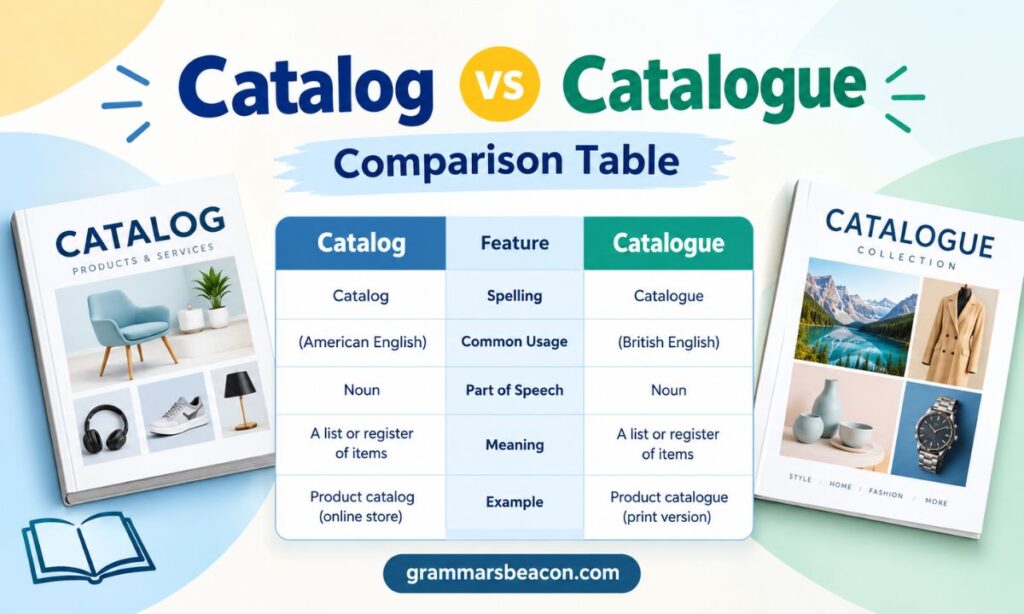
| Feature | Catalog | Catalogue |
| Meaning | List of items | List of items |
| Part of speech | Noun and verb | Noun and verb |
| Main region | United States | UK, Australia, NZ, India, South Africa |
| Canada | Common in business and tech | Common in general writing |
| Verb forms | cataloged, cataloging | catalogued, cataloguing |
| Letters | 7 | 9 |
| Dictionary status | Main US spelling | Main UK spelling |
| Tone | Modern, simple | Traditional, formal |
| Common in tech | Very common | Less common |
| Correct? | Yes | Yes |
Usage Statistics (2025–2026)
Exact search counts change monthly, so treat the points below as general trends rather than fixed numbers. Always check current figures in Google Trends or Google Keyword Planner for your own market.
- Catalog dominates in the US. Searches and published content in American English lean heavily toward the one-L spelling.
- Catalogue leads in the UK and Commonwealth markets. British, Australian, and Indian searchers favor the longer form.
- Tech and software terms favor catalog. Phrases such as “product catalog,” “data catalog,” and “service catalog” appear in this spelling even in many international teams, because platforms and documentation follow American conventions.
- Arts and heritage favor catalogue. Exhibition and auction material often uses the longer form.
- Both spellings are searched globally. Many people type whichever form they see first, so covering the secondary spelling once or twice in a page can capture extra long-tail traffic.
A practical tip: run both terms in Google Trends with your target country selected. The chart will show you which spelling your audience prefers right now.
FAQs
Q1: Is catalog correct?
Yes. Catalog is the standard spelling in American English and is fully accepted in dictionaries.
Q2: Is catalogue wrong?
No. Catalogue is the standard spelling in British English and is widely used outside the US.
Q3: Do they have different meanings?
No. Both spellings mean the same thing, whether used as a noun or a verb.
Q4: Which spelling should I use for SEO?
Use the spelling your target audience searches for. Google treats them as the same word, so audience match matters most.
Q5: Can I use both spellings in one article?
You can mention both once to explain the difference, but otherwise stick to one spelling for consistency.
Q6: Is catalog used in business writing?
Yes. Catalog is very common in American business, retail, and tech writing, and it is often used in global software documentation too.
Conclusion
Catalog and catalogue mean the same thing. The only difference is spelling, shaped by American and British English habits.
Write catalog for American readers and catalogue for readers in the UK and most Commonwealth countries. Check your verb forms, keep your spelling consistent, and let your audience guide the final choice. Whichever one you use, using it the same way every time is what makes your writing look professional.











1 thought on “Catalog vs Catalogue: Understanding The Difference And Usage”