
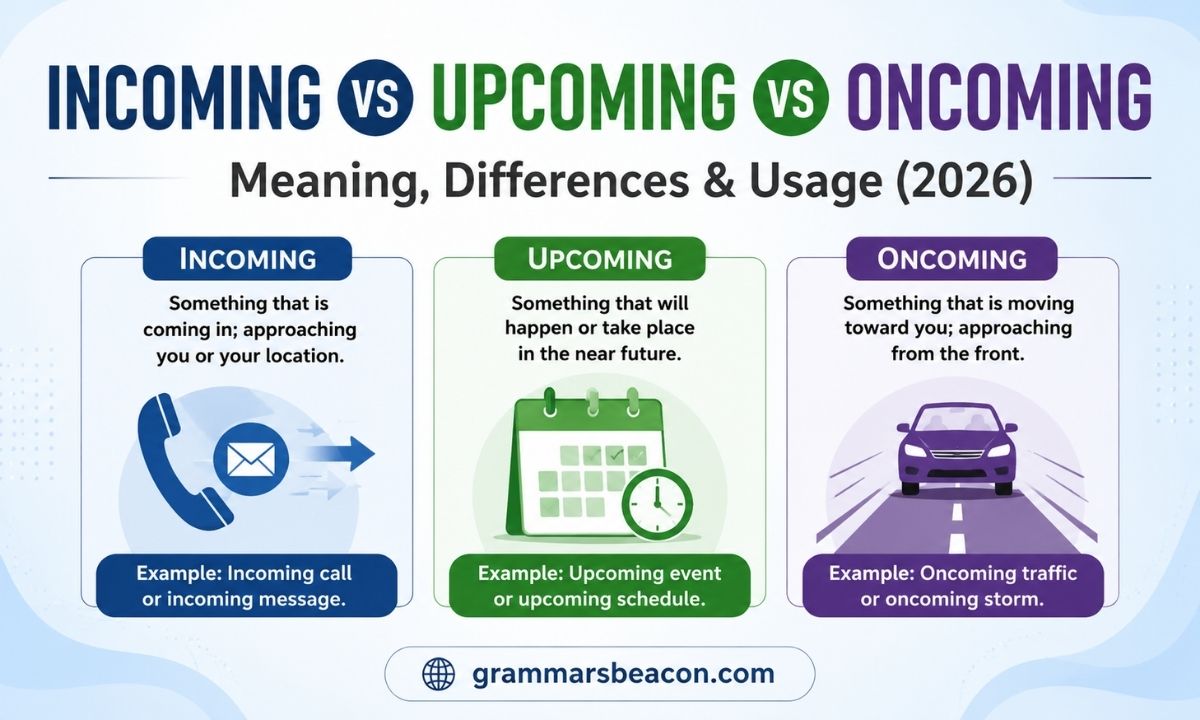
English is full of words that look like cousins but behave like strangers. Incoming, upcoming, and oncoming are a perfect example. They share a root idea of “something is on its way,” yet each one belongs to a completely different situation.
Mix them up in an email, a report, or a casual chat, and your sentence can sound off, even if the meaning is technically understandable. This guide breaks the three words apart in plain language, with real examples, comparison tables, and memory tricks you can actually use.
By the end, you will never have to pause and guess again.
Oncoming vs Upcoming
Before going deep, here is the fastest way to separate the two most commonly confused terms.
- Upcoming describes something planned for a future date, like a meeting, wedding, or product launch. Nothing physically moves; it simply sits on a calendar.
- Oncoming describes something in physical motion, heading straight toward you, such as traffic, a storm, or a moving object.
If you can circle it on a calendar, it is upcoming. If you can see it approaching in real space, it is oncoming.
Understanding “Incoming”, “Upcoming”, and “Oncoming”
All three words describe something that has not fully arrived yet, but the similarities stop there. The real difference comes down to three questions:
- Is it arriving at a device, location, or person right now?
- Is it scheduled for a future date without any physical movement?
- Is it physically moving toward you through space?
Answer those honestly, and the correct word becomes obvious almost every time. Let’s look at each term individually.
What “Incoming” Really Means
Definition of Incoming
Incoming describes something that is arriving, entering, or being received at a specific point, whether that point is a phone, an inbox, a building, or a person. It can happen instantly or within a very short window, but the focus is always on the act of arrival itself.
When You Use “Incoming”
Incoming shows up constantly in modern life because so much of what we deal with daily is about receiving something, not scheduling it.
Tech & Communication
Phones, apps, and software rely heavily on this word. Notifications, calls, texts, and data transfers are almost always labeled “incoming” the moment they start reaching your device.
Deliveries & Logistics
Warehouses, airports, and shipping companies use incoming to flag goods, packages, or flights that are on their way to a destination.
Weather & Natural Forces
Meteorologists and news reports often describe conditions as incoming when a weather system is approaching a region, even before it becomes a direct threat.
Emergencies & Warnings
Military and emergency contexts use incoming as a short, urgent alert, warning people that danger is arriving fast.
Examples of Incoming
- You have an incoming call from an unknown number.
- The airport announced three incoming flights delayed by fog.
- Staff prepared the loading dock for incoming shipments.
- The radio operator shouted a warning about incoming fire.
Key Insight
Incoming is about arrival at a fixed point. It does not require you to picture something moving across a road or a field; it simply means something is reaching its destination.
What “Upcoming” Really Means
Definition of Upcoming
Upcoming describes something scheduled or expected to happen in the near future. There is no physical motion involved at all. It is purely a matter of timing.
Practical Uses of “Upcoming”
This word dominates calendars, marketing copy, and planning conversations. Businesses, schools, and event organizers use it to build anticipation for something that has not happened yet.
Examples
- The upcoming product launch is scheduled for next month.
- She is excited about her upcoming graduation ceremony.
- Check the newsletter for upcoming webinars and workshops.
- The team is preparing slides for the upcoming quarterly review.
Typical Daily Uses
People use upcoming for holidays, birthdays, deadlines, elections, sports fixtures, movie releases, and pretty much anything that has a date attached to it but has not started yet.
Key Insight
If nothing is moving and the only thing that matters is a date on a calendar, upcoming is the right word. Events do not travel toward you, so oncoming would never fit here.
Incoming vs Upcoming vs Oncoming Examples
A side-by-side look makes the contrast obvious instantly.
| Sentence | Correct Word | Why |
| The ___ storm knocked out power lines as it hit the coast. | Oncoming | The storm is physically moving toward the coast |
| There is an ___ email from HR about the new policy. | Incoming | The email is arriving in your inbox |
| The ___ conference has been moved to March. | Upcoming | It is a scheduled, future event |
| Drivers flashed their lights to warn of ___ traffic. | Oncoming | Vehicles are moving toward you |
| The team is finalizing the agenda for the ___ meeting. | Upcoming | It is planned but not yet happening |
| The control tower tracked the ___ aircraft. | Incoming | The plane is arriving at the airport |
What “Oncoming” Really Means
Definition of Oncoming
Oncoming describes something in direct, physical motion toward you or toward a specific point. It almost always involves visible movement through space, and it frequently carries a sense of urgency or danger.
Common Uses of “Oncoming”
Traffic & Vehicles
This is the single most common use of the word. Drivers, cyclists, and pedestrians watch for oncoming traffic before crossing a road or changing lanes.
Danger & Physical Threats
Writers use oncoming to describe threats that are closing in, whether it is an approaching enemy, a runaway vehicle, or any physical hazard heading your way.
Weather
When a storm, wave, or wall of dust is actively bearing down on a location, oncoming captures that sense of forward motion better than incoming does.
Examples
- The cyclist swerved to avoid an oncoming truck.
- Sailors braced themselves against the oncoming waves.
- Residents evacuated before the oncoming wildfire reached the town.
- He stepped back as the oncoming crowd pushed forward.
Key Insight
Oncoming almost always pairs with something you can watch move closer in real time. If nothing is physically approaching through space, oncoming is the wrong choice.
Side-by-Side Comparison
Meaning Differences Table
| Word | Core Meaning | Involves Motion? | Typical Use |
| Incoming | Arriving or being received now | Sometimes | Calls, emails, deliveries, flights |
| Upcoming | Scheduled for the future | No | Events, meetings, launches, deadlines |
| Oncoming | Physically moving toward you | Yes, always | Traffic, storms, threats |
Best Word Choice by Scenario
| Scenario | Best Word |
| A text message arriving on your phone | Incoming |
| A wedding planned for next spring | Upcoming |
| A car approaching in the opposite lane | Oncoming |
| A hurricane forecast for next week | Upcoming (forecast) or Oncoming (approaching now) |
| New employee starting on Monday | Incoming |
| A quarterly sales report due next month | Upcoming |
Why Context Matters
Context is the real deciding factor, not memorization. Ask yourself these three quick questions whenever you are unsure.
1. Is it physically moving toward you?
If yes, and you could physically watch it get closer, oncoming almost certainly fits.
2. Is it arriving to your device, system, or location?
If something is being received, whether digital or physical, incoming is usually correct.
3. Is it planned for the future?
If it is simply sitting on a schedule with no motion involved, upcoming is your word.
Examples from Everyday Life
Incoming
- Incoming mail is sorted every morning at nine.
- The support team handled dozens of incoming tickets today.
- An incoming tide slowly covered the beach.
Upcoming
- Tickets for the upcoming concert sold out in minutes.
- The upcoming semester starts in late August.
- Investors are watching the upcoming earnings call closely.
Oncoming
- The motorcyclist swerved to dodge an oncoming bus.
- Villagers watched the oncoming flood with growing fear.
- The boxer barely dodged the oncoming punch.
Common Mistakes to Avoid
Using “oncoming” for events
Events do not move through space, so phrases like “oncoming meeting” or “oncoming birthday” sound unnatural. Use upcoming instead.
Using “incoming” for scheduled things
Saying “incoming wedding” instead of “upcoming wedding” confuses arrival with scheduling. Reserve incoming for things actually arriving now.
Using “upcoming” for something happening now
If a storm is already hitting your area, calling it upcoming is inaccurate. That is the job of incoming or oncoming, depending on the physical motion involved.
Using “oncoming” for digital stuff
Messages, emails, and notifications do not travel through physical space toward you, so “oncoming message” is incorrect. Stick with incoming message.
Using “incoming” for things that don’t move
A scheduled product release that has no arrival component should stay upcoming, not incoming, since nothing is being received yet.
Easy Memory Tricks
1. Incoming = In-coming
Picture something entering a space, like mail dropping “in” through your letterbox.
2. Upcoming = Up next
Think of it as the next item “up” on your schedule or calendar.
3. Oncoming = On the way toward you
Imagine a car heading “on” toward your direction on the road.
4. The Car Rule
If it has headlights coming straight at you, it is oncoming, never incoming or upcoming.
5. The Calendar Rule
If you can circle the date on a calendar and nothing moves until then, it is upcoming.
Read More: Myself vs My Self: Meaning, Differences, Grammar Rules & Examples
Case Studies
Case Study 1: The Weather App
A weather app shows three labels in one week: an incoming cold front expected to reach the city by evening, an upcoming heatwave forecast for next month, and an oncoming thunderstorm visible on radar moving directly toward downtown. Each label reflects a different stage, arrival, future scheduling, and active physical movement.
Case Study 2: A Company Announcement
A company newsletter announces an upcoming product launch three months away, mentions incoming applications from job seekers for a new role, and later warns staff about oncoming construction traffic near the office entrance. Three different contexts, three correct word choices.
Case Study 3: Traffic Incident
A local news report describes a driver who swerved to avoid oncoming traffic after receiving an incoming call that distracted them for a moment, all while discussing an upcoming city council vote on distracted driving laws. The sentence naturally uses all three words correctly because each one serves its own distinct role.
Quotes to Help You Remember
- “Incoming is about arrival, upcoming is about the calendar, and oncoming is about motion.”
- “If it moves toward you through space, it’s oncoming. If it moves toward you through time, it’s upcoming.”
- “Ask what’s approaching: your inbox, your calendar, or your street.”
Conclusion
Incoming, upcoming, and oncoming may look like near-twins, but each one answers a different question. Incoming tells you something is arriving now, upcoming tells you something is scheduled later, and oncoming tells you something is physically moving straight toward you.
Once you start asking whether something is arriving, scheduled, or approaching, the right word becomes second nature. Keep the three quick questions and the comparison tables above handy, and you will never second-guess these words again.