
Few word pairs trip up English learners as often as “taken” and “taking.” Both come from the same root verb, “take,” yet they behave completely differently in a sentence. Mix them up, and your writing can sound awkward or even confusing.
This guide breaks down the grammar in plain language. You will learn what each form means, when to use it, and how to avoid the mistakes that even confident English speakers sometimes make. By the end, choosing between “taken” and “taking” will feel automatic.
Understanding the Base: “Take”
Before comparing the two forms, it helps to understand the verb they come from. “Take” is an irregular verb, which means it does not follow the standard “-ed” pattern that regular verbs use for the past tense.
Here are the five main forms of “take”:
| Form | Type | Example |
| take | Base form | I take the bus every morning. |
| takes | Third person singular | She takes notes in every class. |
| took | Simple past | He took the wrong turn. |
| taken | Past participle | They have taken the last seat. |
| taking | Present participle | We are taking a break. |
“Take” itself carries several meanings. It can describe grabbing or receiving something, accepting a responsibility, or even needing a certain amount of time, as in “It takes an hour to get there.” This flexibility is exactly why “taken” and “taking” show up so often in everyday English.
Participles Simplified
A participle is a verb form that often combines with helping verbs to build different tenses, or that works on its own as an adjective. English has two kinds:
- Present participle: ends in “-ing” (taking, running, writing)
- Past participle: usually ends in “-ed,” “-en,” or an irregular form (taken, gone, written)
Participles are not full verbs by themselves. They almost always need an auxiliary verb, such as “is,” “was,” “have,” or “has,” to form a complete tense. Understanding this one rule solves most of the confusion around “taken” and “taking.”
Taken vs Taking Grammar
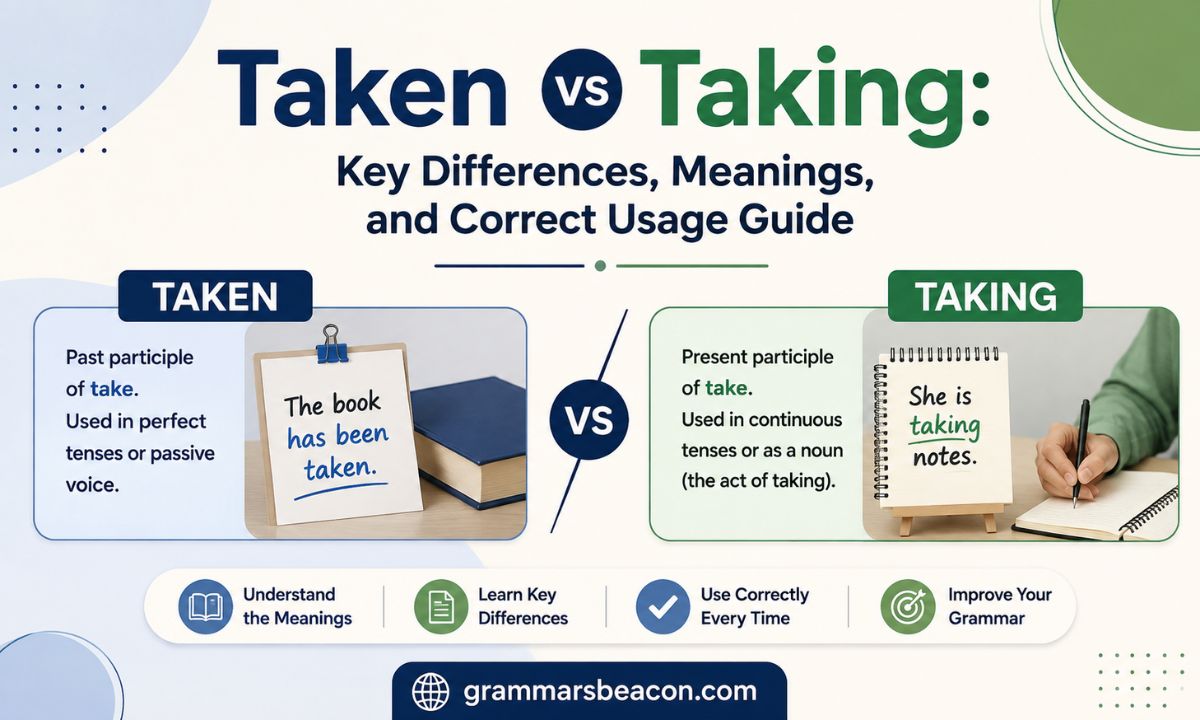
At the core, the grammar rule is simple:
- Taking is the present participle of “take.” It pairs with forms of “be” (am, is, are, was, were, been) to build continuous tenses, and it can also act as a noun.
- Taken is the past participle of “take.” It pairs with forms of “have” (have, has, had) to build perfect tenses, and it pairs with forms of “be” to build the passive voice.
A quick way to remember it: if the sentence needs “have” or “has,” reach for “taken.” If it needs “am,” “is,” “are,” “was,” or “were,” reach for “taking.”
| Feature | Taking | Taken |
| Participle type | Present participle | Past participle |
| Common helper verbs | am, is, are, was, were, been | have, has, had |
| Main function | Ongoing action, gerund | Completed action, passive voice |
| Example | She is taking a photo. | She has taken a photo. |
When to Use “Taking”
Use “taking” whenever an action is happening right now, was happening at a specific point in the past, or will be happening in the future. It always pairs with a form of “to be.”
Examples:
- I am taking a shower.
- They were taking a walk when it started to rain.
- We will be taking the early flight tomorrow.
Taking in Continuous Tenses
“Taking” is the backbone of every continuous (also called progressive) tense connected to the verb “take.” These tenses describe actions in progress rather than finished events.
- Present continuous: She is taking her exam right now.
- Past continuous: He was taking notes when the fire alarm went off.
- Future continuous: I will be taking the 9 a.m. train next week.
- Present perfect continuous: They have been taking classes since January.
In each case, “taking” shows that the action stretches over a period of time rather than being a single, completed event.
Taking as a Gerund (Noun Form)
“Taking” does not always work as a verb. When it functions as the subject or object of a sentence, it becomes a gerund, meaning it behaves like a noun.

Examples:
- Taking risks is part of building a business.
- She enjoys taking long walks after dinner.
- His taking of responsibility impressed the whole team.
A helpful test: if you can replace “taking” with another noun and the sentence still makes sense, it is functioning as a gerund.
Common Expressions with “Taking”
English has several fixed phrases built around “taking.” Learning these will make your speech and writing sound more natural.
- Taking charge – stepping into a leadership role
- Taking part – participating in an event or activity
- Taking place – happening or occurring
- Taking care of – looking after someone or something
- Taking a chance – accepting a risk
- Taking notes – writing down information
When to Use “Taken”
Use “taken” when an action has already been completed, or when the sentence is written in the passive voice. It always needs a helping verb, most often a form of “have” or “be.”
Examples:
- She has taken the medicine already.
- The photo was taken last summer.
- By the time we arrived, they had taken all the good seats.
Taken in Perfect Tenses
“Taken” is essential for building the perfect tenses, which describe actions connected to a specific point in time, often linking the past to the present.
- Present perfect: I have taken this route before.
- Past perfect: She had taken the exam before her illness began.
- Future perfect: By next year, he will have taken over the family business.
These tenses show completion, and “taken” is the form that signals it.
Taken vs Taking Past Participle
A common point of confusion is treating “taken” and “taking” as interchangeable past participles. They are not. Only “taken” is the past participle of “take.” “Taking” is always the present participle, regardless of tense.
| Sentence Type | Correct Form | Example |
| Perfect tense | Taken | We have taken every precaution. |
| Passive voice | Taken | The decision was taken quickly. |
| Continuous tense | Taking | I am taking the next available slot. |
| Gerund/noun use | Taking | Taking breaks improves focus. |
Taken in Passive Voice
The passive voice shifts the focus from who performs an action to who or what receives it. Whenever a sentence is passive, “taken” is the form you need, no matter the overall tense.
Examples:
- The book was taken from the shelf.
- Action has been taken to fix the issue.
- The decision will be taken by the board next week.
Notice how the subject in each sentence receives the action rather than performing it. That is the clearest sign the passive voice, and therefore “taken,” is required.
Common Expressions with “Taken”
Just like “taking,” the word “taken” appears in several well-known idioms and set phrases.
- Taken for granted – not appreciated properly
- Taken aback – surprised or shocked
- Taken ill – suddenly becoming sick
- Taken care of – already handled or resolved
- Taken by surprise – caught off guard
- Taken over – assumed control of something
Common Confusions Between “Taken” and “Taking”
Even confident writers slip up occasionally. Here are the most frequent errors:
- Missing the auxiliary verb: Writing “I taken the bus” instead of “I have taken the bus.” “Taken” can never stand alone as the main verb.
- Wrong helper verb: Using “have” with “taking,” such as “I have taking the test,” instead of the correct “I have taken the test.”
- Confusing gerunds with continuous tense: Assuming every “-ing” word describes an ongoing action, when it may actually be a noun, as in “Taking photos is her hobby.”
- Using “taking” for finished actions: Saying “The package is taking already” instead of the correct “The package has already been taken.”
Paying attention to the helper verb right before “taken” or “taking” solves almost every one of these mistakes.
Other Tricky Pairs and Nuances
The “taken vs taking” pattern applies to many other irregular verbs in English. Recognizing the pattern helps with the entire category:

| Base Verb | Present Participle | Past Participle |
| eat | eating | eaten |
| write | writing | written |
| speak | speaking | spoken |
| break | breaking | broken |
| choose | choosing | chosen |
In every case, the “-ing” form pairs with “be” for continuous tenses, while the past participle pairs with “have” for perfect tenses and with “be” for the passive voice.
Frequency and Real-Life Usage
In everyday spoken English, “taking” tends to appear more often because people frequently describe actions that are happening or about to happen, such as plans, routines, and ongoing activities. “Taken,” on the other hand, shows up more in writing, reports, and narratives, where actions are described as already complete.
News headlines, for instance, often favor “taken” for its formal, finished tone, as in “Action taken against fraud.” Casual conversation leans toward “taking,” as in “I’m taking the dog out.”
READ MORE: A MA or An MA? Correct Usage, Grammar Rules, and Common Mistakes
Practical Tips to Remember the Difference
- Check the helper verb: “have/has/had” signals taken; “am/is/are/was/were” signals taking.
- Ask if the action is finished or ongoing. Finished points to taken; ongoing points to taking.
- Watch for passive structures. If the subject receives the action, use taken.
- Test for noun use. If “-ing” can be swapped with another noun, it is a gerund, and taking is correct.
- Practice with real sentences from articles, shows, or conversations rather than relying on rules alone.
Case Study: A Classroom Example
Maria, an intermediate English learner, kept mixing up these two forms in her writing. Her teacher gave her a simple habit: before writing “taken” or “taking,” pause and identify the helper verb needed in the sentence.
Within a few weeks of daily practice, Maria’s essays showed a clear improvement. She stopped writing sentences like “I have taking the exam” and instead wrote “I have taken the exam” correctly and consistently. The turning point was recognizing that the choice depends on structure and timing, not on which word simply “sounds right.”
Conclusion
“Taken” and “taking” both come from the verb “take,” but they serve very different grammatical roles. “Taking” describes ongoing actions and can also work as a noun, while “taken” describes completed actions and forms the backbone of perfect tenses and the passive voice.
Once you learn to check the helper verb and consider whether an action is finished or still happening, choosing between the two becomes second nature. With a little practice, this once-confusing pair will become one of the easiest parts of your English grammar toolkit.