
If you’ve ever paused mid sentence wondering whether to write “a MA” or “an MA,” you’re not alone. This tiny two letter abbreviation trips up students, job seekers, and even seasoned writers because the rule isn’t about spelling at all. It’s about sound. In this guide, you’ll get a clear, no nonsense answer to the question, plus the grammar logic behind it, real examples, capitalization rules, possessive forms, and the most common mistakes people make when writing about a Master of Arts degree.
Understanding A MA or An MA: The Definitive Guide
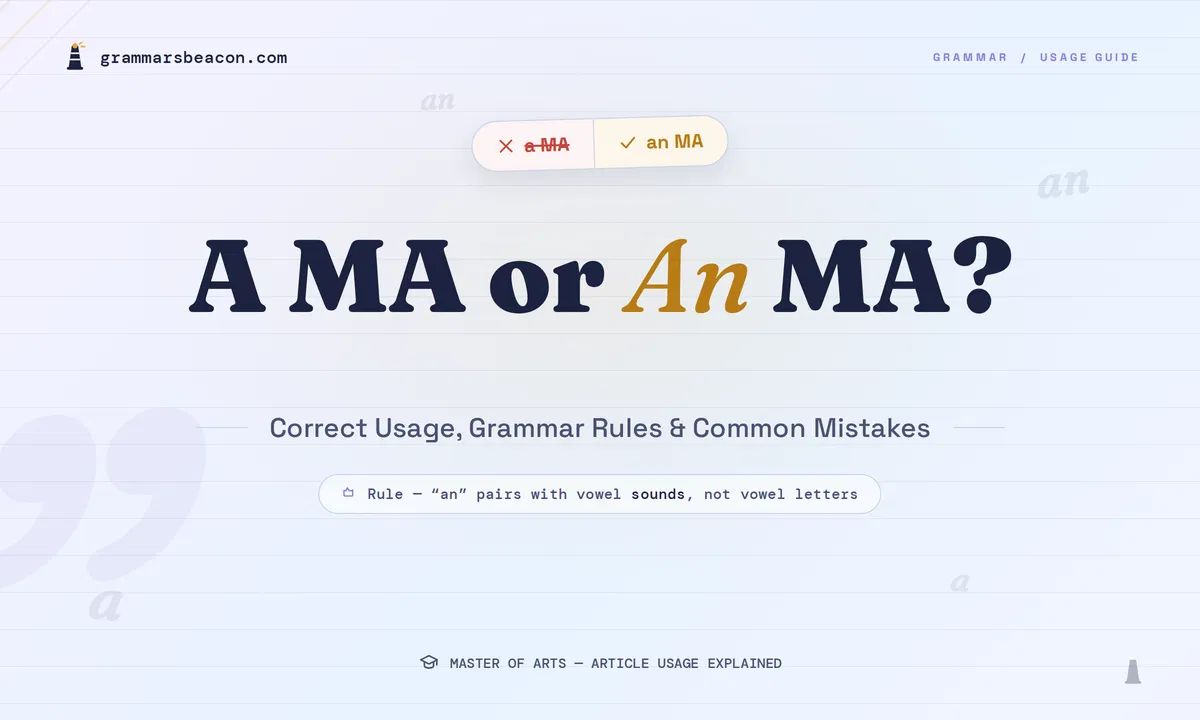
The short answer is this: an MA is correct. English articles follow the sound that begins a word, not the letter it starts with. Since “MA” is pronounced “em-ay,” it opens with a vowel sound, which means it needs “an,” not “a.” Once you understand this one principle, the confusion disappears for good, whether you’re writing a resume, an academic bio, or a casual email.
How English Articles Work: A vs An
Most people learn a simplified version of this rule in school: use “a” before consonants and “an” before vowels. That’s a good starting point, but it’s incomplete.
The real rule is:
- Use a before words that start with a consonant sound.
- Use an before words that start with a vowel sound.
Sound always wins over spelling. That’s why we say “an hour” even though “hour” starts with the consonant letter H, and “a university” even though “university” starts with the vowel letter U. The article depends entirely on pronunciation.
Examples That Prove It’s About Sound
Here are a few familiar examples that show how spelling can be misleading:
- an hour (silent H, vowel sound)
- a European trip (starts with a “yoo” consonant sound)
- an MBA (starts with “em,” a vowel sound)
- a one time offer (starts with a “wuh” consonant sound)
- an SUV (starts with “es,” a vowel sound)
- an FAQ (starts with “ef,” a vowel sound)
Notice the pattern with abbreviations like MBA, SUV, and FAQ. Each one is read letter by letter, and several letters of the alphabet, including M, F, S, L, N, R, and X, actually begin with vowel sounds when spoken aloud.
A MA or AN MA Grammar
Grammatically, “MA” behaves exactly like MBA, SUV, and FAQ. It’s an abbreviation that’s pronounced letter by letter rather than as a single word. When you say “MA” out loud, it comes out as “em-ay.” The very first sound is “em,” and that sound starts with a vowel. That single detail is the entire grammar rule in action, and it’s why native speakers instinctively say “an MA” without ever thinking about spelling.
Why Abbreviations Change the Rule
Abbreviations create confusion because our eyes and ears disagree. Visually, “M” looks like a solid consonant. But spoken language doesn’t care about how a letter looks on a page, it only cares about how it sounds when read aloud. This mismatch is exactly why abbreviations and acronyms are the most common source of “a vs an” mistakes in English. The fix is simple: say the abbreviation out loud before choosing your article, and let your ear make the final call.
So… Is It A MA or An MA?
By now the answer should feel obvious.
✔ The correct form is:
an MA
We use “an” because MA is pronounced “em-ay,” and that pronunciation begins with a vowel sound. This holds true in every context, whether you’re referring to the degree itself, a person who holds it, or the process of earning it.
Correct Sentence Examples
- She earned an MA in Psychology last spring.
- He is currently pursuing an MA in English Literature.
- After completing an MA, she started teaching at a local college.
- Our department just hired an MA holder with strong research experience.
- You’ll need an MA degree to qualify for this position.
Incorrect Examples
- ❌ She earned a MA in Psychology last spring.
- ❌ He is currently pursuing a MA in English Literature.
- ❌ Our department just hired a MA holder.
- ❌ You’ll need a MA degree to qualify for this position.
Each of these examples reads awkwardly out loud because “a MA” forces a consonant sound onto a word that actually starts with a vowel sound.
Understanding What MA Means (Pronunciation + Meaning)
MA stands for Master of Arts, a postgraduate academic degree typically awarded after completing one to two years of advanced study beyond a bachelor’s degree. It’s most commonly earned in the humanities, arts, and social sciences, covering fields like literature, history, sociology, and fine arts. When spoken, MA is pronounced “em-ay,” two distinct letter sounds rather than a single blended word.
Key Facts About the MA Degree
- Typically takes one to two years of full time study to complete.
- Usually requires a completed bachelor’s degree for admission.
- Common in fields such as literature, history, linguistics, and social sciences.
- May involve a thesis, capstone project, or comprehensive exams depending on the program.
- Often serves as a stepping stone toward a PhD or a specific career path.
A Master of Arts or An Master of Arts?
Here’s where many writers get tripped up again. When you spell out the full degree name instead of using the abbreviation, the article changes. “Master” is a full word that starts with the consonant sound “m” (as in “mat”), not the vowel sound “em.” That means the correct article is “a,” not “an.”
So while it’s “an MA,” it’s “a Master of Arts.” The article depends entirely on what word or abbreviation directly follows it, not on the underlying meaning.
Correct Examples
- She holds a Master of Arts in Sociology.
- He is completing a Master of Arts degree this year.
- A Master of Arts typically takes two years to finish.
- They awarded her a Master of Arts with honors.
Capitalization Rules for Academic Degrees
Capitalization is another area where writers often stumble, and style guides are fairly consistent on the core rules.
General Rules
- Lowercase generic references like “master’s degree” or “bachelor’s degree.”
- Capitalize the full, formal degree name, such as “Master of Arts” or “Bachelor of Science.”
- Capitalize abbreviations like MA, BA, and PhD.
- Capitalize the degree name when it functions as a title, such as on a resume, diploma, or business card.
Table: What to Capitalize
| Term | Capitalization | Example |
| Generic degree reference | Lowercase | she has a master’s degree |
| Formal degree name | Capitalized | Master of Arts in History |
| Abbreviation | Capitalized | MA, BA, PhD |
| Degree following a name | Capitalized | Sarah Lee, MA |
| Field of study (common noun) | Lowercase | a master’s in psychology |
| Field of study (proper noun) | Capitalized | a master’s in English |
Examples From Style Guides
Major style guides largely agree on the fundamentals, even though small details differ. <cite index=”10-1″>The Chicago Manual of Style recommends lowercase for academic degrees except when the degree functions as a title, while the Associated Press Stylebook favors lowercase for general references but capitalizes degrees when they follow a person’s name.</cite> <cite index=”10-1″>Both guides agree that abbreviated degrees, such as MA or PhD, should always be capitalized.</cite> For everyday writing, following one consistent style guide throughout your document matters more than memorizing every exception.
Possessive Forms: Master’s vs Masters
Another frequent stumbling block is whether “master’s” needs an apostrophe.
Why?
The apostrophe exists because the phrase historically implies possession, as in “the degree of a master.” <cite index=”13-1″>Terms like master’s degree and master’s are treated as possessives and require an apostrophe, while formal degree names such as Master of Arts are never written as possessives.</cite>
Correct Usage
- She’s finishing her master’s degree this year.
- He has a master’s in Economics.
- Master of Arts (no apostrophe, formal degree name)
Incorrect Usage
- ❌ She’s finishing her masters degree this year.
- ❌ He has a master’s of Economics.
- ❌ A Master’s of Arts
Abbreviating the Degree: MA vs M.A.
Both “MA” and “M.A.” are widely accepted, but they belong to different style traditions and shouldn’t be mixed within the same document.
Regional Differences
- American English often drops periods in degree abbreviations: MA, BA, PhD.
- British and some academic institutions still prefer periods: M.A., B.A., Ph.D.
- <cite index=”12-1″>Some academic style guides recommend lowercasing general degree references while punctuating the abbreviated form, as in “Sam has a master’s degree in English; Sam Le, M.A.”</cite>
Consistency Is Key
Whichever format you choose, MA or M.A., stick with it throughout the entire document. Mixing styles is one of the fastest ways to make writing look unpolished, even if each individual instance is technically correct.
READ MORE: In Process vs In Progress: Key Differences, Meanings, and Correct Usage
Degree vs Field of Study
It’s easy to confuse how the degree name and the subject area should be styled, but the rule is straightforward once you separate the two.
Correct Formats
- an MA in History (field capitalized because it’s a proper noun)
- a master’s in psychology (field lowercase because it’s a common noun)
- a Master of Arts in Political Science
- an MA holder specializing in linguistics
Quick Comparison Table
| Form | When to Use | Article |
| MA | Casual or standard abbreviation | an MA |
| M.A. | Formal or traditional style with periods | an M.A. |
| master’s degree | Generic, lowercase reference | a master’s degree |
| Master of Arts | Full, formal degree name | a Master of Arts |
Common Mistakes People Make
Even confident writers slip up with this rule more often than you’d expect.
Frequent Errors
- Writing “a MA” instead of “an MA.”
- Using “masters” without an apostrophe when possession is intended.
- Capitalizing generic terms like “Master’s Degree” when lowercase is correct.
- Mixing MA and M.A. within the same resume or document.
- Capitalizing the field of study when it isn’t a proper noun.
Why These Errors Happen
Most of these mistakes happen because writers rely on how a word looks rather than how it sounds, or because they copy formatting from inconsistent sources like old resumes, templates, or other websites. Autocorrect tools also don’t always catch article errors, since “a MA” isn’t technically a misspelled word.
How to Avoid These Mistakes
A few simple habits will keep your writing accurate every time.
Article Checklist
- Say the abbreviation out loud before choosing “a” or “an.”
- Remember: sound decides the article, not spelling.
- Default to “an MA” and “a Master of Arts.”
Capitalization Checklist
- Lowercase generic mentions like “master’s degree.”
- Capitalize full formal names like “Master of Arts.”
- Always capitalize abbreviations like MA and PhD.
Consistency Checklist
- Pick either MA or M.A. and use it throughout the whole document.
- Match the style guide your school, employer, or publication requires.
Apostrophe Checklist
- Use an apostrophe for “master’s degree” and “master’s.”
- Never use an apostrophe with “Master of Arts.”
Conclusion
The rule behind “a MA” versus “an MA” comes down to one simple idea: English articles follow sound, not spelling. Because MA is pronounced “em-ay,” it always takes “an,” while the spelled out version, “Master of Arts,” takes “a” instead.
Add in the right capitalization, consistent abbreviation style, and correct possessive apostrophes, and you’ll write about academic degrees with total confidence, whether you’re polishing a resume, drafting an academic bio, or simply settling a friendly grammar debate.