
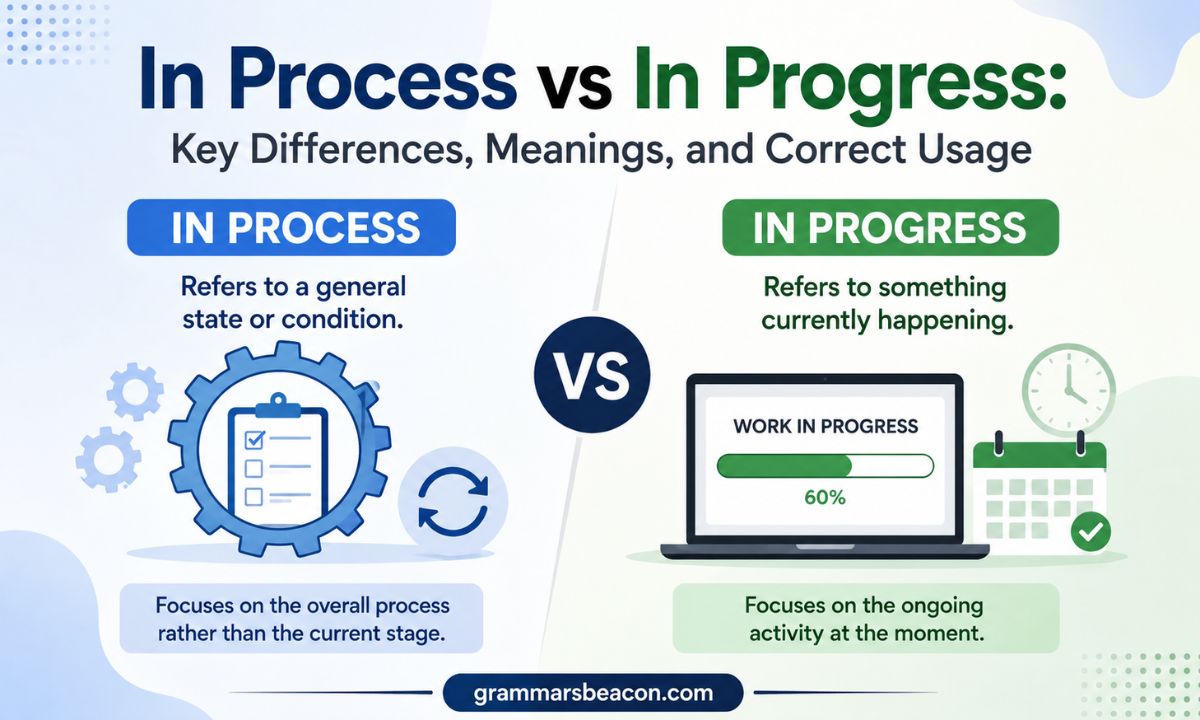
“In process” and “in progress” look almost identical, get used almost interchangeably in everyday speech, and still manage to trip up writers, project managers, and customer service teams every single day. They aren’t quite synonyms. One describes something moving through a system. The other describes something being actively worked on. Mixing them up rarely causes a disaster, but it does create small moments of confusion a customer who doesn’t know if a human is touching their order, a teammate who isn’t sure if a ticket needs attention or is just waiting in a queue.
This guide breaks down exactly what each phrase means, where the words come from, how different industries use them, and how to pick the right one every time.
What “In Process” vs “In Progress” Really Mean
At the core, the difference comes down to this:
- In process describes something moving through a defined sequence of steps — often a system, procedure, or workflow — without necessarily implying that someone is actively working on it right now.
- In progress describes something that is actively being done, with ongoing effort or motion happening in real time.
Think of “in process” as describing a status within a system and “in progress” as describing active work by a person or team.
In Process vs In Progress Grammar
Grammatically, both phrases follow the same pattern: preposition (“in”) + noun (“process” or “progress”). Neither “process” nor “progress” is functioning as a verb here — they’re nouns being used adjectivally, usually as a predicate adjective after a linking verb like “is,” “was,” or “remains.”
- The order is in process. (predicate adjective describing “order”)
- The renovation is in progress. (predicate adjective describing “renovation”)
Both phrases are uncountable in this construction — you don’t say “an in process” or “an in progress” on their own. When used to modify a noun directly (attributively), they’re typically hyphenated: “an in-progress draft,” “an in-process application.”
Meaning of “In Process”
“In process” signals that something is moving through a formal or defined sequence of steps — often administrative, technical, legal, or industrial. It carries a slightly mechanical, systems-oriented tone. It doesn’t necessarily mean a person is doing something at this exact second; it means the item is somewhere in a pipeline.
Examples:
- “Your refund is in process and should post within five business days.”
- “The background check is currently in process.”
- “The shipment is in process at our fulfillment center.”
Meaning of “In Progress”
“In progress” signals active, ongoing effort. It implies motion, momentum, and usually a visible or identifiable person or team doing the work right now.
Examples:
- “The meeting is in progress — please wait outside.”
- “Renovation work is in progress on the third floor.”
- “Her thesis is still in progress.”
Side-By-Side Comparison: “In Process” vs “In Progress”
| Feature | In Process | In Progress |
| Core focus | Movement through a system or procedure | Active effort by a person or team |
| Connotation | Neutral, mechanical, procedural | Dynamic, active, effortful |
| Implies a human is acting right now? | Not necessarily | Usually, yes |
| Common in | Admin, legal, manufacturing, back-end systems | Project management, creative work, live events |
| Typical subject | Orders, applications, transactions, claims | Tasks, projects, meetings, drafts, negotiations |
| Sounds natural in casual speech? | Less so | Yes |
Where These Words Come From (And Why It Matters)
The connotations above aren’t arbitrary — they’re baked into the Latin roots of each word, and understanding the origin makes the modern usage rules much easier to remember.
Origin of “Process”
“Process” comes from the Latin processus, meaning “a going forward” or “advance,” itself from procedere (“pro-” forward + “cedere” to go, move, or yield). Historically, “process” was closely tied to formal, structured sequences — legal proceedings, official procedures, defined steps that unfold in order regardless of who is watching. That procedural, step-by-step DNA is exactly why “in process” still sounds systemic and impersonal today.
Origin of “Progress”
“Progress” comes from the Latin progressus, from progredi (“pro-” forward + “gradi” to step or walk). It was historically associated with advancement, growth, and improvement — a journey forward, often driven by effort. That sense of forward motion powered by someone’s action is why “in progress” still feels active and human-driven.
Why “In Progress” Is More Common Today
If you scroll through project management tools, customer dashboards, and everyday conversation, “in progress” shows up far more often than “in process.” There are a few clear reasons why.
1. It’s clearer
“In progress” immediately tells the reader that something is actively happening right now. There’s less ambiguity about whether work is genuinely underway or just sitting in a queue somewhere.
2. It feels more active
Because of its roots in forward motion and effort, “in progress” carries an energy that “in process” doesn’t. It suggests someone is pushing the work forward, not just letting it move through a pipeline on its own.
3. It’s used in project management
Kanban boards, sprint trackers, and ticketing systems (Trello, Jira, Asana, and countless others) standardized on “In Progress” as the default column name for active work. That widespread adoption has trained millions of people to reach for “in progress” by default.
4. It works in more contexts
“In progress” comfortably describes tasks, projects, meetings, negotiations, relationships, renovations, and creative work. “In process” sounds natural in a narrower band of contexts — mostly formal, administrative, or systemic ones.
In Process vs In Progress Meaning
To recap the core distinction in one line: “in process” means something is moving through a system; “in progress” means someone is actively working on it. If you can picture a person currently doing the work, “in progress” almost always fits. If you’re describing a status inside a pipeline, database, or formal procedure, “in process” is usually the better choice.
When to Use “In Progress” vs. “In Process” (Context-Based Guide)
Here’s a practical, context-based way to decide which phrase to reach for.
Use “In Progress” when:
- Describing a task, project, or piece of work someone is actively doing
- Referring to a meeting, event, or live activity currently underway
- Labeling a column or status in a project management or task-tracking tool
- Talking about creative work (a painting, manuscript, or design in progress)
- Describing physical work like construction or renovation happening now
- Speaking casually — it almost always sounds more natural in conversation
Use “In Process” when:
- Describing an order, application, claim, or transaction moving through a formal system
- Referring to a legal, administrative, or bureaucratic procedure
- Talking about a manufacturing or supply chain step (including “work-in-process” inventory)
- Describing a back-end or automated system process (data processing, batch jobs)
- Communicating in formal or technical documentation where precision about “systemic status” matters
Comparison Examples (To Make It Crystal Clear)
Example 1
- In process: “Your loan application is in process and will be reviewed by underwriting.”
- In progress: “The loan officer is currently in progress reviewing your documents.” (Here, “in progress” describes the officer’s active work — though many writers would instead say “currently reviewing,” since “in progress” more naturally attaches to the task itself: “The review is in progress.”)
Example 2
- In process: “The patent application has been in process for eight months.”
- In progress: “The inventor’s prototype is still in progress in the workshop.”
Example 3
- In process: “Background verification for new hires is in process through HR.”
- In progress: “Onboarding training is in progress this week for new hires.”
How Different Industries Use “In Process” vs “In Progress”
Usage shifts noticeably depending on the field. Here’s how each industry tends to lean.
Technology & Agile Workflows
“In Progress” is the near-universal standard for kanban and sprint boards — it’s the column between “To Do” and “Done” in tools like Jira, Trello, and Asana. “In process” still appears, but mostly in back-end or systems contexts: a batch job, data pipeline, or automated workflow is often described as “in process” rather than “in progress,” since no human is actively watching it happen in real time.
Business & Operations
Both phrases coexist here, split by context. Formal administrative workflows — invoicing, approvals, procurement — tend to use “in process.” Active initiatives, projects, and strategic work tend to use “in progress.”
Customer Service
Customer-facing language leans heavily on “in process” for anything systemic: “Your refund is in process,” “Your return is in process.” When a live agent is actively handling something, “in progress” fits better: “Your ticket is in progress with our support team.”
Manufacturing & Supply Chain
This is where “in process” has real institutional weight. Work-in-process (WIP) is a standard accounting and operations term referring to partially completed goods still moving through production — it’s a formal line item on balance sheets, distinct from raw materials and finished goods. Manufacturing floors and finance departments use “in process” precisely and consistently for this reason.
Academia & Research
Researchers commonly describe ongoing studies, drafts, and experiments as “in progress” — “research in progress” is a common phrase at conferences and in grant applications. “In process” shows up more in administrative contexts, like a manuscript “in process” of peer review or a submission “in process” through a journal’s system.
Creative Industries (Art, Design, Writing)
“Work in progress” (often abbreviated WIP) is deeply embedded in creative culture — artists share “WIP” sketches, writers post “WIP” excerpts, designers show “WIP” mockups. “In process” is rarely used in these communities; it simply doesn’t carry the same personal, hands-on connotation that creative work calls for.
Grammar Rules: How to Use Each Phrase Correctly
Sentence Construction
Both phrases most commonly follow a linking verb (“is,” “was,” “remains,” “continues to be”):
- The audit is in process.
- The negotiation remains in progress.
They can also function as postpositive modifiers, placed right after the noun they describe:
- The project, in progress since January, is ahead of schedule.
Correct placements
When placed after the noun or verb, no hyphen is needed:
- The claim is in process.
- The build is in progress.
When placed before a noun (attributive position), hyphenate:
- An in-process claim requires no further documents.
- Share your in-progress draft with the editor.
Verb Combinations
Certain verbs pair naturally with each phrase.
Pairs with “In Progress”:
- is, was, remains, continues, currently, ongoing, still
Pairs with “In Process”:
- is, currently, still, remains, being processed, undergoing, pending
In Process vs In Progress Examples
A few more real-world sentences to lock in the distinction:
- “The merger is currently in progress, with both legal teams meeting daily.” (active work)
- “Your tax refund is in process and typically takes 21 days.” (system status)
- “The mural is still in progress — check back next week.” (active creative work)
- “The visa application is in process at the consulate.” (bureaucratic pipeline)
- “Renovations to the lobby are in progress through March.” (active physical work)
- “The invoice is in process and will be paid within 30 days.” (administrative workflow)
Capitalization Notes
In regular prose, both phrases stay lowercase: “the order is in process,” “the project is in progress.” Capitalize them only when they function as a formal label or status name — most commonly as a column header or ticket status in a project management tool: In Progress, In Process. Title Case is a stylistic convention for UI labels, not a grammar rule for sentences.
Quick Memory Tricks (Easy to Remember)
Mnemonic 1:
“Process” = paperwork. Think of a form moving through a stack of trays on someone’s desk. Nobody has to be touching it right now for it to still be “in process.”
Mnemonic 2:
“Progress” = a person pushing forward. Picture someone actively walking, building, or writing. If a person is visibly doing the work, it’s “in progress.”
Mnemonic 3:
P for Pipeline, P for Person. “In Process” → Pipeline (a system). “In Progress” → Person (active effort). Same first letter, different P-word to anchor the meaning.
Quick Test:
Ask yourself: “Is someone actively working on this right now, or is it just moving through a system on its own?” Active effort → “in progress.” Sitting in a queue or pipeline → “in process.”
Common Mistakes (Avoid These)
Mistake 1: Using “in process” for tasks
Saying “I’m in process of writing the report” sounds stiff and slightly incorrect. Natural options are “I’m in the process of writing the report” or, more simply, “The report is in progress.”
Mistake 2: Using “in progress” for system steps
Labeling an automated backend job “in progress” can be misleading if no active human effort is happening — “in process” or “processing” is often the more accurate, honest label for automated systems.
Mistake 3: Mixing them in documentation
Using both phrases inconsistently across a dashboard, ticketing system, or style guide confuses users and teammates who start wondering if the two statuses mean different things. Pick one term per context and apply it consistently.
READ MORE: Brief vs Debrief: Key Differences, Meanings, and Correct Usage Guide
Mistake 4: Over-formalizing everyday language
Saying “the coffee is in process” instead of “the coffee is brewing” or reaching for “in process” in casual conversation when “in progress” (or just plain language) would sound far more natural is a common overcorrection.
Real Case Study: A Technical Team Miscommunication
A software team’s ticketing system used “In Process” as a status meaning “queued and automatically being handled by a script,” while individual engineers used “In Progress” informally in stand-ups to mean “someone is actively coding this.” When a support ticket was marked “In Process,” a new team member assumed a colleague was actively working on it and didn’t escalate — when in reality, the ticket was simply sitting in an automated queue waiting for a nightly batch job. The ticket sat untouched for two extra days before a customer complained. The team resolved the confusion by renaming their statuses to “Queued” and “In Progress,” reserving “in progress” strictly for tasks with an actively assigned human owner.
Another Case Study: Manufacturing Confusion
On a factory floor, production staff referred to partially assembled units as “in progress” in daily verbal updates, while the finance team’s inventory reports used the formal accounting term “work-in-process” (WIP) for the exact same units. When a new operations manager reviewed the reports, the mismatch between verbal updates (“still in progress”) and the WIP inventory figures caused a temporary miscount during a quarterly audit — the finance team believed more units were complete than the floor staff intended to communicate. The fix was simple: floor staff adopted the formal “work-in-process” terminology in written updates, reserving casual “in progress” language for verbal check-ins only.
Helpful Quotes to Remember
A few short lines worth keeping in mind:
- “Process is the path; progress is the proof.”
- “If a person is doing it, it’s in progress. If a system is moving it, it’s in process.”
- “Progress moves because someone pushes it. Process moves because a system carries it.”
Conclusion
“In process” and “in progress” aren’t interchangeable twins they’re two words shaped by different Latin roots, different connotations, and different real-world uses. “In process” points to something moving through a system: an order, an application, a manufacturing step. “In progress” points to something someone is actively doing right now: a project, a meeting, a piece of creative work.
Once you internalize that core distinction system versus effort choosing the right phrase becomes almost automatic, whether you’re writing a customer email, labeling a project status, or just trying to describe what’s happening on your desk right now.