
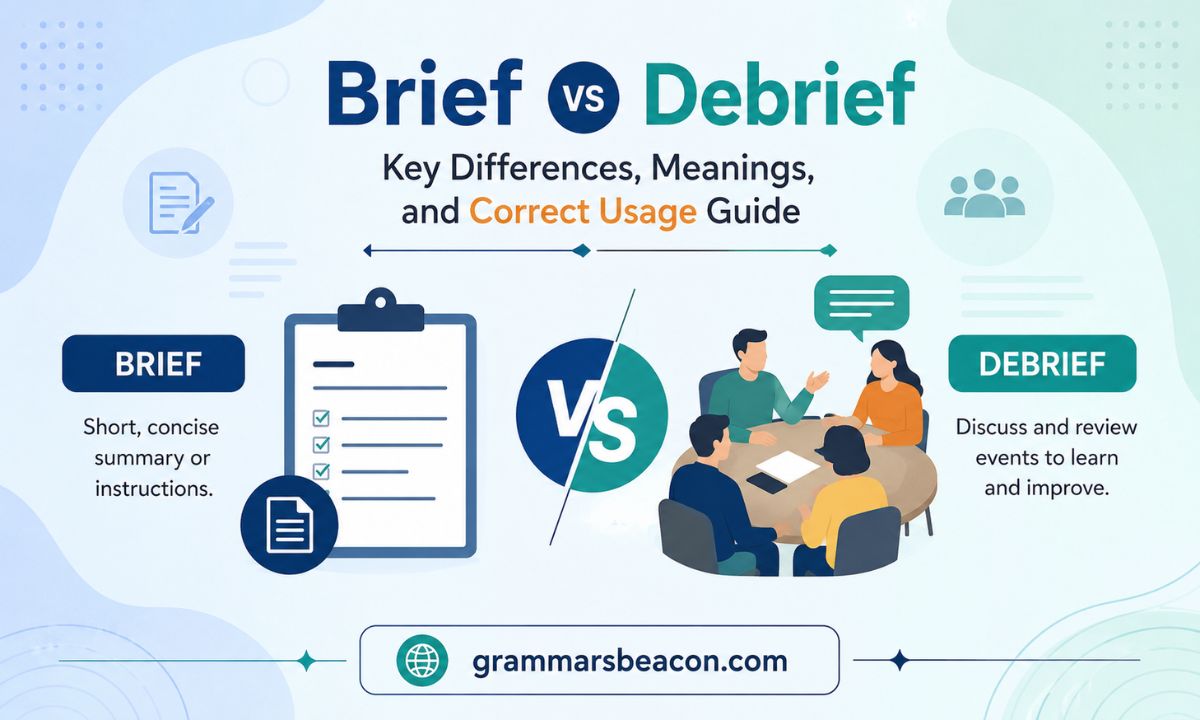
Most people hear the words “brief” and “debrief” in meetings, on the news, or in military dramas and assume they mean roughly the same thing. They don’t. A brief happens before something starts. A debrief happens after something ends. That single distinction changes how each word is used in business, the military, healthcare, and everyday conversation.
This guide breaks down both terms in plain English, shows you how to use them correctly, and gives you real examples so you never mix them up again.
Understanding the Term “Brief” in Communication
The word “brief” shows up everywhere, from courtrooms to boardrooms to your manager’s morning email. At its core, it describes something short, focused, and to the point.
In communication, a brief is the information a person needs before they start a task. It sets expectations, explains the goal, and removes guesswork. Whether it’s a pilot receiving flight instructions or a marketing team getting campaign details, a brief exists to prepare people for what comes next.
What Does “Brief” Mean? (Definition You Can Use Today)
“Brief” can function as three different parts of speech, and its meaning shifts slightly depending on how it’s used.

As a verb:
To brief someone means to give them essential information before they begin a task or event.
Example: The manager briefed the sales team before the client call.
As a noun:
A brief is a short document, summary, or set of instructions.
Example: The creative brief outlined the client’s goals and target audience.
As an adjective:
Brief describes something short in duration or length.
Example: She gave a brief explanation before moving to the next slide.
Understanding these three roles is the first step toward using the word accurately in any context.
Brief vs Debrief Meaning
In simple terms, the difference comes down to timing and purpose.
| Aspect | Brief | Debrief |
| When it happens | Before an event or task | After an event or task |
| Purpose | Prepares and instructs | Reviews and evaluates |
| Focus | Future actions and goals | Past performance and lessons |
| Common word forms | Noun, verb, adjective | Verb, noun |
| Typical setting | Meetings, military missions, legal cases | Military operations, project reviews, therapy sessions |
A brief looks forward. A debrief looks back. Once you remember that, the confusion mostly disappears.
Origins & Uses of “Brief” (Keep It Real)
The word “brief” traces back to the Latin term “brevis,” meaning short. It entered English through Old French and was originally tied to legal and religious documents that summarized important information in a compact form.
Over centuries, the word expanded beyond legal writing into everyday speech. Today it’s used in:
- Legal settings (a legal brief)
- Military and government communication (mission briefings)
- Business and marketing (creative briefs, project briefs)
- Casual conversation (keeping things brief)
Despite the variety of contexts, the underlying idea stays consistent: brevity combined with essential information.
Legal Briefs: What They Really Are
In law, a brief is a written document submitted to a court that outlines the facts, legal arguments, and reasoning behind a party’s position. Despite the name, legal briefs are rarely short. Some run for dozens of pages.
The word “brief” here doesn’t refer to length but to focus. A legal brief is meant to present only what’s necessary to support an argument, cutting out anything irrelevant to the case. Attorneys use it to persuade judges by laying out precedent, statutes, and logical reasoning in a structured, professional format.
What ‘Debrief’ Means in Different Fields

Once you understand “brief,” the meaning of “debrief” becomes easier to grasp. The prefix “de-” reverses or undoes the action, so instead of giving information, a debrief involves collecting it after something has already happened.
Debriefing looks different depending on the industry, but the goal is always the same: extract lessons and insights from a completed event.
Definition: What Does “Debrief” Mean?
To debrief someone means to question or discuss details with them after a task, mission, or event has concluded. It can also function as a noun describing that review session itself.
Example: The pilots were debriefed immediately after landing.
Debrief is a relatively recent addition to English, first recorded in the 1940s during World War II, when military intelligence needed a term for questioning soldiers and agents returning from missions.
Debriefing in Intelligence and Military Operations
Debriefing has deep roots in military and intelligence work. After a mission, soldiers, pilots, or agents sit down with commanding officers to walk through what happened. This process helps identify:
- What went according to plan
- What didn’t go as expected
- Any threats, risks, or intelligence gathered
- Lessons that should shape future missions
Military debriefs are often structured and formal, sometimes involving written reports alongside verbal discussion. The goal isn’t blame. It’s accuracy and improvement.
Debriefing in Business and Project Management
Outside the military, debriefing has become a standard practice in workplaces, especially after major projects, product launches, or client presentations.
A good business debrief might include:
- A review of what worked well
- An honest look at what fell short
- Data or feedback collected during the project
- Actionable steps for the next initiative
- Input from every team member involved
Teams that debrief consistently tend to avoid repeating the same mistakes, since the process turns experience into documented knowledge rather than letting it fade from memory.
Brief vs Debrief Examples
Seeing both words in context makes the distinction click faster.
| Sentence | Word Used | Why |
| The director briefed the crew before filming began. | Brief | Preparation before the event |
| After the flight, the crew was debriefed by the airline safety team. | Debrief | Review after the event |
| Please keep your presentation brief. | Brief | Adjective describing short duration |
| The therapist debriefed the volunteers after the trial ended. | Debrief | Post-event discussion |
| The lawyer filed a brief with the court. | Brief | Noun referring to a document |
Brief vs Debrief: Linguistic & Functional Differences
Beyond timing, the two words differ in grammar and typical usage patterns.
- Brief works as a noun, verb, and adjective, giving it flexibility across sentence types.
- Debrief mainly functions as a verb and occasionally as a noun, but it’s never used as an adjective.
- Brief often pairs with words like “meeting,” “document,” or “summary.”
- Debrief typically pairs with words like “session,” “report,” or “review.”
- Brief points toward instructions and expectations.
- Debrief points toward reflection and evaluation.
These small grammatical patterns are useful clues if you’re ever unsure which word fits a sentence.
When to Brief vs When to Debrief
A simple rule solves most confusion: brief before, debrief after.
If you’re preparing someone for a task, meeting, or mission, you brief them. If you’re reviewing something that already happened, you debrief them.

READ MORE: Quieter vs More Quiet: Which Is Correct? Grammar Guide
When to Use a Brief
Use a brief whenever people need context, direction, or instructions before starting something. This applies to:
- Kicking off a new project
- Preparing a team for a client meeting
- Giving instructions before an emergency response
- Outlining goals for a creative campaign
Key Benefits of a Good Briefing
- Reduces confusion and miscommunication
- Aligns everyone on goals and expectations
- Saves time by preventing repeated questions
- Builds confidence before high-pressure tasks
When to Use a Debrief
Use a debrief once the task, event, or mission has wrapped up. This applies to:
- Reviewing a completed marketing campaign
- Discussing an emergency response after the incident
- Wrapping up a development sprint
- Processing a stressful or high-stakes event with a team
Why Debriefing Matters
- Captures lessons while memories are still fresh
- Identifies gaps between planning and execution
- Encourages accountability without assigning blame
- Improves performance in future projects
Debrief Meaning
To summarize it simply: debrief means to gather information, feedback, or an account of events from someone after a task, mission, or experience has ended. It’s the structured pause that turns action into insight.
Practical Scenarios (Brief vs Debrief in Action)
Real-world case studies make the difference even clearer.
Case Study 1: Creative Agency Launching a Campaign
Before launch, the account manager briefs the creative team on the client’s goals, target audience, budget, and timeline. Everyone leaves the meeting with a clear picture of what success looks like.
After the campaign ends, the team gathers for a debrief. They review performance data, discuss what resonated with the audience, and note changes for the next campaign.
Case Study 2: Emergency Response Team
Before responding to an incident, first responders receive a brief covering the situation, potential hazards, and assigned roles. This preparation keeps everyone safe and coordinated.
Once the incident is resolved, the team holds a debrief to discuss decisions made under pressure, identify what worked, and flag anything that needs to change in future protocols.
Case Study 3: Software Development Sprint
At the start of a sprint, developers attend a briefing where the product owner outlines priorities, deadlines, and technical requirements.
At the end of the sprint, the team runs a retrospective, which is essentially a debrief. They discuss blockers, celebrate wins, and adjust their workflow for the next cycle.
Conclusion
Brief and debrief may share the same root word, but they serve opposite purposes. A brief prepares people before action, giving them the information, context, and direction they need. A debrief reviews that action afterward, turning experience into lessons for next time.
Once you remember that briefings look forward and debriefings look back, choosing the right word becomes second nature. Whether you’re leading a military mission, managing a marketing campaign, or wrapping up a work sprint, using these terms correctly makes your communication clearer and more professional.