If you have ever paused mid-sentence wondering whether to write “quieter” or “more quiet,” you are not alone. This is one of the most common comparative adjective mix-ups in English, and the confusion makes sense. Quiet does not follow a single, clean-cut rule the way most short adjectives do.
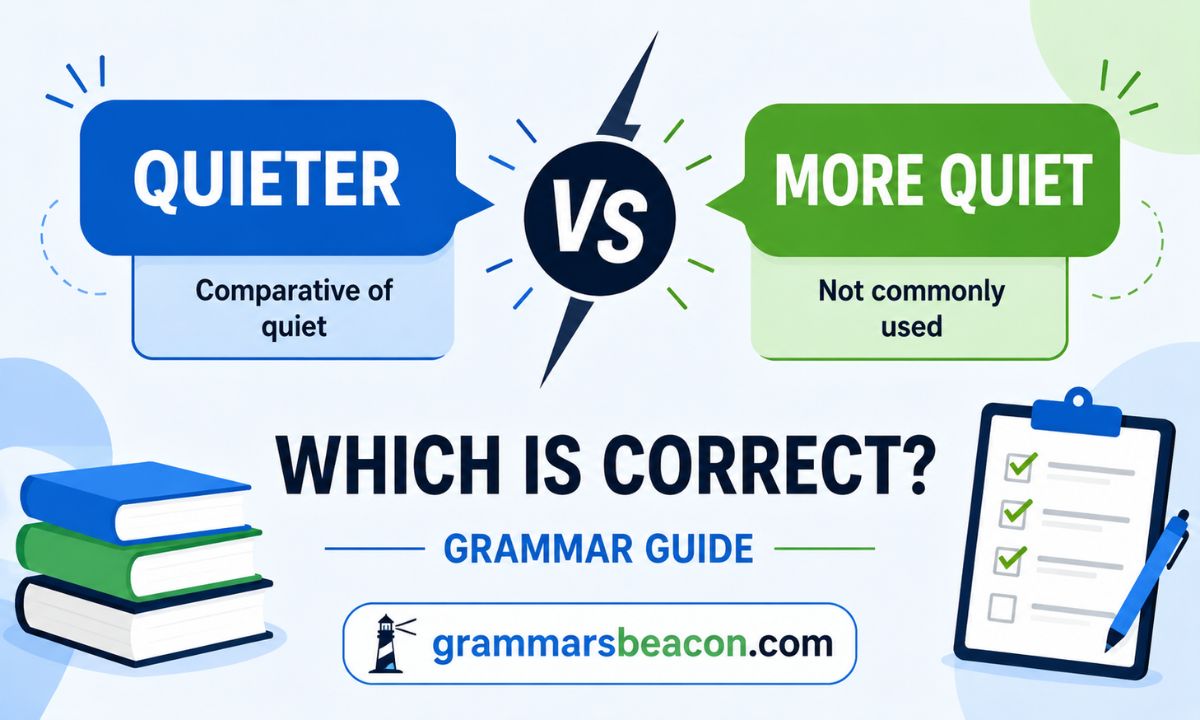
The short answer is that both forms are grammatically correct, but they are not used equally. Quieter is the natural, everyday choice for native speakers, while more quiet shows up mostly in formal writing or when someone wants extra emphasis. This guide breaks down exactly why that is, how comparative adjectives work, and when each form actually belongs in your writing or speech.
Understanding “Quiet” as an Adjective
Quiet is a descriptive word used to talk about low noise levels, calm environments, or peaceful behavior. It can describe a place, a sound, a person, or even a mood.
A few simple examples show how it works in everyday sentences:
- The library is quiet in the early morning.
- She kept a quiet voice during the call.
- Their neighborhood feels quiet after sunset.
As an adjective, quiet can also shift into comparative and superlative forms when you want to compare two or more things. That is exactly where the quieter versus more quiet debate begins.
Quieter or More Quiet Meaning
Both quieter and more quiet describe a lower level of noise compared to something else. There is no real difference in meaning between the two. The difference is entirely about form, tone, and how natural each one sounds in context.
- Quieter is the standard comparative form built by adding “-er” to the base word.
- More quiet is the periphrastic form, built by placing “more” in front of the adjective instead of changing its ending.
So when someone asks which one is “correct,” the honest answer is that both are grammatically valid. The real question is which one fits the situation better, and that comes down to English’s general preference for shorter, smoother-sounding comparatives.
How Comparatives Work in English
To understand why quieter is favored, it helps to know the general pattern English follows when forming comparative adjectives.
| Adjective Length | Comparative Rule | Example |
| One syllable | Add “-er” | tall → taller |
| One syllable ending in silent “e” | Add “-r” | large → larger |
| Two syllables ending in “y” | Change “y” to “i” + “-er” | happy → happier |
| Most two-syllable adjectives | Use “more” + adjective | careful → more careful |
| Three or more syllables | Use “more” + adjective | beautiful → more beautiful |
Quiet sits in an unusual spot. Technically it has two syllables (qui-et), which would normally push it toward the “more” pattern. But because it ends in a light, easy-to-pronounce sound, English treats it more like a short adjective. That is why quieter feels just as smooth as taller or colder, even though the syllable count says otherwise.
Quieter as the Preferred Comparative Form
Quieter is the comparative form most grammar authorities and style guides recommend for everyday use. It is shorter, easier to say, and matches the rhythm of similar short adjectives.
Common, natural examples include:
- This street is quieter than the main road.
- The new engine runs quieter than the old one.
- Can you speak a little quieter, please?
- Today felt quieter than yesterday at the office.
Because it follows the same pattern as words like colder, faster, and softer, quieter simply feels more familiar to the ear. That familiarity is a big reason it dominates in conversation, journalism, and everyday writing.
When More Quiet Is Grammatically Acceptable
More quiet is not incorrect. It has its place, especially in situations where a writer wants to slow the sentence down or add emphasis.
You will typically see more quiet used in these contexts:
- Formal or literary writing, where a slightly longer phrase adds weight to a sentence.
- Emphatic statements, where the speaker wants to stress a gradual or deliberate change.
- Poetic or descriptive passages, where rhythm matters more than brevity.
Example: “As the evening went on, the house grew more quiet, almost still.”
Here, more quiet creates a slower, more reflective tone than quieter would. That subtle stylistic effect is the main reason this form still survives in modern English.
Quieter vs More Quiet in Real-World Usage
Looking at how these two forms actually show up in books, articles, and everyday speech makes the pattern clear.
| Context | Preferred Form | Why |
| Casual conversation | Quieter | Shorter, more natural |
| News and blog writing | Quieter | Matches modern style guides |
| Academic or formal essays | Either, quieter is still common | More quiet occasionally used for emphasis |
| Poetry or creative writing | More quiet (sometimes) | Adds rhythm and reflection |
| Technical or product descriptions | Quieter | Concise and reader-friendly |
In nearly every practical setting, quieter wins simply because it communicates the same idea with fewer words.
Frequency Comparison: What Native Speakers Actually Use
Language data backs up what most grammar guides already suggest. In large collections of English text, such as corpus databases used by linguists, quieter appears far more often than more quiet across spoken and written English.
A rough breakdown looks like this:
| Form | Approximate Usage Frequency | Common Setting |
| Quieter | Very high | Everyday speech, writing, media |
| More quiet | Low to moderate | Formal writing, emphasis, literature |
The takeaway is simple: if you are unsure which one to pick, quieter is the safer, more natural default in almost any situation.
More Quiet Meaning
When people search for “more quiet meaning,” they are usually just confirming that it functions the same way as quieter, describing something with less noise than something else. There is no hidden or different definition attached to it.
The only real distinction is tone. More quiet can sound slightly more deliberate or formal, while quieter feels conversational and direct. Meaning-wise, they are interchangeable.
Quietest vs Most Quiet
The same logic extends to superlative forms, used when comparing three or more things.
- Quietest is the standard superlative, formed by adding “-est.”
- Most quiet is the alternative, formed with “most” plus the base adjective.
Examples:
- This is the quietest room in the building.
- She was the quietest student in the entire class.
- Of all three neighborhoods, this one felt the most quiet at night.
Just like with the comparative form, quietest is far more common in everyday English, while most quiet tends to appear in more formal or stylistic writing.
Quieter vs Less Noisy: Meaning Isn’t Always Equal
It is worth noting that quieter and less noisy are close, but not perfectly identical, in meaning.
- Quieter often implies an overall sense of calm, including subtle background sounds.
- Less noisy focuses specifically on a reduction in loud or disruptive sound.
Example comparison:
- The new fan is quieter than the old one. (Overall sound experience is calmer.)
- The new engine is less noisy. (Specifically, the loud disruptive sound has dropped.)
They overlap in most casual contexts, but choosing the more precise term can matter in technical writing, product reviews, or scientific descriptions.
“As Quiet As” for Equal Comparisons
Not every comparison involves one thing being more or less quiet than another. Sometimes two things are equally quiet, and that calls for a different structure entirely: “as quiet as.”
Examples:
- The house was as quiet as a library.
- She tried to stay as quiet as possible during the meeting.
- The engine runs as quiet as the previous model.
This structure works for direct, equal comparisons and is especially useful in descriptive or narrative writing.
READ MORE: Wish You vs Wishing You: Meaning, Usage, and Key Differences
Common Idioms Using “As Quiet As”
English also uses “as quiet as” inside popular idioms to add color and imagery to descriptions.
- As quiet as a mouse
- As quiet as the grave
- Quiet as a church
- Dead quiet
These expressions do not follow strict grammar rules; they are fixed phrases used for effect rather than literal comparison.
Common Mistakes and Misunderstandings
A few errors show up again and again when people use comparative forms of quiet. Avoiding these will instantly make your writing sound more polished.
- Double comparatives: Never combine both forms, such as “more quieter.” This is grammatically incorrect and should always be avoided.
- Mixing forms in one sentence: Stick to one style, either quieter or more quiet, rather than switching mid-sentence.
- Confusing quieter with quietest: Quieter compares two things; quietest compares three or more.
- Overusing more quiet in casual writing: It can sound stiff or overly formal in everyday contexts where quieter fits better.
More Quiet Synonym
If you want alternatives that carry a similar meaning to more quiet, several options work depending on tone and context:
- Calmer
- Softer (in terms of sound)
- More peaceful
- Less noisy
- More hushed
- Stiller
These synonyms can add variety to writing, especially when you want to avoid repeating the same comparative structure multiple times in one piece.
Practical Decision Guide: Choosing the Right Form Instantly
Use this quick guide whenever you are unsure which form fits your sentence.
- Choose quieter for everyday speech, casual writing, business communication, and most general content.
- Choose more quiet for formal writing, emphasis, or a slower, more reflective tone.
- Choose quietest when comparing three or more things in standard writing.
- Choose most quiet only when you want a more formal or stylistic superlative.
- Choose as quiet as when two things are equally quiet, not one more than the other.
Quick Rules You Can Memorize
- One-syllable-feeling adjectives like quiet usually take “-er” and “-est.”
- Never combine “more” with an “-er” ending; that creates an incorrect double comparative.
- Quieter and quietest are the default, standard choices in modern English.
- More quiet and most quiet are optional, used mainly for emphasis or formal tone.
- Use “as quiet as” for equal comparisons, not for showing a difference.
Handy Comparison Chart
| Form | Type | Common Use | Example Sentence |
| Quiet | Base adjective | Describing calm or low noise | The room is quiet. |
| Quieter | Comparative | Comparing two things | This room is quieter than that one. |
| More quiet | Comparative (alternative) | Formal or emphatic tone | The house grew more quiet as night fell. |
| Quietest | Superlative | Comparing three or more | This is the quietest street in town. |
| Most quiet | Superlative (alternative) | Formal or stylistic emphasis | It was the most quiet moment of the trip. |
| As quiet as | Equal comparison | Two things equally quiet | It’s as quiet as a library in here. |
Conclusion
Quieter and more quiet ultimately mean the same thing, but they are not used the same way. Quieter is the natural, everyday choice that fits almost any situation, from casual conversation to professional writing. More quiet still has a place, particularly when you want a formal tone or a slower, more emphatic rhythm in your sentence.
The safest approach is simple: default to quieter and quietest for standard comparisons, and reserve more quiet or most quiet for moments where style and emphasis matter more than brevity. Once you understand this distinction, you will never have to pause mid-sentence again wondering which form to use.