
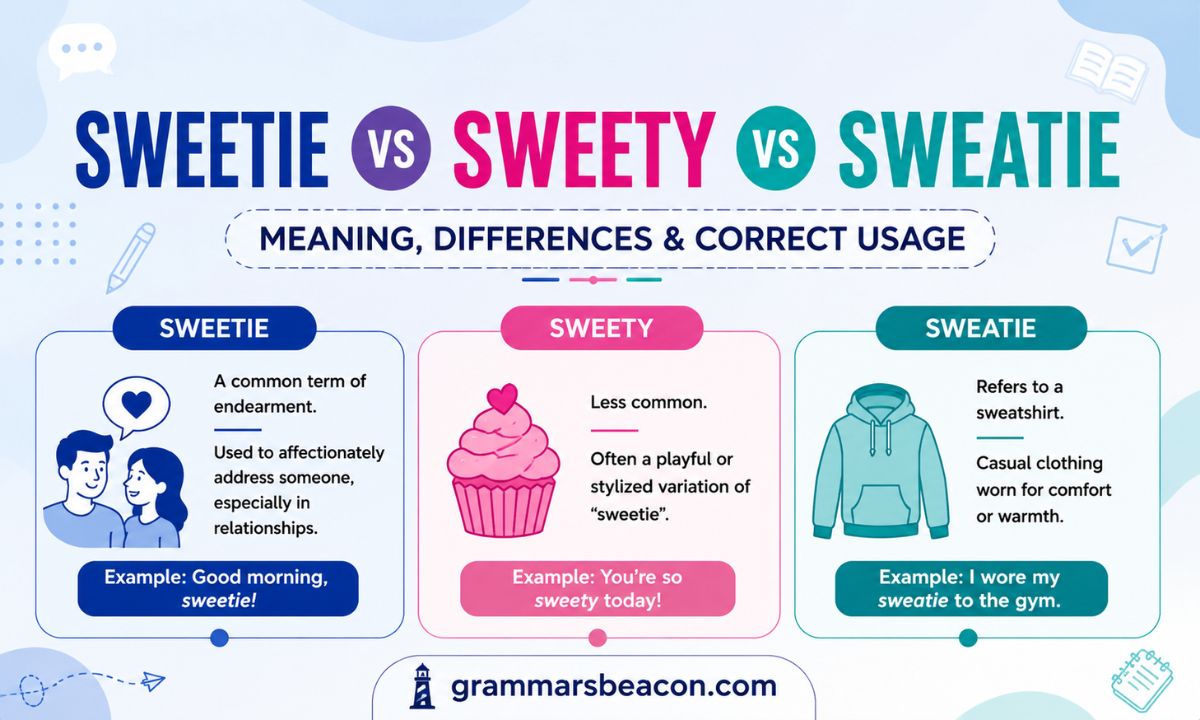
If you have ever paused mid text message wondering whether to type “sweetie” or “sweety,” you are not alone. These two spellings look almost identical, sound the same out loud, and yet only one of them is actually correct in standard English. Throw a third word, “sweatie,” into the mix, and the confusion multiplies fast.
This guide clears up the confusion once and for all. You will learn the correct spelling, the real meaning behind each term, where these words come from, and exactly when it is appropriate to use them. By the end, you will never second guess yourself again.
Sweetie vs Sweety vs Sweatie: Why These Spellings Confuse People
At first glance, “sweetie,” “sweety,” and “sweatie” all seem to point to the same warm, affectionate feeling. That is exactly why people mix them up so often. They share the same root word, “sweet,” and they all end with a similar sound when spoken aloud.
The problem is that English does not always spell words the way they sound. A single vowel swap or an extra letter can shift a word from a standard term of endearment into a misspelling, or in the case of “sweatie,” into something that has nothing to do with affection at all.
Here is a quick snapshot before we go further:
- Sweetie is the correct, dictionary recognized spelling.
- Sweety is a common but nonstandard variant, often seen in texting and casual writing.
- Sweatie is generally an accidental typo for “sweaty,” though it occasionally shows up as playful slang.
Understanding these small differences matters more than people realize, especially in written communication where tone and intent can be easily misread.
Why English Spelling Creates Mix-Ups Like Sweetie vs Sweety
English is a blended language, shaped by Old English, French, Latin, and centuries of everyday slang. That mixed heritage is part of why spelling rules feel inconsistent. Words that sound alike do not always follow the same pattern.

A few reasons this particular mix-up happens so frequently:
- Autocorrect inconsistency – some keyboards accept “sweety” without flagging it as an error.
- Sound over sight – most people hear this word spoken far more often than they see it written down.
- Conflicting patterns – similar sounding words like cutie, beauty, and pretty all follow different spelling rules, which creates mixed signals.
- Non native speaker influence – people learning English sometimes spell the word phonetically, based on how it sounds in their first language.
- Casual, fast typing – texting and social media prioritize speed over accuracy, letting nonstandard spellings spread.
None of this means people who write “sweety” are careless. It simply reflects how inconsistent English spelling can be, especially with informal, affectionate vocabulary that rarely gets taught in a formal grammar lesson.
Sweetie vs Sweety: The Real Difference
Sweetie — The Correct, Standard, Universally Accepted Spelling
“Sweetie” is the spelling you will find in every major dictionary, including Cambridge and Merriam-Webster. It functions as a noun and carries a few related meanings:
| Meaning | Example |
| A term of endearment for someone you love | “Goodnight, sweetie.” |
| A kind, likeable person | “She is such a sweetie, always helping others.” |
| A piece of candy (mainly British English) | “Can I have a sweetie from the jar?” |
Because it is the recognized spelling, “sweetie” is safe to use across texting, emails, casual conversation, and even light professional contexts among close colleagues. It reads as warm without looking like a typo.
Sweety — The Common Misspelling That Appears Everywhere
“Sweety” shows up constantly in texts, social media captions, and casual chats, but it is not the standard form. Most style guides and dictionaries treat it as a misspelling of “sweetie,” even though the intended meaning is identical.
Why does it spread so widely despite being incorrect?
- It matches the pattern of words like “party” or “candy,” which end in a plain “y.”
- Many popular songs, memes, and informal posts use this spelling, reinforcing it as normal.
- Some regional or informal dialects have simply adopted it through habit.
A handful of dictionaries note “sweety” as a minor variant, but for anything you want to appear polished, whether a message to a partner or a caption on a public post, “sweetie” remains the safer and more widely accepted choice.
Sweetie Pie Meaning
“Sweetie pie” is an extended, extra affectionate version of “sweetie.” It is typically used for someone especially dear, such as a child, romantic partner, or close family member. The phrase leans playful and gentle, often carrying a slightly old fashioned, homey charm, similar to calling someone “honey bun” or “darling.”
You will commonly hear it in phrases like:
- “Come here, sweetie pie.”
- “He’s my sweetie pie, my darling man.”
- “What a sweetie pie you are.”
It works well in warm, informal, and family settings, but like “sweetie” itself, it should be reserved for people you actually share a close relationship with.
Sweatie: The Odd One Out — What It Really Means
What Sweatie Actually Means
Unlike “sweetie” and “sweety,” “sweatie” is not a recognized term of endearment at all. It holds no real dictionary standing as an affectionate nickname. Instead, it is almost always the result of a spelling slip, where someone means to write “sweaty” but adds an extra “i.”
Sweatie vs Sweaty — A Common Typing Mishap
“Sweaty” is a real, standard English adjective describing something covered in or affected by sweat, as in “a sweaty gym shirt” or “sweaty palms before an interview.” When people type “sweatie” instead, autocorrect or a quick typing mistake is almost always the culprit.
Here is the distinction in a simple table:
| Word | Word Type | Meaning | Correct Usage |
| Sweaty | Adjective | Covered in or related to sweat | “My hands are sweaty.” |
| Sweatie | Not standard | Typically a typo for “sweaty” | Avoid using |
Is Sweatie Ever Used as a Pet Name?
Occasionally, “sweatie” pops up online as an intentional joke, a humorous nickname poking fun at someone who just finished a workout, or a playful pun combining “sweetie” and “sweaty.” Outside of that lighthearted context, it should not be used as a genuine term of affection. If your goal is to express warmth, stick with “sweetie.”
Pet Names in American English and Where “Sweetie” Fits
Why People Use Pet Names
Pet names, also called terms of endearment, help express closeness, affection, and familiarity. They soften a conversation, signal warmth, and often replace someone’s actual name in casual or loving exchanges. Parents use them with children, partners use them with each other, and even friends use them casually.
Common Pet Names in American English
Some of the most widely used pet names alongside “sweetie” include:
- Honey
- Darling
- Babe or baby
- Sweetheart
- Dear
- Love
- Cutie
- Pumpkin
“Sweetie” fits comfortably in this list because it is gentle, familiar, and appropriate across a wide range of relationships, from romantic partners to children to close friends.
Why “Sweety” and “Sweatie” Don’t Fit the Pattern
Notice that every widely accepted pet name above follows a consistent, dictionary approved spelling. “Sweety” breaks that consistency because it is a nonstandard variant, and “sweatie” breaks it entirely because it is not a real term of endearment in the first place. If you want your affectionate language to look intentional rather than accidental, matching the standard spelling matters.
Where These Words Come From: The History Behind Sweet, Sweetie & Sweety

The Origin of “Sweet”
The word “sweet” traces back to the Old English “swete,” meaning pleasant, agreeable, or delightful to the senses. Over time, its meaning expanded beyond taste to describe personality, kindness, and general likability, which is exactly how we use it today when we call someone “sweet.”
How “Sweetie” Developed
As English speakers looked for softer, more personal ways to address loved ones, they began adding the affectionate suffix “-ie” to “sweet,” a pattern also seen in words like “auntie” and “doggie.” This suffix signals fondness and familiarity, which is how “sweetie” became a natural, standardized term of endearment.
How “Sweety” Emerged
“Sweety” developed later as an informal offshoot, likely influenced by the plain “-y” ending common in many English words. Because it sounds identical to “sweetie” when spoken, it spread through casual writing, texting, and internet culture, even though it never gained the same dictionary recognition.
Sweetie vs Sweety vs Sweatie at a Glance
| Term | Status | Typical Meaning | Best Used For |
| Sweetie | Correct, standard spelling | Term of endearment, kind person, candy (British English) | Everyday affectionate use, texting, casual writing |
| Sweety | Common misspelling | Same meaning as sweetie, but nonstandard | Very casual, informal texting only |
| Sweatie | Not a real word | Usually a typo for sweaty; rarely a joking nickname | Avoid, unless intentionally humorous |
Context Matters: When to Use These Terms (and When to Avoid Them)
When to Use “Sweetie”
“Sweetie” works well with:
- Romantic partners
- Children
- Close friends and family members
- Warm, informal customer interactions, in some service industries
When You Shouldn’t Use Pet Names
Avoid pet names like “sweetie” in these situations:
- Formal professional emails or meetings
- Conversations with people you do not know well
- Workplace settings where it could sound condescending
- Any context where the other person has expressed discomfort with informal language
Recognizing the Fine Line
Because “sweetie” is familiar and intimate, it can sometimes come across as patronizing rather than warm, especially between strangers or in a professional hierarchy. Reading the relationship and the setting correctly is just as important as spelling the word correctly.
READ MORE: Anyone Has or Anyone Have: Correct Grammar, Usage, and Examples
Choosing the Right Word: Practical Tips You Can Use Today

Spell it Correctly Every Time
When in doubt, always default to “sweetie.” It is the version recognized by dictionaries, style guides, and readers everywhere, which makes it the safest choice for both personal and public writing.
Avoid “Sweety” Unless It’s Playful
Reserve “sweety” for extremely casual settings, such as texting a close friend who will not notice or mind the nonstandard spelling. Skip it entirely in anything that might be read more formally.
Treat “Sweatie” as a Mistake to Avoid
Unless you are deliberately making a pun, treat “sweatie” as a spelling error. Proofread your messages, especially after workouts or in casual banter, where autocorrect might slip it in unintentionally.
Etiquette Tips for Using Pet Names
- Gauge the relationship before using any pet name.
- Watch for the other person’s reaction and adjust accordingly.
- Save pet names for private, informal, or clearly affectionate contexts.
- When unsure, use the person’s actual name instead.
Personal vs Professional Examples
| Setting | Appropriate Example | Avoid |
| Texting a partner | “Goodnight, sweetie.” | “Goodnight, sweatie.” |
| Talking to a child | “Time for bed, sweetie pie.” | “Time for bed, sweety.” |
| Professional email | “Hi Sarah, following up on…” | “Hi sweetie, following up on…” |
| Casual friend chat | “Thanks sweety, you’re the best!” | “Thanks sweatie!” |
Final Thoughts
The difference between “sweetie,” “sweety,” and “sweatie” comes down to standard spelling, intended meaning, and context. “Sweetie” remains the correct, widely accepted term of endearment suitable for nearly any warm, informal interaction. “Sweety” is a casual variant best kept to relaxed texting. “Sweatie” is not a genuine pet name at all, and should be treated as a simple spelling mistake unless you are intentionally joking around.
The next time you want to type something affectionate, you can skip the second guessing. Choose “sweetie,” use it with the right person in the right setting, and your message will always land exactly as warm as you intended.











1 thought on “Sweetie vs Sweety vs Sweatie: Meaning, Differences & Correct Usage”