
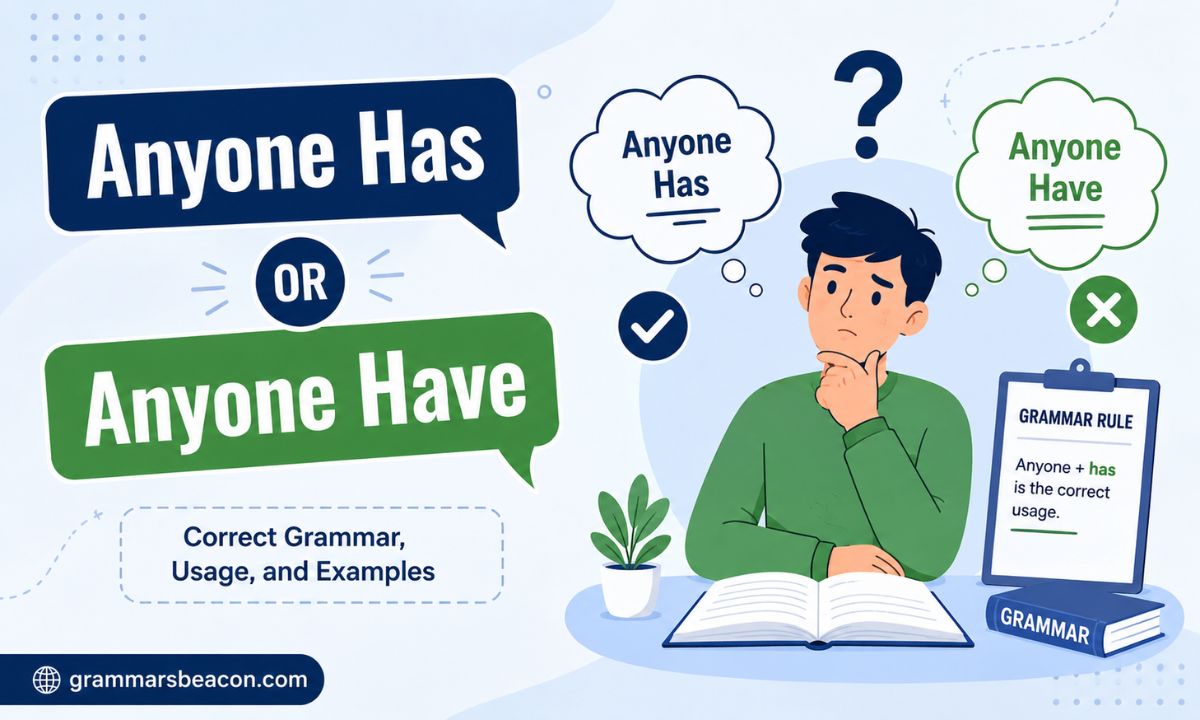
If you have ever paused mid sentence wondering whether to write “anyone has” or “anyone have,” you are not alone. This tiny grammar choice trips up native speakers and English learners alike, mostly because spoken English and written English do not always follow the same pattern.
The good news is that the rule is simple once you understand how “anyone” behaves as a subject. In this guide, you will learn the exact rule, see real examples, and finally stop second guessing yourself in emails, essays, and everyday conversation.
Quick Answer First: Anyone Has vs Anyone Have
Here is the short version if you are in a hurry:
- Use “anyone has” in statements: Anyone has the right to ask questions.
- Use “anyone have” after helping verbs like “does,” “do,” “can,” or “did”: Does anyone have a pen?
The word “anyone” is always grammatically singular, so it pairs with “has” on its own. It only appears with “have” when an auxiliary verb like “does” or “did” is already doing the agreement work in the sentence.
The Core Grammar Rule You Must Know

English subject verb agreement depends on whether the subject is singular or plural. “Anyone” looks like it could refer to a group of people, but grammatically it behaves exactly like “he,” “she,” or “it.”
Anyone Is Always Singular
Even though “anyone” refers to an unspecified person out of many possible people, it is treated as one grammatical unit. Think of it as short for “any one person.” That mental trick makes the rule click instantly.
Because “anyone” is singular, it needs a singular verb form in a normal statement, which means “has” instead of “have.”
Common Singular Indefinite Pronouns
“Anyone” is not the only pronoun that follows this rule. Several indefinite pronouns behave the same way.
| Indefinite Pronoun | Correct Verb Form | Example |
| Anyone | has | Anyone has the option to leave early. |
| Anybody | has | Anybody has access to the shared folder. |
| Everyone | has | Everyone has submitted the form. |
| Someone | has | Someone has already fixed the bug. |
| Nobody | has | Nobody has seen the results yet. |
| Each | has | Each has a different opinion. |
Notice the pattern. All of these pronouns take a singular verb, no exceptions, because they all refer to one unspecified individual at a time.
Anyone Has or Anyone Have Examples
Seeing both forms side by side in real sentences makes the rule easier to remember.
- Anyone has the ability to learn a new language.
- Does anyone have a charger I can borrow?
- Anyone has the right to disagree politely.
- I do not think anyone has finished the assignment.
- Can anyone have this much luck twice in one week?
Notice that “has” shows up in plain statements, while “have” only appears when a helping verb like “does,” “do,” or “can” comes before “anyone.”
When “Anyone Has” Is Correct
“Anyone has” is correct whenever “anyone” is the subject of a simple declarative sentence with no auxiliary verb doing the work of agreement.
Declarative Statements
Declarative sentences state a fact, opinion, or observation. In these sentences, “anyone” pairs directly with “has.”
- Anyone has the freedom to express their opinion.
- Anyone has permission to enter after 9 a.m.
- Anyone has a chance to win the raffle.
These sentences are simple, direct, and grammatically complete without needing an extra helping verb.
Embedded Clauses and Indirect Speech
“Anyone has” also shows up correctly inside embedded clauses, which are clauses tucked inside a larger sentence, often after words like “that,” “if,” or “whether.”
- She said that anyone has the right to appeal the decision.
- I am not sure whether anyone has noticed the mistake.
- The manager confirmed that anyone has access to the report.
In these cases, “anyone” is still functioning as a normal subject inside its own clause, so the singular verb rule still applies.
Formal and Written English
Formal writing, including academic papers, business reports, and professional emails, almost always favors “anyone has” in statements. Style guides and grammar authorities consistently treat “anyone” as singular, which is why “anyone has” is the standard, expected form in edited writing.
If you are writing a report, an email to a client, or an academic essay, “anyone has” is the safer and more polished choice whenever you are making a statement rather than asking a question.
When “Anyone Have” Is Correct
“Anyone have” is not wrong. It becomes correct the moment an auxiliary verb like “does,” “do,” “did,” “can,” or “could” appears before “anyone” and takes on the job of agreement.
Direct Questions
In questions, English uses a helping verb, and the main verb drops back to its base form. That is why “have” appears instead of “has.”
- Does anyone have a spare charger?
- Did anyone have trouble finding the venue?
- Could anyone have predicted this outcome?
The auxiliary verb, not “anyone,” is what agrees with the subject in these sentences. The main verb stays in its plain, uninflected form.
Does Anyone Have or Has Questions
This exact phrase, “does anyone have or has,” is one of the most searched grammar questions online, and the answer is always the same: “does anyone have” is correct.
- Correct: Does anyone have a question?
- Incorrect: Does anyone has a question?
The rule behind this is straightforward. Once “does” appears in the sentence, it already carries the third person singular marker. Adding an “s” to “have” as well would be double marking the same grammatical feature, which English does not allow.
Negative Constructions
Negative sentences follow the same auxiliary verb logic as questions.
- I do not think anyone has a copy of the file. (statement with “has”)
- Doesn’t anyone have the answer to this? (question with “have”)
- Nobody said anyone had a problem with the plan.
Pay attention to whether an auxiliary verb like “does” or “do” is present. If it is, use “have.” If it is not, use “has.”
Conditional and Hypothetical Sentences
Conditional sentences, especially those built with “if,” typically use “has” when describing a present or general condition.
- If anyone has a concern, please raise it now.
- If anyone has already left, mark their name on the list.
However, when a conditional sentence includes an auxiliary verb such as “does” or “did,” “have” returns to its base form once again.
- If anyone does have a concern, they should speak up.
Why People Keep Getting This Wrong
If the rule is this clear, why does the mistake happen so often? The answer lies in how differently we speak versus how we write.
Spoken English vs Written English
In casual conversation, people often rush through sentences and blend sounds together. Phrases like “anyone have any ideas” sometimes slip out because they sound similar to the correct “does anyone have any ideas,” especially when the “does” gets dropped in fast speech. This spoken habit then leaks into texting, casual emails, and even formal writing if you are not paying close attention.
Word Order Illusions
Another reason for the confusion is word order. In a question, the auxiliary verb “does” appears right before “anyone,” which can trick your brain into thinking “anyone” needs its own separate agreement with “have.” In reality, “does” has already handled that agreement, so “have” just tags along in its base form.
Subject-Verb Agreement Made Simple
Here is a simple three-step method to check your sentence every time.

- Find the subject of the sentence. If it is “anyone,” treat it as singular, just like “he” or “she.”
- Check whether there is an auxiliary verb like “does,” “do,” “did,” “can,” or “could” before or near “anyone.”
- If there is no auxiliary verb, use “has.” If there is one, use “have” in its base form.
This quick mental checklist works for “anyone” and every other singular indefinite pronoun listed earlier in this article.
Anyone Has vs Anyone Have: Side-by-Side Comparison
| Sentence Type | Correct Form | Example |
| Statement | anyone has | Anyone has the right to vote. |
| Question with “does” | anyone have | Does anyone have a minute? |
| Negative statement | anyone has | Nobody believes anyone has the full picture. |
| Negative question | anyone have | Doesn’t anyone have an update? |
| Conditional (simple) | anyone has | If anyone has feedback, share it. |
| Conditional with “does” | anyone have | If anyone does have feedback, share it. |
| Past question | anyone have | Did anyone have a backup plan? |
Anyone vs Anybody: Is There a Difference?
“Anyone” and “anybody” mean the same thing and follow identical grammar rules. Both are singular indefinite pronouns, and both pair with “has” in statements and “have” after auxiliary verbs.
- Anybody has the option to join the meeting.
- Does anybody have the schedule for tomorrow?
The only real difference between the two is style. “Anyone” tends to sound slightly more formal, while “anybody” feels a touch more casual, but grammatically they are interchangeable.
Common Mistakes (And How to Fix Them)
Mistake 1: Matching Meaning Instead of Grammar
Because “anyone” can refer to a group of possible people, writers sometimes assume it needs a plural verb like “have.” Remember that grammar cares about the form of the pronoun, not the number of people it could theoretically include. Fix: always treat “anyone” as one grammatical unit, similar to “he” or “she.”
Mistake 2: Forgetting the Auxiliary Verb Rule
Some writers use “has” even after “does,” producing the incorrect “does anyone has.” Fix: once “does” appears, the main verb always returns to its base form, so it becomes “does anyone have.”
Mistake 3: Copying Spoken English Into Writing
Casual speech often drops helping verbs or blends words together, which can lead to writing “anyone have” in a plain statement by mistake. Fix: read your sentence aloud slowly and check for a hidden auxiliary verb before deciding between “has” and “have.”
Pronunciation Traps That Cause Confusion
Spoken English moves fast, and certain sounds blend together in ways that hide the grammar. “Does anyone” can sound almost like “anyone” alone when spoken quickly, which is part of why some people mistakenly write “anyone have” in a plain statement. Slowing down and mentally inserting the full auxiliary verb before writing can prevent this common slip.
READ MORE: Taken vs Taking: Key Differences, Meanings, and Correct Usage Guide
Real-World Usage Examples
Everyday Conversation
- Does anyone have change for a twenty?
- Anyone has a story to tell if you ask the right questions.
- I don’t think anyone has seen this movie yet.
Workplace Communication
- Anyone has the ability to request time off through the portal.
- Does anyone have the updated budget spreadsheet?
- If anyone has questions about the new policy, please reach out to HR.
Academic and Exam Writing
- Anyone has the right to a fair hearing under the law.
- The study asks whether anyone has experienced similar symptoms.
- Does anyone have evidence that contradicts this theory?
Quick Grammar Checklist (Bookmark This)
Use this checklist any time you are unsure which form to use.
- Is “anyone” the plain subject of a statement? Use has.
- Is there a “does,” “do,” or “did” nearby? Use have.
- Is it a question starting with an auxiliary verb? Use have.
- Is it a simple conditional sentence with “if anyone”? Use has.
- Does the conditional sentence also include “does” or “did”? Use have.
Conclusion
The choice between “anyone has” and “anyone have” comes down to one reliable rule. “Anyone” is always singular, so it takes “has” on its own in statements, and it only shifts to “have” when an auxiliary verb like “does,” “do,” “did,” “can,” or “could” is already handling the agreement.
Once this pattern clicks, you will stop second guessing yourself in emails, reports, conversations, and exams. Keep the checklist above nearby, apply it to similar pronouns like “everyone,” “somebody,” and “nobody,” and your subject verb agreement will stay accurate every time.