
Have you ever typed “I taught myself” and then paused, wondering if it should actually be “my self”? You’re not alone. This mix up trips up native speakers, students, and even professional writers because the two forms look almost identical on the page.
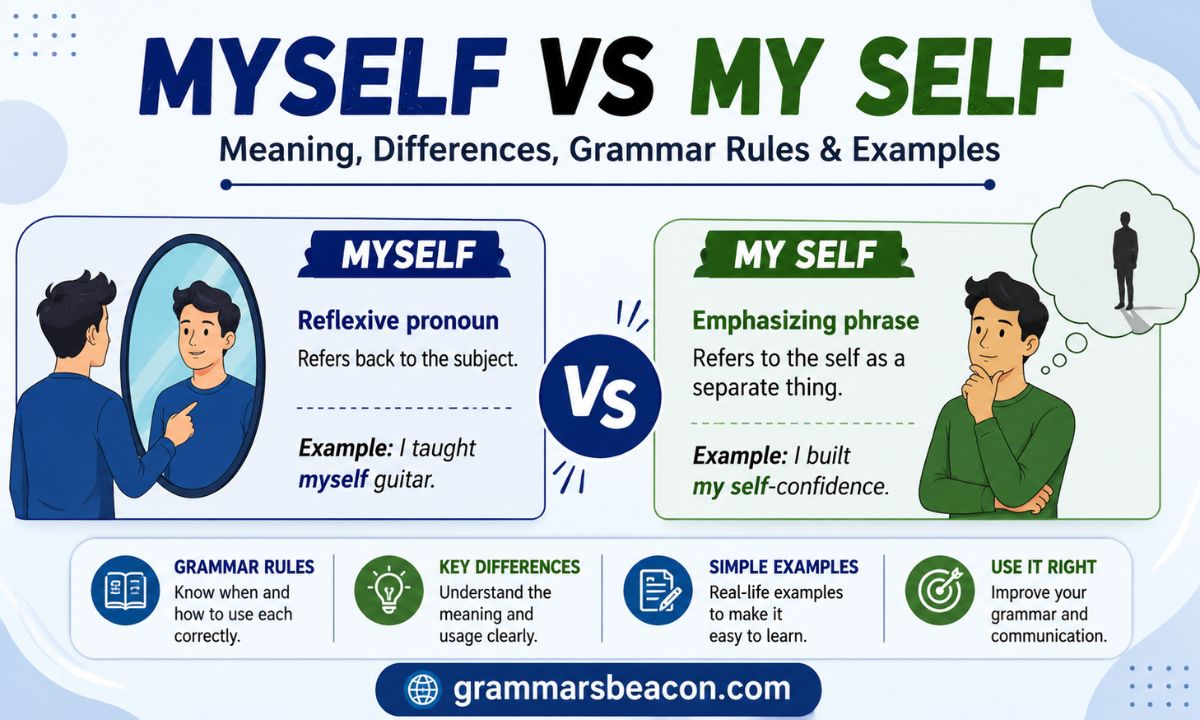
The truth is simple once you see it clearly. “Myself” is a grammar word. “My self” is an identity phrase. One belongs in a sentence about action. The other belongs in a conversation about who you are. This guide breaks down both forms with real examples, common mistakes, and a quick test you can use every time you’re unsure.
Myself vs My Self
At a glance, here is how the two forms differ:
| Feature | Myself | My Self |
| Word count | One word | Two words |
| Part of speech | Reflexive/intensive pronoun | Possessive adjective + noun |
| Used in | Everyday grammar, formal writing | Psychology, philosophy, reflective writing |
| Function | Refers action back to the subject or adds emphasis | Describes identity, consciousness, or inner being |
| Example | I hurt myself. | I lost touch with my self. |
| Standard English? | Yes, always | Only in specific reflective or philosophical contexts |
Myself vs My Self: What’s the Real Difference?
The core difference comes down to grammar versus meaning. “Myself” follows fixed rules. It shows up after a verb when the subject and the object are the same person, or it adds emphasis to a statement someone already made.
“My self,” on the other hand, isn’t a standard grammatical pronoun at all. It’s a possessive word (“my”) paired with a noun (“self”). In this form, “self” behaves like any other noun, similar to “my mind,” “my heart,” or “my identity.” You could swap it for phrases like “my inner being” or “who I truly am” and the sentence would still make sense.
That single space is doing a lot of work. It shifts the phrase from a grammar category into a meaning category, and that shift changes how the sentence should be read.
What “Myself” Really Means in English
“Myself” is one of English’s reflexive pronouns, a small group of words that includes himself, herself, yourself, and ourselves. These words exist to show that the subject of a sentence and the receiver of an action are the same person.
“Myself” as a Reflexive & Intensive Pronoun
“Myself” has two jobs in a sentence, and knowing which one is being used helps you spot mistakes quickly.
Two main functions of “myself”:
- Reflexive use: The action loops back to the subject. Example: I cut myself while chopping vegetables.
- Intensive use: The word adds emphasis but isn’t grammatically necessary. Example: I built this website myself.
A simple test separates the two. Remove “myself” from the sentence. If the sentence breaks or loses meaning, it’s reflexive. If the sentence still works fine without it, it’s intensive.
Correct Examples in Everyday Sentences
Reflexive Use
- I taught myself how to code.
- She hurt herself during the workout.
- I convinced myself to stay calm.
- He introduced himself to the new team.
In each case, removing the reflexive pronoun leaves an incomplete thought. “I taught” is missing an object. “She hurt” doesn’t say who or what was hurt.
Intensive Use
- I baked this cake myself.
- The manager herself approved the request.
- I fixed the sink myself.
- They painted the house themselves.
Here, deleting the word changes nothing except the level of emphasis. “I baked this cake” is a complete sentence on its own.
Incorrect Uses of “Myself” (Very Common!)
Many writers reach for “myself” when they actually need “I” or “me,” often because it sounds more polite or formal. It isn’t. Reflexive pronouns can only be used when the subject already appears earlier in the same sentence.
| Incorrect | Correct | Why |
| John and myself went to the meeting. | John and I went to the meeting. | No earlier subject for “myself” to reflect back to. |
| Please send the file to Sarah or myself. | Please send the file to Sarah or me. | “Myself” cannot stand in for an object pronoun. |
| Myself and the team completed the project. | I and the team completed the project (better: The team and I). | “Myself” cannot open a sentence as the subject. |
A quick rule of thumb: if there’s no matching subject already in the sentence, “myself” doesn’t belong there.
Understanding “My Self” (Two Separate Words)
Written as two words, “self” stops acting like part of a pronoun and starts acting like a noun in its own right. This version shows up far less often in daily speech, but it carries real weight in reflective and academic writing.
What “My Self” Actually Means
“My self” refers to your identity, your consciousness, or the person you understand yourself to be beneath roles, labels, and daily habits. It’s less about doing something and more about being someone.
Examples
- I’m slowly reconnecting with my self after a stressful year.
- Therapy helped me understand my self on a deeper level.
- My self today feels different from who I was a decade ago.
- Losing my job made me question my self and my purpose.
None of these sentences describe an action bouncing back to a subject. Instead, “self” functions as the main noun, describing an inner state or identity.
Where “My Self” Is Commonly Used
Psychology
In psychology, “self” is treated as a core concept tied to self-awareness, self-esteem, and self-concept. Writers and clinicians often discuss “my self” or “the self” when exploring how people understand and value who they are.
Philosophy
Philosophers have debated the nature of the self for centuries, asking whether it is fixed, changing, or even real. In this context, “my self” refers to personal identity and consciousness rather than a grammatical function.
Literature
Reflective and literary writing often leans on “my self” to capture inner conflict, growth, or transformation. It appears in memoirs, poetry, and personal essays where the focus is introspective rather than action based.
Myself vs My Self Examples
| Sentence | Correct Form | Reason |
| I did all the work ___. | myself | Emphasizes personal effort (intensive) |
| I hurt ___ at the gym. | myself | Action reflects back to subject (reflexive) |
| I’m learning to accept ___. | my self | Refers to identity, not action |
| I introduced ___ to the group. | myself | Reflexive pronoun |
| Meditation helped me find ___. | my self | Refers to inner being |
Why “Myselves” Is Incorrect, Always
It’s tempting to assume “myself” can be pluralized the way regular nouns are, but reflexive pronouns don’t work that way. “I” is always singular, so there’s no plural version of “myself.” When a group of people wants to express the same reflexive idea, English uses “ourselves” instead.
- Incorrect: We finished the project myselves.
- Correct: We finished the project ourselves.
There is no situation in standard English where “myselves” is grammatically valid.
How “Myself” Functions in Grammar
Reflexive Structure: Subject = Object
In reflexive sentences, the subject performs an action, and that same person receives the action. The formula looks like this:
Subject + Verb + Reflexive Pronoun
Example: I (subject) taught (verb) myself (object, same person as subject).
Intensive Structure: Adding Emphasis
Intensive pronouns sit right after the subject or noun they’re emphasizing, and their only job is to highlight that the person did something alone or personally.
Example: I myself reviewed every page before publishing.
Removing “myself” here still leaves a complete, grammatically correct sentence: “I reviewed every page before publishing.”
Identity & Philosophy: The Non-Reflexive “Self”
“Self” as a Concept
Outside of grammar, “self” stands as an abstract noun representing identity, consciousness, and personal experience. Thinkers across psychology and philosophy, including Carl Jung and Sigmund Freud, explored the self as the center of human awareness. In this sense, “my self” isn’t a grammatical structure at all. It’s a way of naming your inner life.
How Spacing Changes Meaning
That single space between “my” and “self” flips the entire category of the phrase.
- Myself (one word): grammar tool, used for actions and emphasis.
- My self (two words): identity concept, used for reflection and consciousness.
Think of it this way: “myself” describes what you do, while “my self” describes who you are.
Common Errors and How to Avoid Them
Using “Myself” Instead of “Me” or “I”
This happens when people want to sound formal or polite in emails and professional writing. Stick to “I” for subjects and “me” for objects unless the sentence is truly reflexive or intensive.
Using “My Self” When “Myself” Is Correct
Some writers split the word by habit or autocorrect confusion, producing sentences like “I told my self to relax” when “I told myself to relax” is correct, since this is a reflexive action, not an identity statement.
Adding “Myself” to Sound Formal
Business writing is especially prone to this. Phrases like “please contact myself” are incorrect because there’s no earlier subject in the sentence for “myself” to reflect.
Confusing Identity With Grammar
Writers sometimes reach for “my self” in casual sentences that are really about action, not identity. If the sentence describes doing something, “myself” is almost always the right choice.
Quick Decision Guide to Remember the Difference
Ask yourself: Is it about grammar or identity?
If the sentence describes an action, use “myself.” If the sentence describes your inner being, identity, or consciousness, use “my self.”
Fast Test
- Remove the word from the sentence.
- If the sentence still makes sense and reads naturally, it’s likely intensive “myself.”
- If removing it breaks the sentence, it’s reflexive “myself.”
- If the sentence is about identity or feelings rather than action, use “my self.”
One-Line Rule
Myself is for doing. My self is for being.
Read More: Each Is or Each Are: Grammar Rules, Examples & Correct Usage
Real-Life Examples & Micro Case Studies
Case Study 1: Email at Work
A marketing coordinator once wrote, “Please forward the report to John or myself.” Her manager corrected it to “Please forward the report to John or me,” explaining that “myself” cannot replace an object pronoun in a request like this. This is one of the most common mistakes in professional writing.
Case Study 2: Personal Journal Entry
A journaling client wrote, “I’m trying to find my self again after a difficult year.” Here, “my self” correctly captures an identity focused reflection, not a grammatical action, which is exactly the kind of context where the two word form fits naturally.
Case Study 3: Classroom Grammar
An English teacher demonstrated the difference using two sentences on the board: “I hurt myself” and “I’m exploring my self through writing.” Students quickly noticed that the first sentence described a physical action, while the second described an internal, reflective process.
Case Study 4: Meditation Coaching
A meditation instructor often tells clients, “Take time to sit with your self today,” deliberately choosing the two word form to emphasize inner presence and awareness rather than any physical task.
Conclusion
The difference between “myself” and “my self” comes down to one simple idea: grammar versus identity. “Myself” is a reflexive or intensive pronoun used to show that an action loops back to the subject or to add emphasis. “My self,” written as two words, refers to your inner being, consciousness, or identity, and shows up mostly in psychology, philosophy, and reflective writing.
When you’re unsure which to use, ask whether the sentence is about doing something or being someone. Doing calls for “myself.” Being calls for “my self.” Keep that one line in mind, and you’ll get it right every time.