
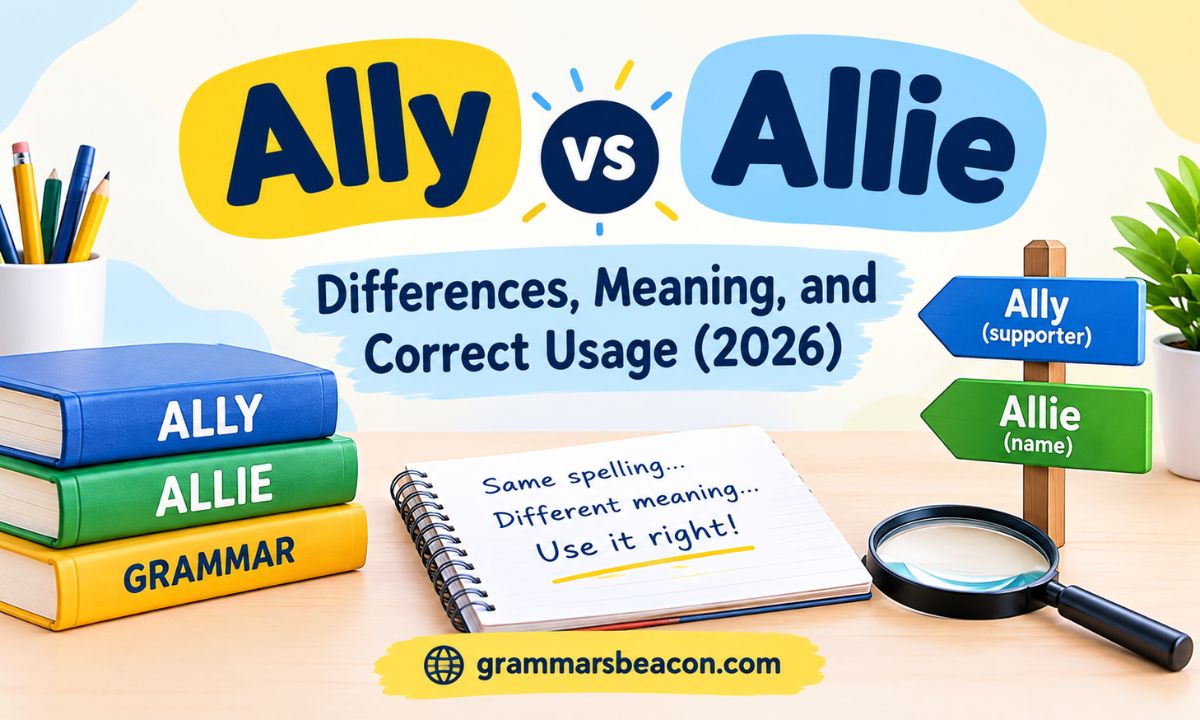
Two words sound close, look almost the same, and get mixed up all the time. Ally is a common word for a supporter or partner. Allie is a first name. This guide covers meanings, origins, pronunciation, examples, common mistakes, and a short practice quiz, so you can pick the right spelling every time.
Allie Meaning
Allie is a given name, usually a short form of Alice, Alison, Alexandra, or Alyssa. It is not an everyday vocabulary word. If you see it in a sentence, it should point to a person, a character, or a brand.
The Core Difference
| Feature | Ally | Allie |
| Type | Common noun and verb | Proper noun (name) |
| Meaning | A supporter, partner, or to team up | A person’s first name or nickname |
| Capitalized? | Only at the start of a sentence | Always |
| Plural | Allies | Allies (as in “the Allies of the name”) |
The short rule: if you mean a supporter, write ally. If you mean a person named Allie, write Allie.
Ally Definition, History, and Usage
Ally Definition
An ally is a person, group, or country that supports another, especially during a struggle or shared effort. The word carries trust, loyalty, and cooperation.
Ally as a noun
As a noun, ally names the supporter itself.
- She was my strongest ally during the merger.
- The two countries have been allies for decades.
Ally as a verb
As a verb, ally means to join or unite for a purpose. It is often used with “with” or “against,” and it is pronounced differently from the noun (see the pronunciation section).
- The small parties allied to block the bill.
- He allied himself with the local teachers.
Word Origins
Ally comes from Old French alier, which traces back to the Latin alligare, meaning “to bind to.” That idea of binding together explains the modern meaning. An ally is someone tied to you by a shared goal. The related words alliance, alloy, and rally grow from similar roots.
Ally in Politics Meaning
In politics and international relations, an ally is a nation or group that formally or informally cooperates with another for security, trade, or shared goals. Allies may sign treaties, share intelligence, or vote together in legislatures.
Examples of modern political allies
- NATO members, who commit to collective defense.
- The United States and Japan, linked by a long-standing security partnership.
- European Union states, which cooperate on trade and policy.
- Coalition parties inside a government that join forces to pass laws.
Note that “the Allies” with a capital A refers specifically to the alliance of nations in the World Wars.
Allie Meaning
Allie works as a warm, friendly personal name. It has no dictionary meaning outside of naming, which is why it should never replace the word ally in ordinary writing.
Allie Definition
Allie is a feminine given name in most English-speaking countries, though it is occasionally used for boys. It often appears as a nickname, and it can also be a legal first name on its own. It is sometimes a rare surname.
Read More: Sponser vs Sponsor
Related Articles You May Find Helpful
- Ally vs Alley: What Sets Them Apart
- Aid vs Aide: Correct Usage
- Alright vs All Right: Which Is Correct?
Allie Name Meaning
Baby-name sources describe Allie as a form of Alice (“noble”), Alexandra (“defender of mankind”), and Alison. Because it draws from several roots, its meaning is usually given as noble, protector, or kind. Some sources link it to a Celtic root for “harmony,” though that origin is less certain.
Allie Nickname Meaning
As a nickname, Allie signals warmth and closeness. Friends and family often shorten these names to Allie:
- Alice
- Alison
- Alexandra
- Alyssa
- Allison
In a nickname role, it feels casual and affectionate rather than formal.
Popularity of the Name Allie
Allie rose in the United States in the early 20th century, faded, and returned in the mid-1980s. In recent U.S. birth data, it sits around the 900s for girls, so it is familiar but not among the top names. Rankings shift year to year, so check the Social Security Administration’s baby name data for the latest figure. The name also gets a boost from public figures and fictional characters who share it.
A Direct Comparison
| Question | Ally | Allie |
| Can it be a verb? | Yes | No |
| Does it describe a supporter? | Yes | No |
| Is it a personal name? | Rarely (Ally is also a spelling of the name) | Yes |
| Is it found in most dictionaries as a word? | Yes | No, it appears in name databases |
| Common in formal writing? | Yes | Only when naming a person |
How to Use Ally in a Sentence
Examples as a noun
- A good mentor is an ally in your career.
- The senator found an unexpected ally in the opposition.
- Sleep is an athlete’s best ally.
Examples as a verb
- The two companies allied to enter the new market.
- She refused to ally with anyone who ignored the facts.
- Farmers allied against the new tax.
Ally Synonyms
Use these when you want variety in your writing:
- Supporter
- Partner
- Friend
- Collaborator
- Associate
- Confederate
- Backer
- Advocate
For the verb, try unite, join, team up, or band together.
Read More: Encorporate vs Incorporate
How to Use Allie in a Sentence
Allie always names someone, so it is capitalized and usually followed by an action.
- Allie called to confirm the meeting time.
- I asked Allie to review my draft.
- “Allie, could you pass the notes?” he asked.
Ally vs Allie Examples in Sentences
| Correct | Why |
| Allie is my closest friend and biggest ally. | Name first, supporter second. |
| The coalition gained a new ally. | Supporter, so lowercase ally. |
| Allie plans to ally with her classmates for the project. | Name, then the verb. |
| Our allies backed the proposal. | Plural of the common noun. |
Related Articles You May Find Helpful
- Affect vs Effect Made Simple
- Complement vs Compliment: Quick Guide
- Its vs It’s: Rules and Examples
Common Grammar Mistakes With Ally vs Allie
Most errors come from spelling by ear. Here are the three you will see most often.
Using “Allie” when you mean “Ally”
- Wrong: He is a loyal allie to the team.
- Right: He is a loyal ally to the team.
Using “Ally” as someone’s name
Ally is a valid spelling of a name, but it is a different choice from Allie. If a person spells her name Allie, do not change it to Ally.
- Wrong: I emailed Ally Johnson (when her name is Allie).
- Right: I emailed Allie Johnson.
Always match the spelling the person uses.
Capitalization errors
- Wrong: She is my allie, allie brown.
- Right: She is my ally, Allie Brown.
Ally stays lowercase unless it starts a sentence. Allie always starts with a capital letter.
Why Ally vs Allie Creates Spelling Confusion
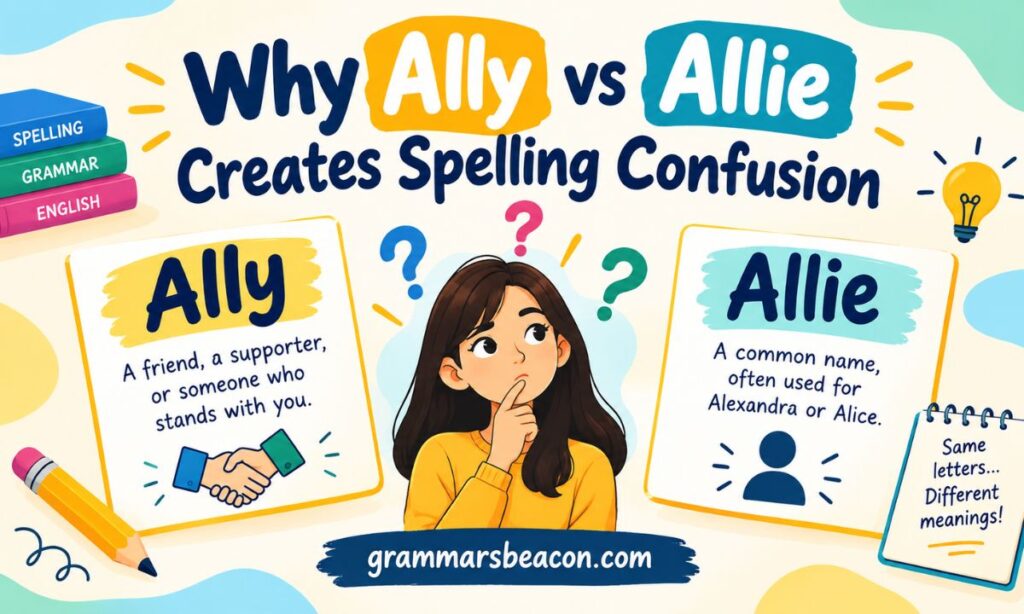
Identical pronunciation
The name Allie (AL-ee) and the name spelling Ally sound the same. That overlap causes mix-ups in speech. The common noun ally sounds slightly different (AL-eye), but many people still spell by sound.
Nearly identical spelling
The words differ by one letter. A quick glance or a spellchecker that accepts both can hide the error, since both are real words in most dictionaries.
Read More: Become vs Became
Different grammatical roles
Ally is a common word that can act as a noun or verb. Allie is a proper noun. Writers who forget this distinction often pick whichever looks more familiar.
Ally Pronunciation
| Word | Pronunciation | Sounds like |
| Ally (noun) | /ˈæl.aɪ/ | AL-eye |
| Ally (verb) | /əˈlaɪ/ | uh-LYE |
| Allie (name) | /ˈæl.i/ | AL-ee |
Stress falls on the first syllable for the noun and on the second for the verb.
When to Use Ally vs Allie
Are you describing a supporter or partner?
Use ally. It fits people, groups, and nations that back someone else.
Are you referring to someone’s name?
Use Allie, with a capital A, unless the person spells it another way.
Quick reference table
| Situation | Correct choice |
| Someone who supports you | ally |
| To join forces | ally (verb) |
| A person’s first name | Allie |
| Military or political partner | ally |
| Nickname for Alexandra | Allie |
| Plural supporters | allies |
Ally in Social Advocacy
Today, ally is widely used in social justice and inclusion work. An ally in this sense is someone who stands with a group they may not belong to, using their voice or position to help. Common examples include allies to the LGBTQ+ community, allies in workplace equality efforts, and allies in disability advocacy. Strong allies listen, learn, and act, rather than just declare support.
Related Articles You May Find Helpful
- Advocate vs Advocator
- Mentor vs Coach: Key Differences
- Inclusive Language Basics
Allie as a Cultural Name
Allie appears across books, television, and music. Literary readers may recall Allie Caulfield, the late brother in The Catcher in the Rye, and Allie Fox from The Mosquito Coast. The name feels friendly and approachable, which helps explain its lasting appeal.
Tips to Remember the Ally vs Allie Spelling Difference
Think about alliances
Ally and alliance both contain “ally.” If the word connects to alliance, use ally.
Apply the name rule
If you can swap in a person’s name, or capitalize it as a name, use Allie.
Check the sentence context
Ask: does the sentence describe support or a person? Support means ally. A person means Allie.
Reference Cambridge Dictionary Definitions
When in doubt, look up the word in a trusted source such as the Cambridge Dictionary. It lists ally as a noun and verb, and it will not list Allie as a common word.
Final Thoughts
The rule is simple. Ally means a supporter or partner, and it can also be a verb. Allie is a name and always takes a capital letter. Check the context, think about alliance, and match a person’s spelling when writing their name. With these habits, you will avoid this common mix-up in emails, essays, and everyday writing.
If you would like this as a Word document or an HTML file ready to publish, I can put it in one for you.











1 thought on “Ally vs Allie: Differences, Meaning, and Correct Usage (2026)”