
Have you ever written “she become a manager” and then paused, unsure if that sounds right? Or typed “I became happy every day” and felt something was off? You’re not alone. Become and became trip up learners and native speakers alike because they come from the same irregular verb but belong to completely different points in time.
This guide clears up the confusion for good. You’ll learn exactly when to use become, became, becomes, has become, and have become, with real examples, a comparison table, and memory tricks that make the choice automatic.
Understanding the Basics of Become vs Became
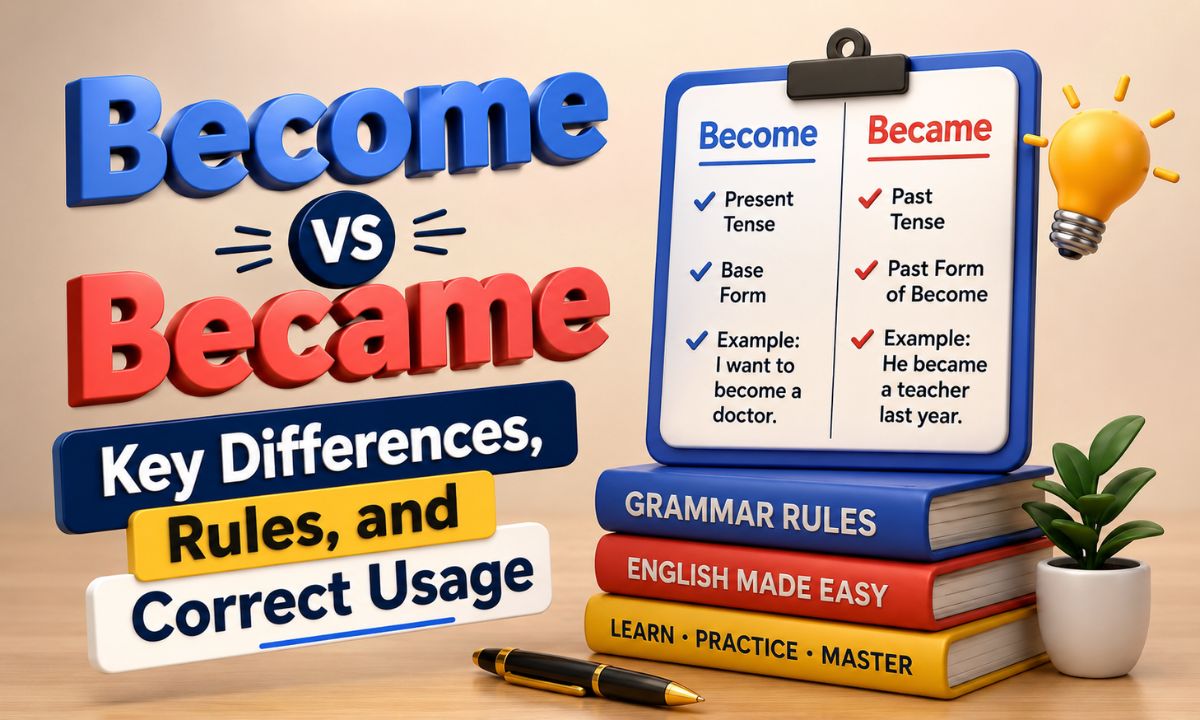
Become and became are two forms of one irregular verb that means “to change into something” or “to start being something.” The core difference comes down to time.
- Become is used for the present, for general truths, and with plural subjects or I/you/we/they.
- Became is the simple past tense, used only for actions that are already finished.
Because become is irregular, it doesn’t follow the normal “-ed” pattern that regular verbs use. There is no such word as “becomed.” Instead, English gives us three key forms to memorize:
- Become (base form and past participle)
- Became (simple past)
- Becomes (present tense, singular subject)
Once you separate these three forms in your mind, the rest of this guide will feel like common sense.
The Base Form “Become”: What It Really Means
Become describes a transformation that is happening now, happens regularly, or is a general truth. It’s forward-looking rather than backward-looking, and it applies to more than physical change. You can become confident, become a doctor, become tired, or become part of a team.
When to Use “Become”
Use become when:
- The subject is plural (they, we, people, students)
- The subject is I, you, we, or they
- You’re describing a habitual or repeated action
- You’re stating a general truth or ongoing process
- The sentence is in the base or infinitive form (to become)
Examples of “Become” in Present Tense
- I become nervous before big presentations.
- They become excited whenever the holidays approach.
- We become better writers with daily practice.
- Children become curious as they grow older.
- People become more patient with experience.
Quick Tip
If you can swap the subject with “I,” “we,” or “they” and the sentence still sounds natural, become is almost always the correct choice.
Become vs Became Sentences
Seeing both forms side by side in real sentences makes the contrast click faster than any rule can.
| Sentence with Become | Sentence with Became |
| I become anxious during exams. | I became anxious during my last exam. |
| They become close friends over time. | They became close friends last summer. |
| She wants to become a lawyer. | She became a lawyer in 2019. |
| The weather can become unpredictable. | The weather became unpredictable overnight. |
| We become stronger through practice. | We became stronger after months of training. |
Notice the pattern: become sits in the present or describes something ongoing, while became locks the action into a finished moment in the past.
The Simple Past Form “Became”: Understanding Its Purpose
Became belongs fully to the past. You use it when a change already happened and is complete, with no connection required to the present moment.
When to Use “Became”
Use became when:
- The action is finished and belongs to a specific past time
- You’re telling a story, recounting history, or describing a completed milestone
- Time markers like yesterday, last year, in 2020, or ago appear in the sentence
- The subject can be singular or plural, since became doesn’t change based on subject count
Correct Examples of “Became”
- She became a doctor after seven years of study.
- The company became profitable within its second year.
- He became frustrated during the long delay.
- The sky became dark just before the storm hit.
- They became business partners after that meeting.
Pro Tip
If your sentence includes a clear past-time signal, such as “last week” or “in 2015,” became is the only correct option. Never pair those markers with become.
Become vs Becomes: The Simple Present Tense Difference
This is where many writers stumble. Become and becomes are both present tense, but they depend entirely on subject-verb agreement.
- Become pairs with I, you, we, they, and plural nouns.
- Becomes pairs with he, she, it, and singular nouns.
Examples:
- She becomes nervous before speeches.
- He becomes happier when he travels.
- The room becomes quiet after midnight.
- A habit becomes part of your identity.
- I become more focused in the morning.
- They become quieter as the meeting drags on.
A simple rule of thumb: add an “s” to become only when the subject is singular and third-person, just like most present tense verbs.
Present Perfect Tense: “Has Become” and “Have Become”
The present perfect tense connects a past change to the present moment. It signals that something changed and the result is still relevant now. Both has become and have become use become, the past participle, never became.
Has Become
Use has become with singular subjects: he, she, it, or singular nouns.
- The city has become safer over the years.
- My dog has become calmer lately.
- This app has become essential for my daily routine.
Have Become
Use have become with I, you, we, they, and plural subjects.
- We have become more aware of our health.
- You have become a great communicator.
- Students have become more independent with online learning.
Why “Has Became” Is Always Incorrect
“Has became” is a grammar mistake you’ll see often, but it’s never correct. Perfect tenses require the past participle, and the past participle of become is become, not became. There’s no situation, formal or casual, where “has became” or “have became” is acceptable. If you remember one rule from this entire guide, remember this one.
The Subtleties of “Would Become”
Would become describes a future outcome viewed from a past perspective, or a hypothetical result. It often appears in storytelling, predictions, and conditional statements.
Examples
- Nobody knew he would become a famous author.
- She hoped the small business would become a success.
- If they moved to the city, they would become closer to their extended family.
- The intern later would become the company’s youngest director.
This structure is especially common in narrative writing, where you’re looking back at a past moment while pointing toward a future that has since arrived.
Comparison Table: Become vs Became vs Becomes vs Has Become vs Have Become
| Form | Tense | Used With | Example |
| Become | Present / Base form | I, you, we, they, plural nouns | They become tired after long shifts. |
| Becomes | Simple present | He, she, it, singular nouns | She becomes tired quickly. |
| Became | Simple past | Any subject | He became tired after the run. |
| Has become | Present perfect | He, she, it, singular nouns | It has become a daily habit. |
| Have become | Present perfect | I, you, we, they, plural nouns | We have become close friends. |
Memory Tricks to Never Confuse Become vs Became Again
If the rules above still feel abstract, these five mental shortcuts will help the difference stick permanently.
1. The Timeline Trick
Picture a simple timeline. Become sits on the present side, became sits on the past side. If the action is finished and behind you, reach for became.
2. The “S” Rule
Only singular third-person subjects (he, she, it) take the “s”: becomes. Everyone else uses the plain form, become.
3. The “Has Became” Red Flag
Train yourself to treat “has became” and “have became” as an automatic red flag. Perfect tenses always pair with become, never became.
4. The Sound Test
Read the sentence aloud with a past-time word inserted, like “yesterday” or “last year.” If it sounds natural, became is correct. If it sounds odd, stick with become.
5. The Color Change Analogy
Think of a leaf changing color. “The leaf becomes orange” describes an ongoing seasonal process. “The leaf became orange” describes one specific moment when the color finished changing. That mental picture separates ongoing change from completed change instantly.
Became or Become for Future
Neither became nor becomes belongs in future tense sentences. For future meaning, pair become with will, going to, or another future marker, and keep it in its base form.
- Correct: The milk will become warm.
- Incorrect: The milk will became warm.
- Correct: She is going to become a nurse next year.
- Incorrect: She is going to became a nurse next year.
After will, going to, can, could, should, or any modal verb, always use the base form become.
Read More: Persue or Pursue? Learn the Correct Spelling of Pursue (Complete Guide)
Mini Case Study: How Grammar Changes Meaning
Small grammar choices can completely shift how a sentence is understood. Here are three quick scenarios that show the stakes.
Case Study 1: Career Transformation
“She becomes a manager” suggests a repeated or general pattern, almost like a role she steps into regularly. “She became a manager” states a one-time, completed promotion. “She has become a manager” tells us the promotion happened and she still holds that role today.
Case Study 2: Habits
“He becomes irritable when he’s hungry” describes a recurring personality trait. “He became irritable during the meeting” describes one specific incident. The first sentence describes character, the second describes an event.
Case Study 3: Long-Term Change
“The neighborhood has become safer” links a past improvement directly to today’s reality. “The neighborhood became safer in 2018” simply marks a completed change without confirming whether that safety continues now. That small shift changes what a reader assumes about the present.
Expert Insights
Grammar teachers consistently point to one root cause behind this confusion: learners memorize vocabulary lists but skip the tense logic behind irregular verbs. Because become doesn’t take an “-ed” ending, the brain doesn’t get the usual visual cue that signals past tense, which makes memorizing became as a standalone word essential rather than optional.
A practical habit recommended by many English tutors is to keep a running list of irregular verbs, grouped by base form, past tense, and past participle, since verbs like become, go, and see all follow this same three-form pattern. Reviewing these groups together, rather than in isolation, builds the kind of intuitive recognition that makes correct tense choice automatic during actual conversation or writing, not just during a grammar exercise.
FAQs About Become vs Became
What is the difference between “become” and “became”?
Become is the present tense and base form, used for ongoing or general change. Became is the simple past tense, used only for actions that are already complete.
Can “became” be used in perfect tenses?
No. Perfect tenses require the past participle, which is become, so you always say has become or have become.
Is “has became” grammatically correct?
No, “has became” is always incorrect. The correct present perfect form is “has become.”
When should I use “becomes”?
Use becomes with singular, third-person subjects like he, she, it, or a singular noun in present tense sentences.
How can I remember when to use “became”?
Check for a past-time signal like yesterday, last year, or ago. If one is present, became is the correct choice.
Conclusion
Become and became aren’t as confusing as they first appear once you anchor each form to a moment in time. Use become for the present, general truths, and plural subjects. Use becomes for singular, third-person subjects. Reserve became strictly for completed past actions, and remember that perfect tenses always pair with become, never became.
With the comparison table, sentence examples, and memory tricks in this guide, you now have everything you need to choose the right form every time, whether you’re writing an email, a story, or a casual message. The next time you pause mid-sentence wondering which one fits, you’ll already know the answer.











1 thought on “Become vs Became: Key Differences, Rules, and Correct Usage”