
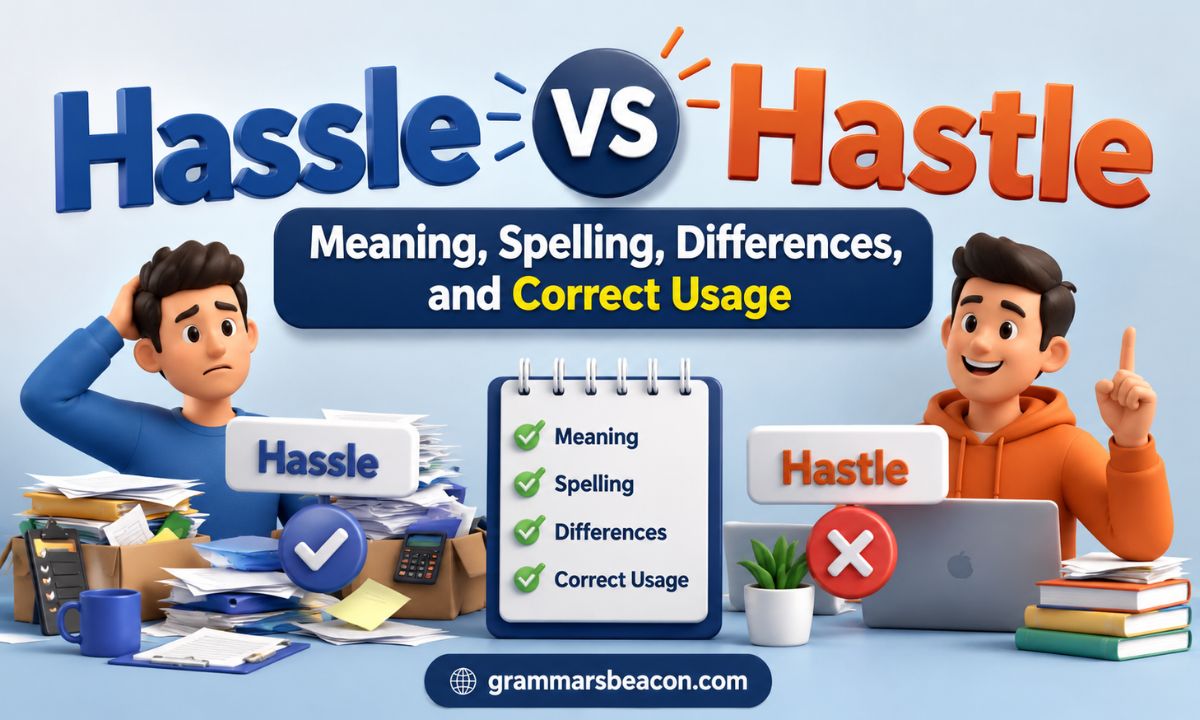
If you have ever typed a message and paused, wondering whether the correct word is “hassle” or “hastle,” you are far from alone. This mix-up shows up in emails, school assignments, social media captions, and even business websites. The good news is that the answer is simple once you understand where the confusion comes from and how the word actually works.
This guide covers the meaning, correct spelling, origin, common mistakes, and real-life usage of “hassle,” along with easy tricks to help you remember it for good.
Hassle vs Hastle Meaning
Only one of these two words is real English. “Hassle” is a legitimate word found in every major dictionary, while “hastle” is not recognized anywhere as standard English. It is simply a misspelling that has spread because of how the word sounds when spoken quickly.
“Hassle” refers to a situation, task, or person that causes trouble, extra effort, or annoyance. It can describe anything from a minor inconvenience to an ongoing source of frustration.
What Is the Correct Spelling: Hassle vs Hastle?
The correct spelling is hassle, spelled with a double “s” and no “t.” There is no version of this word that includes a “t” in standard English, no matter the context, tone, or region.
| Spelling | Status | Notes |
| Hassle | Correct | Found in Merriam-Webster, Oxford, and Cambridge dictionaries |
| Hastle | Incorrect | Not listed in any recognized dictionary |
If you remember nothing else from this article, remember this: hassle has two S letters and zero T letters.
Why People Mistype “Hassle” as “Hastle”
The spelling mistake is common enough that it deserves its own explanation. Here are the main reasons people write “hastle” instead of “hassle.”
1. Phonetic Confusion
When spoken casually, “hassle” can sound like it has a hidden “t” sound before the final syllable, especially in fast or informal speech.
2. Double-Letter Mistakes
English learners and native speakers alike often struggle with double letters. Dropping or shifting one “s” changes the shape of the word and opens the door to spelling errors.
3. Typing Errors
On a keyboard, the letters “s” and “t” sit close together. A quick typing session can easily produce “hastle” by accident, especially on mobile keyboards.
4. Auto-Correct Interference
Some auto-correct tools fail to catch this particular error because “hastle” looks close enough to a real word that the system does not always flag it.
5. Bad Online Examples
Once a misspelling appears in enough blog posts, comments, or captions, other writers copy it without checking. This creates a cycle where the wrong spelling keeps circulating.
What the Word “Hassle” Actually Means
At its core, “hassle” describes anything that requires unnecessary time, energy, or patience. It can be a physical task, an emotional strain, or a repeated annoyance. The word is informal but widely accepted in everyday speech, business writing, and casual conversation.
Hassle as a Noun: Meaning + Examples
Definition
As a noun, “hassle” means a problem, inconvenience, or source of irritation. It often refers to a task that feels more difficult or time-consuming than it should be.
Examples
- Renewing my passport turned into a huge hassle.
- Moving apartments is always a hassle, even with help.
- She avoided the hassle by booking her flight early.
Common Situations Where “Hassle” Works Well
- Dealing with paperwork or bureaucracy
- Waiting in long lines
- Fixing technical problems
- Handling last-minute changes to plans
- Resolving billing disputes
Hassle as a Verb: Meaning + Examples
Definition
As a verb, “hassle” means to bother, pressure, or repeatedly nag someone. This usage carries a slightly more active and personal tone compared to the noun form.
Examples
- Stop hassling your brother about his homework.
- The salesman kept hassling customers near the entrance.
- She felt hassled by constant phone calls from telemarketers.
Hassle vs Hastle Examples
| Sentence | Correct? | Why |
| It was such a hassle to reschedule the meeting. | Yes | Correct spelling used |
| It was such a hastle to reschedule the meeting. | No | “Hastle” is not a word |
| Please don’t hassle me about the deadline. | Yes | Correct verb usage |
| Please don’t hastle me about the deadline. | No | Incorrect spelling |
How “Hassle” Is Used in Daily Life
Common Daily Uses
People use “hassle” constantly to describe minor frustrations, from traffic delays to slow internet connections.
Business & Professional Uses
Companies frequently use phrases like “hassle-free returns” or “no hassle guarantee” in marketing because customers value convenience and simplicity.
Casual Conversational Uses
In everyday conversation, people say things like “don’t make this a hassle” or “it’s not worth the hassle” to describe effort that outweighs the benefit.
Etymology: Where the Word “Hassle” Comes From
Possible Origins
Language historians generally trace “hassle” to American English slang from the early twentieth century. Some believe it may be a blend of “haggle” and “tussle,” two words that both involve friction or disagreement.
Meaning Evolution
Originally used to describe arguments or physical scuffles, the word gradually softened over time to describe general inconvenience and everyday annoyance rather than actual conflict.
Interesting Fact
By the mid-1900s, “hassle” had moved from slang into mainstream American English, and it eventually became common across British, Australian, and other English-speaking regions as well.
Why the Confusion? Why People Think It’s Spelled “Hastle”
1. English Word Patterns Are Inconsistent
English spelling does not always follow logical sound patterns, so learners often guess based on similar-sounding words like “castle” or “bustle,” which do contain a “t.”
2. Misheard in Conversation
Because the word is usually learned by ear before it is learned by reading, many people form an incorrect mental image of its spelling.
3. Memory Errors
Once someone writes “hastle” a few times, the incorrect version can feel familiar, making the mistake harder to unlearn without a clear correction.
How to Remember the Correct Spelling of “Hassle”
1. Think of “Less Hassle = Less Stress”
Both “hassle” and “stress” contain a double “s,” and hassles usually create stress. This connection makes the spelling easier to recall.
2. Remember the Pair
Picture the double “s” as a pair standing together, similar to words like “missile” or “hustle,” which also use double letters without a “t.”
3. Visual Trick
Write the word slowly and notice that it has no “t” anywhere. Seeing it written correctly a few times helps train visual memory.
4. Use a Quick Mnemonic
“Hassle has no ‘t’ for trouble, just double ‘s’ for stress.”
Read More: Become vs Became: Key Differences, Rules, and Correct Usage
5. Think of Customer Service Phrases
Brands constantly use “hassle-free,” and seeing this phrase correctly spelled in ads and packaging reinforces the right version naturally.
Hassle in Pop Culture & Media
Common Pop-Culture Uses
The word appears often in song lyrics, movie dialogue, and everyday television scripts to describe minor conflicts or inconveniences in relatable situations.
Why It’s Popular
“Hassle” is short, easy to pronounce, and instantly understood, which makes it a favorite word for casual dialogue and informal writing across media.
Case Studies: Real-Life Examples of When “Hassle” Applies
Case Study 1: Customer Service Hassle
A customer ordered a product online, but it arrived with a defect. Getting a refund involved multiple emails, a returned package, and several days of waiting. This entire experience is a textbook example of a hassle because it required far more effort than a simple purchase should.
Case Study 2: Travel Hassle
A traveler arrived at the airport only to discover a delayed flight, a long security line, and a gate change announced at the last minute. Each individual problem was small, but combined, they created a frustrating travel hassle.
Case Study 3: Workplace Hassle
An employee needed approval from three different departments for a routine request. Chasing signatures and waiting on replies turned a simple task into a multi-day hassle, showing how workplace inefficiency often creates unnecessary friction.
Sentence Examples Using “Hassle” Correctly
Noun Examples
- Finding parking downtown is always a hassle.
- The whole process was more hassle than expected.
- Avoid the hassle by applying online instead of in person.
Verb Examples
- The neighbors keep hassling us about the fence.
- I don’t want to hassle you, but the report is overdue.
- Reporters hassled the celebrity for a comment outside the venue.
Common Mistakes People Make With “Hassle”
- Spelling it as “hastle” instead of “hassle”
- Confusing “hassle” with “haggle,” which means negotiating over price
- Using “hassle” in place of stronger words like “harassment,” which carries a more serious legal and emotional meaning
- Overusing “hassle” in formal writing where “inconvenience” or “difficulty” would sound more professional
Hassle: Quick Facts
| Fact | Detail |
| Correct spelling | Hassle |
| Part of speech | Noun and verb |
| Pronunciation | /ˈhæs.əl/ |
| Common phrase | Hassle-free |
| Incorrect spelling | Hastle |
| Formal alternative | Inconvenience |
Frequently Asked Questions
Is “hastle” a real English word?
No. “Hastle” is not a recognized word in any standard English dictionary. The correct spelling is always “hassle.”
What does “hassle” mean?
“Hassle” means a problem, inconvenience, or annoying situation. As a verb, it means to bother or pressure someone repeatedly.
Why do people confuse “hassle” and “hastle”?
The confusion usually comes from how the word sounds when spoken quickly, along with typing habits and influence from similar-looking words.
How can I remember the correct spelling of “hassle”?
Remember that it has a double “s” and no “t.” Linking it to the word “stress” can help the spelling stick in memory.
Can you give examples of “hassle” in sentences?
Yes. For example: “Renewing my license was a real hassle” or “Please stop hassling me about the deadline.”
Conclusion
The debate between hassle and hastle has a clear and simple answer. “Hassle” is the correct spelling, backed by every major dictionary and used consistently in professional, academic, and casual English. “Hastle” is nothing more than a common typo caused by pronunciation habits, quick typing, and repeated online mistakes.
Once you understand the meaning, origin, and correct usage of “hassle,” the spelling becomes easy to remember for good. Whether you use it as a noun to describe an inconvenience or as a verb to describe bothering someone, sticking to the correct spelling keeps your writing clear, credible, and professional.











1 thought on “Hassle vs Hastle: Meaning, Spelling, Differences, and Correct Usage”