
Have you ever paused mid-sentence, unsure whether to type “nighttime” or “night time”? You’re not alone. This is one of the most common spelling mix-ups in English, and it trips up students, bloggers, and professional writers alike.
The good news is that the answer is fairly simple once you understand how English compound words evolve. In this guide, you’ll learn the correct modern form, the grammar rules behind it, real-world examples, and how usage differs across American and British English.
Nighttime or Night Time: Which One Is Correct?
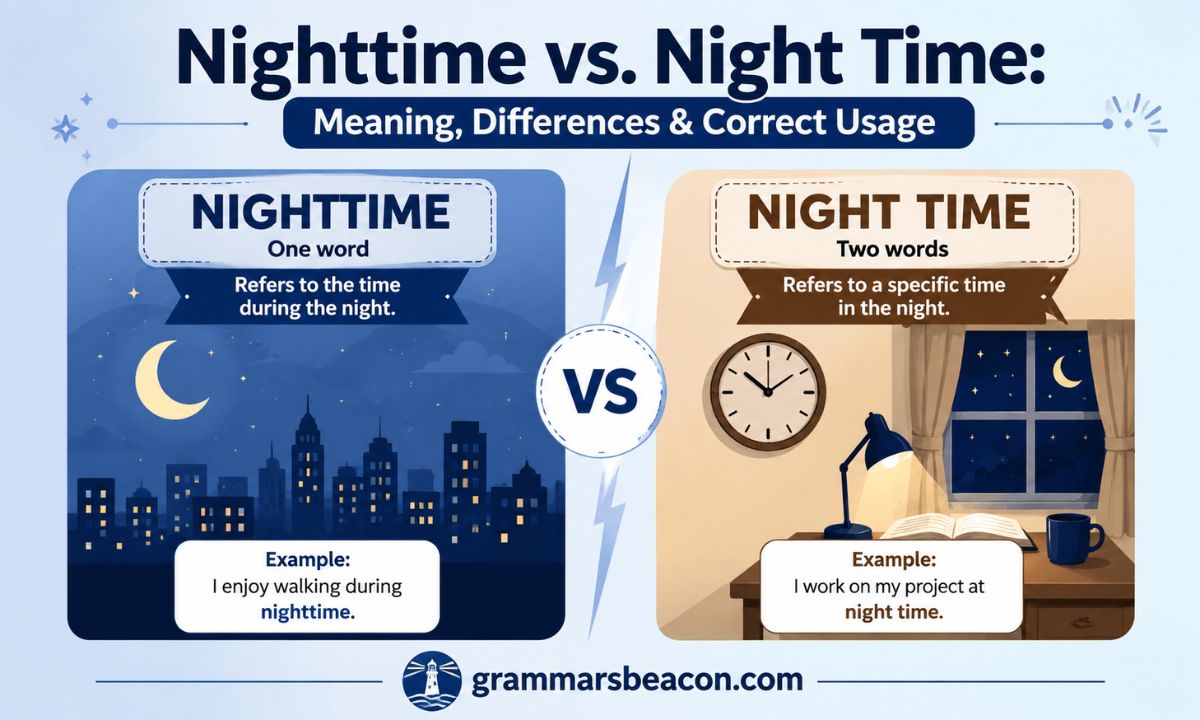
In modern English, “nighttime” (written as one word) is the standard and preferred form. It refers to the period between sunset and sunrise, the hours of darkness when most people sleep.
“Night time,” written as two separate words, isn’t grammatically wrong, but it’s considered older, more informal, and less common in today’s writing. You’ll still see it in casual speech, older texts, and certain stylistic contexts, but for everyday, academic, and professional writing, “nighttime” is the safer and more polished choice.
Nighttime vs Night Time Grammar
From a grammatical standpoint, the difference comes down to word formation:
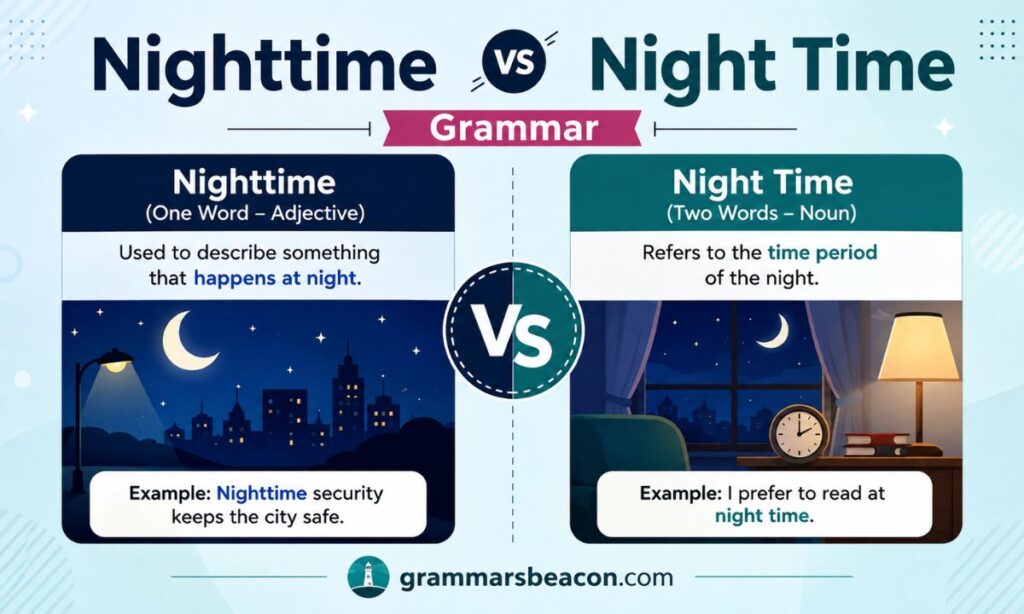
- Nighttime functions as a single compound noun. It can also work as an adjective (a nighttime routine, nighttime traffic).
- Night time functions as two separate words, typically a noun (“night”) modified by another noun (“time”), which reads more like a descriptive phrase than a fixed term.
Both versions are understood the same way by readers, but only one aligns with current grammar conventions used by editors, publishers, and style guides.
Nighttime or Night Time — What’s the Correct Term?
If you need a quick rule to remember, think of similar words that made the same transition:
- daytime (not “day time”)
- anytime (not “any time,” though “any time” still exists in specific contexts)
- weekend (not “week end”)
“Nighttime” followed the same natural path. Language tends to merge frequently paired words into a single compound once that pairing becomes common enough in everyday use.
The Correct Modern Standard
Today, “nighttime” is:
- Recognized by major dictionaries as the standard spelling
- Used in journalism, textbooks, and professional communication
- The preferred form in American English
- Increasingly common in British English too, though “night-time” (hyphenated) also appears there
Why the Confusion Happens
The confusion exists for a simple reason: both forms are technically real, and both have appeared in print for decades. Older books, historical documents, and some regional publications still use “night time” as two words. Since readers encounter both versions regularly, it’s easy to assume they’re interchangeable.
In reality, English compounding is a gradual process. A two-word phrase gets used so often that it eventually fuses into one word, sometimes passing through a hyphenated stage first. “Nighttime” has essentially completed that journey.
Understanding the Word Structure
To fully grasp the distinction, it helps to understand how English builds words through compounding.
Compound Nouns
A compound noun forms when two or more words combine to create a single new word with its own meaning. Compound nouns can appear in three forms:
| Form | Example | Structure |
| Closed (one word) | nighttime | night + time |
| Hyphenated | night-time | night + time (joined by a hyphen) |
| Open (two words) | night time | night + time (kept separate) |
“Nighttime” has fully transitioned into the closed form, meaning it’s now written and read as a single, unified word.
Two-Word Phrases That Stay Separate
Not every noun pairing merges into one word. Some phrases remain permanently separate because they function more like descriptive combinations than fixed terms. For example, “morning routine” or “evening walk” are unlikely to ever merge into single words because they aren’t used as frequently as a fixed unit the way “nighttime” is.
This is why “night time” isn’t automatically incorrect. It simply hasn’t been adopted as the modern standard the way “nighttime” has.
The Transition from “Night Time” to “Nighttime”
Understanding how this word evolved helps explain why the one-word form is now dominant.
Historical Development
English compound words rarely appear overnight. They usually pass through stages:
- Two separate words used together frequently (night time)
- A hyphenated version as the pairing becomes more fixed (night-time)
- A single closed compound once usage is common enough (nighttime)
Early Use: “Night Time”
In earlier English writing, “night time” appeared almost exclusively as two words. It was treated the same way as other simple noun phrases, describing “the time of night” rather than functioning as a standalone concept.
Emergence of “Nighttime”
As the term grew more common in everyday speech and writing, particularly through the 19th and 20th centuries, it gradually solidified into a single compound. This shift mirrors how many other English words evolved, moving from separate terms into unified, easily recognizable compounds.
Dictionaries and Style Guides
Dictionary entries and editorial style guides are the clearest indicators of which form is considered “correct” today.
Major Dictionary Positions (Summarized)
| Source | Preferred Form |
| Merriam-Webster | nighttime |
| Cambridge Dictionary | nighttime |
| Oxford Dictionary | nighttime (night-time also used in UK contexts) |
| Collins Dictionary | nighttime |
Editorial and Publishing Standards
Most professional editing standards, including those followed by news organizations, academic publishers, and corporate style guides, recommend:
- Nighttime for general writing, journalism, academic work, and business communication
- Night time only in specific stylistic cases, such as direct quotations from older texts or when deliberately emphasizing “the time of night” as two distinct ideas
Modern Usage and Language Trends
Language data from books, news archives, and online writing consistently shows “nighttime” overtaking “night time” in frequency, especially since the mid-20th century. This trend reflects a broader pattern in English: high-frequency word pairs simplify over time for easier reading and faster writing.
Nighttime vs Night Time Examples
Seeing both forms in context makes the distinction easier to remember.
Using “nighttime” (recommended):
- The nighttime sky was full of stars.
- She prefers nighttime workouts over morning ones.
- Nighttime traffic has increased significantly this year.
- Doctors recommend a consistent nighttime routine for better sleep.
Using “night time” (less common, more casual or stylistic):
- We arrived some time during the night time hours.
- The story is set in the night time of a small village.
Notice how “nighttime” reads more naturally as a single concept, while “night time” feels more like a descriptive phrase.
American, British, and International English
Regional differences matter here.
| Region | Preferred Form | Notes |
| American English | nighttime | Standard in journalism, education, and business writing |
| British English | nighttime or night-time | Both accepted; hyphenated form still common in UK publications |
| International/ESL contexts | nighttime | Recommended for consistency and clarity |
Why the One-Word Form Became Dominant
American English tends to simplify compound words faster than British English, which often retains hyphens longer. Since American publishing and digital content dominate global English usage, “nighttime” has become the de facto international standard, even in regions where “night-time” still appears in print.
Read More: Lunchtime vs Lunch Time: Meaning, Differences & Correct Usage
Grammar Guide: How to Use “Nighttime” Correctly
Using “nighttime” correctly comes down to recognizing its role in a sentence.
Nighttime as a Noun
When used as a noun, “nighttime” refers directly to the period of darkness itself.
- Example: Nighttime brings a sense of calm after a busy day.
- Example: I enjoy reading during the nighttime.
Nighttime as an Adjectival Noun
“Nighttime” frequently modifies another noun, functioning almost like an adjective.
- Example: nighttime routine
- Example: nighttime driving
- Example: nighttime temperatures
In these cases, “nighttime” describes something that happens at night, rather than referring to the night itself.
Examples of “Nighttime” in Real Writing
Seeing how the word functions across different writing styles reinforces correct usage.
Everyday Conversation
- “Let’s grab dinner sometime during the nighttime hours.”
- “I always feel more productive at nighttime.”
Books and Literature
Authors frequently use “nighttime” to set mood and atmosphere, describing scenes, sounds, and settings tied to darkness and stillness. It appears often in descriptive passages where a single, smooth word improves the flow of a sentence.
Professional Writing
In business, healthcare, and academic writing, “nighttime” appears in contexts like:
- Nighttime shift schedules
- Nighttime security protocols
- Nighttime symptoms in medical reports
- Nighttime energy usage in utility reports
Practical Usage Table
| Context | Recommended Form | Example |
| Academic writing | nighttime | “Nighttime exposure to light affects sleep quality.” |
| Business communication | nighttime | “Our nighttime support team is available 24/7.” |
| Casual conversation | nighttime | “I love walking at nighttime.” |
| Creative or historical writing | night time (optional) | “In the old night time hours, the village slept.” |
| British publications | night-time or nighttime | “Night-time deliveries begin at 10 PM.” |
Conclusion
When it comes to nighttime vs. night time, modern English clearly favors the single-word form. “Nighttime” is the standard, widely accepted spelling across dictionaries, style guides, journalism, and everyday writing, both in American and increasingly in British English.
“Night time” isn’t incorrect, but it’s better reserved for casual writing, stylistic emphasis, or direct quotations from older sources. For clarity, professionalism, and consistency, default to “nighttime” in nearly all of your writing.
The next time you’re describing the hours after sunset, you’ll know exactly which form to reach for.